A 59,000-year-old Neanderthal tooth found in Slovenia has left archaeologists astonished. Far from being a simple fossilized dental piece, its surface hides a medical secret: scraping marks and a precise perforation made with flint tools. This finding, published in Nature, demonstrates that our evolutionary cousins already practiced a primitive form of endodontics, challenging the belief that dentistry is an exclusive invention of modern humans. 🦷
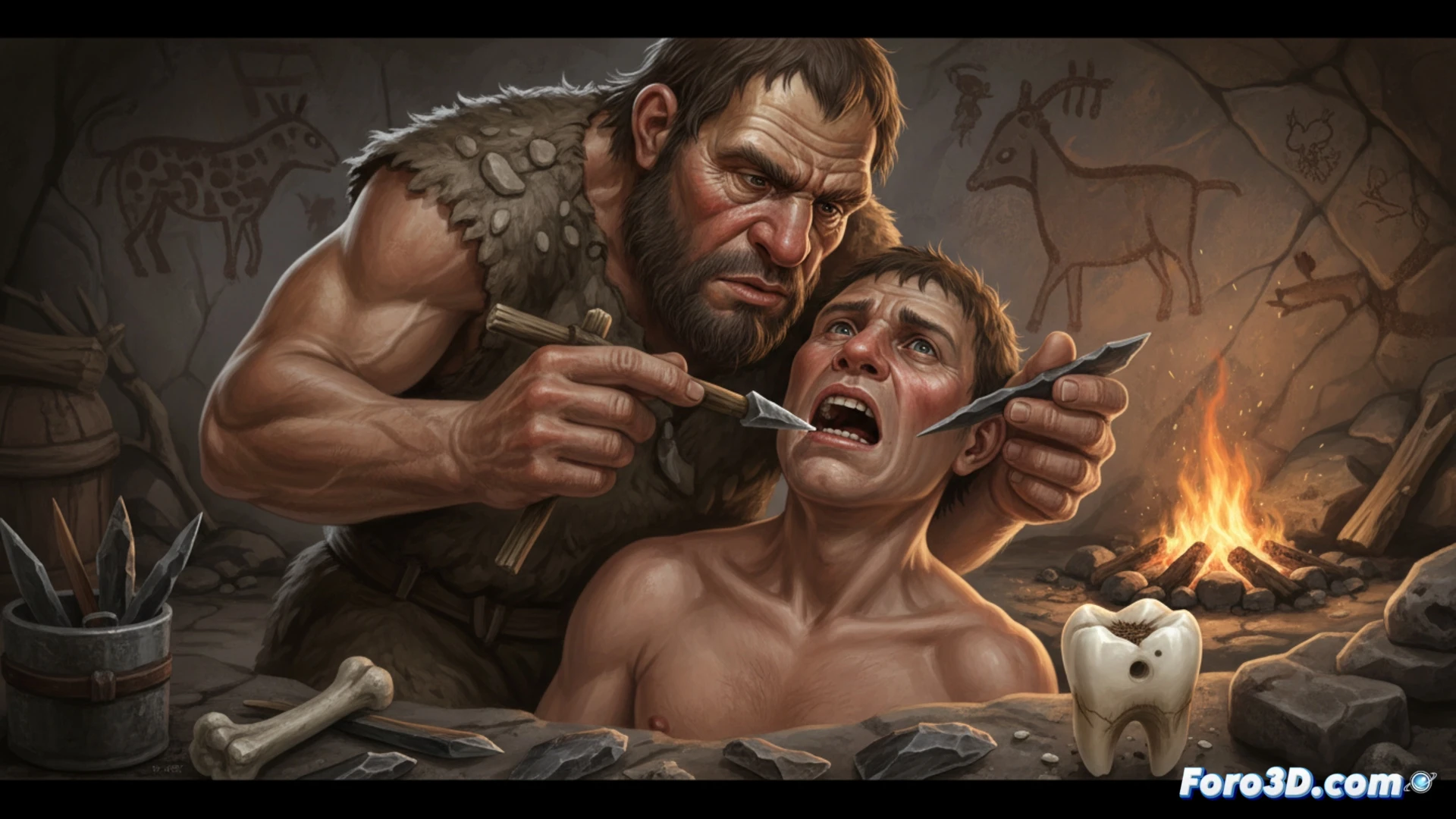
Microscopic photogrammetry: the digital eye that discovered the treated cavity 🔬
The research team used scanning electron microscopy and micro-computed tomography to generate a high-resolution 3D model of the tooth. Through focus photogrammetry, the striations and cavity were digitally reconstructed, allowing scientists to virtually rotate the fossil and measure the direction of the marks with millimeter precision. This digital workflow, combining laser scanning and volumetric rendering, has been key to distinguishing tool marks from natural erosion. The virtual replica of the tooth has been shared in open repositories, allowing other paleontologists to verify the treatment without handling the fragile original.
When the past is illuminated with pixels 💡
Digital archaeology does not just document; it reinterprets. Thanks to these techniques, we have discovered that a Neanderthal, 59,000 years ago, relieved the pain of a cavity by perforating the enamel with a stone tip. This act of manual precision implies an understanding of dental anatomy and the ability to plan a surgical procedure. The digitization of heritage forces us to rethink what it means to be human, demonstrating that empathy for others' pain and the search for a cure are not monopolies of our species.
As a digital archaeologist, what 3D reconstruction and microwear analysis software would you recommend to verify whether the marks on the 59,000-year-old Neanderthal tooth were made by a stone drill and not by natural processes?
(PS: and remember: if you can't find a bone, you can always model it yourself)