The discovery of the Nautilus samoaensis in the deep waters of American Samoa represents a milestone for malacology and scientific visualization. This cephalopod, nicknamed the living fossil due to its ancestral morphology, presents unique shell patterns that distinguish it from its congeners. For the Foro3D community, this species offers a perfect canvas to explore advanced techniques in scanning, modeling, and biomimetic animation, combining real expedition data with high-fidelity digital reconstructions.
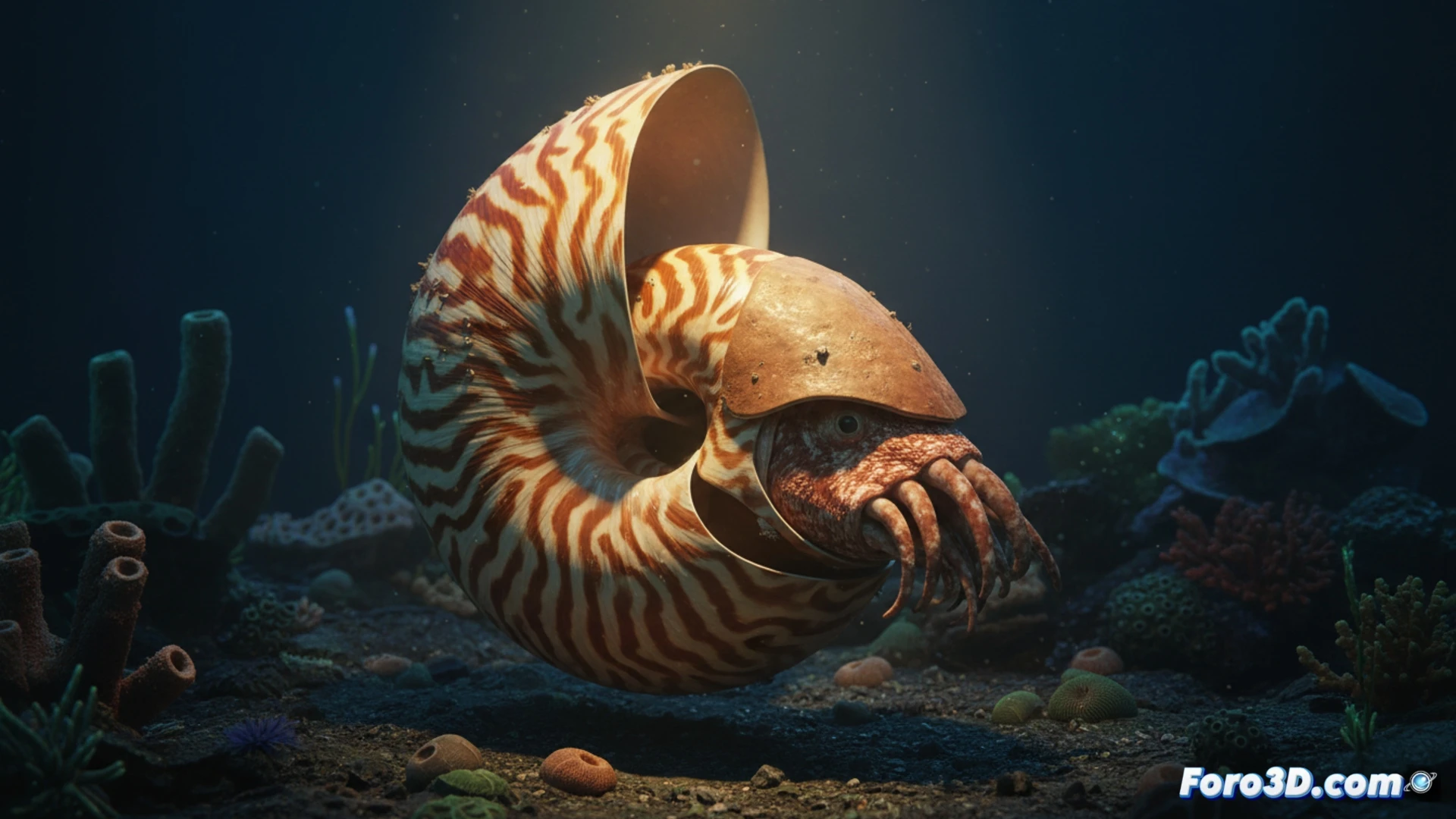
Digital Reconstruction and Morphometric Analysis 🐚
The 3D modeling of the Nautilus samoaensis requires a multidisciplinary workflow. First, high-resolution images of the type specimens are captured using underwater photogrammetry and micro-CT. Then, in software such as Blender or ZBrush, the external shell is reconstructed, paying special attention to the reddish-brown color bands and growth lines that define the new species. The internal gas chamber, with its septa and siphuncle, is modeled separately to allow animations that explain the animal's buoyancy. Comparison with species like Nautilus pompilius is performed through mesh deformation analysis, revealing subtle differences in spiral curvature and wall thickness.
Habitat Visualization and Evolutionary Outreach 🌊
To contextualize the discovery, the 3D model is integrated into an immersive virtual environment. Using bathymetric data from NOAA, the continental slope of American Samoa is recreated, where the nautilus inhabits depths between 200 and 600 meters. An interactive visualization allows the user to explore this deep-sea ecosystem, activate labels on the nautilus's anatomy, and slide a geological timeline to understand why this species has remained virtually unchanged for 500 million years. This educational approach transforms the news into a powerful and visually striking scientific outreach tool.
What are the main technical challenges when generating a photorealistic 3D model of the Nautilus samoaensis from images of specimens collected in deep waters, and how are they overcome to achieve accurate scientific visualization?
(PS: fluid physics for simulating the ocean is like the sea: unpredictable and you always run out of RAM)