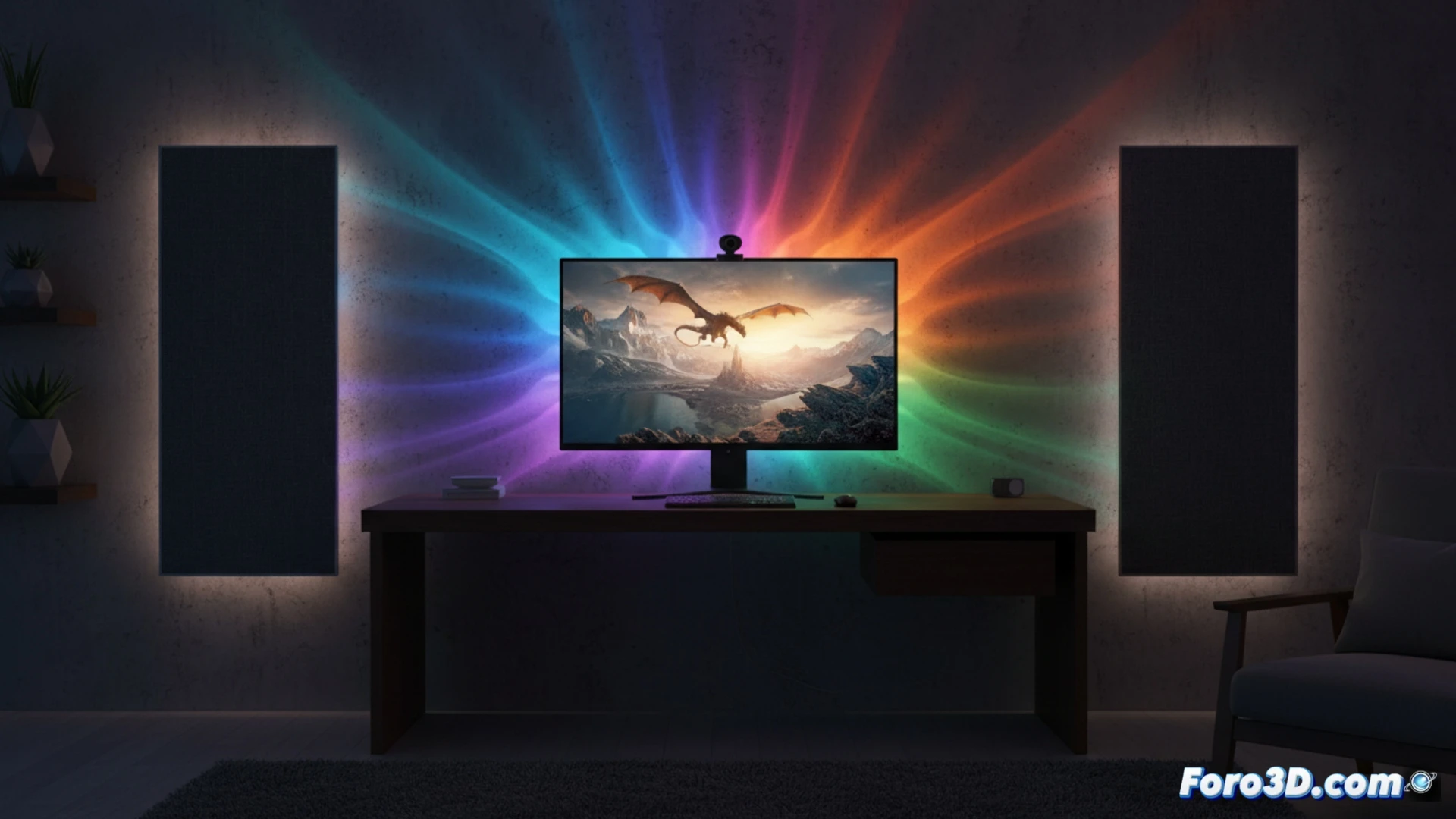
The Nanoleaf 4D represents the perfect convergence between scenic lighting technology and home entertainment. This kit, composed of a camera and an LED strip, captures the color of your monitor's edge in real time and replicates it on the surrounding wall. For scenography professionals, it's fascinating to see how a low-cost system manages to emulate backlighting and chromatic ambiance techniques that we previously only saw in large mapping productions or concerts.
Technical Mechanism: Color Capture and Real-Time Processing 🎯
The heart of the system is a camera placed above the monitor, pointing towards the screen. This camera scans the visible perimeter and sends color data to a controller. The algorithm analyzes chromatic variations and translates them into commands for the LED strip, which is attached to the back of the monitor. Unlike a professional DMX system, there is no console or cue programming here; the synchronization is pure reactive. Latency is minimal, but not zero. In technical tests, a slight delay is noticeable in very fast transitions, similar to what is corrected with preview in a lighting design software. For an enthusiast, the immersion is immediate; for a technician, it's a reminder that calibration (adjusting capture zones) is key to avoiding desynchronization.
From Stage to Living Room: Imitation or Real Innovation? 💡
As lighting designers, we know that ambient color modifies the perception of the scene. Nanoleaf 4D applies this principle without needing software licenses or mapping hardware. It doesn't replace a system of 12 synchronized projectors, but it democratizes the immersive experience. The question we must ask ourselves is whether this technology, born from gaming, will influence future designs of interactive scenography for small theaters or art installations. For now, it's a curious tool that demonstrates that synchronizing light and content is no longer exclusive to large shows.
As a digital scenographer, how would you implement Nanoleaf 4D synchronization with DMX control systems or stage lighting protocols to integrate it into a professional live setup?
(PS: designing a 3D stage is easy, the hard part is making sure the musicians don't fall off it)