On the remote island of Pohnpei, Micronesia, lies Nan Madol, a ceremonial city built on 92 artificial coral islets. Its walls are erected with basalt columns weighing up to 50 tons, transported from distant quarries. The logistics of its construction, in the middle of the Pacific Ocean, defies all conventional archaeological explanation. For digital archaeology, this site represents a technical challenge and a unique opportunity to apply virtual reconstruction tools.
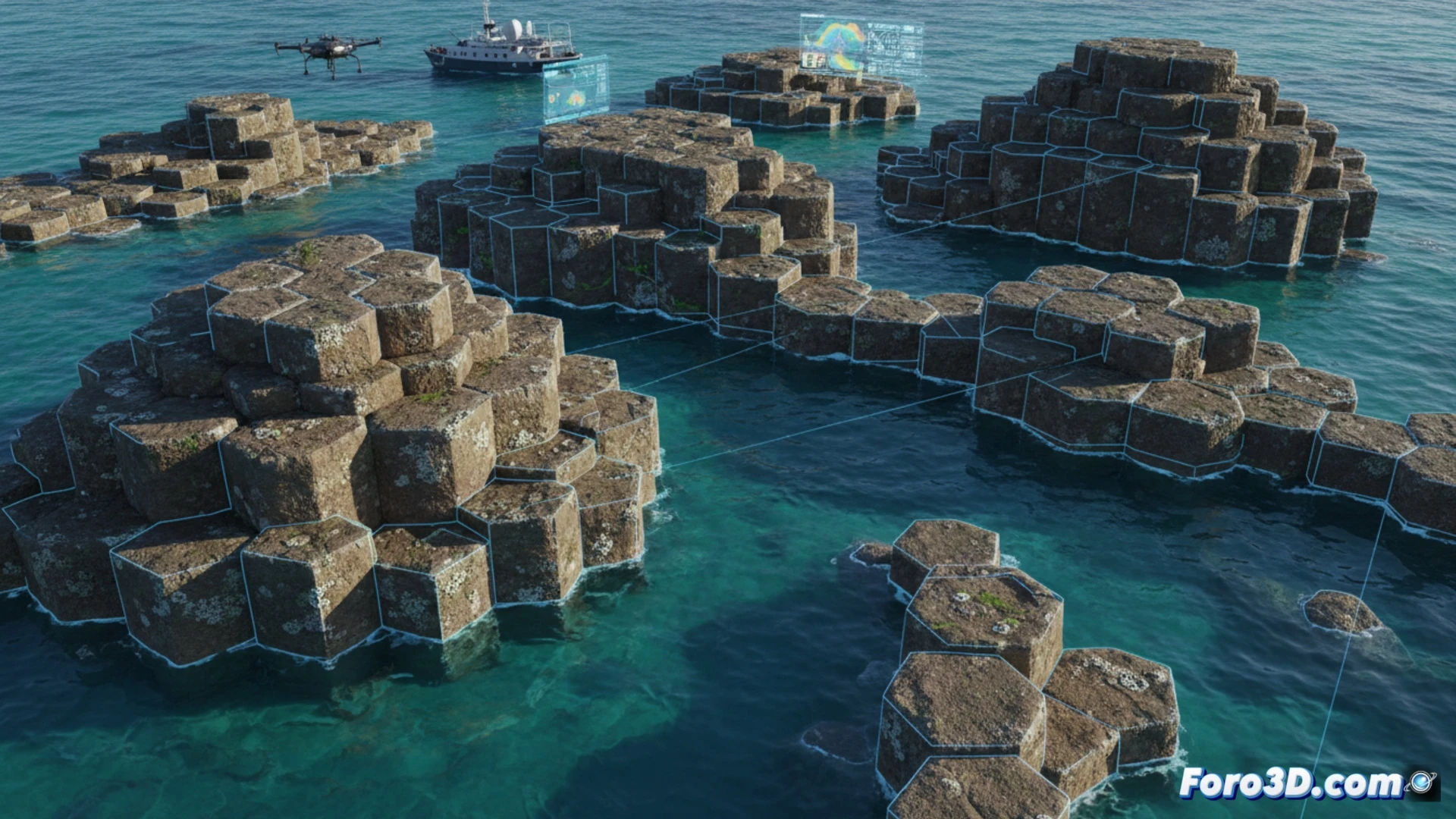
Aerial Photogrammetry and LiDAR: The Key to Unlocking the Mystery 🏛️
The dense vegetation and fragility of the reefs make traditional excavation prohibitive. However, a flight of drones equipped with high-resolution cameras and LiDAR sensors could capture the exact topography of the 93-hectare complex. Photogrammetry would generate a millimeter-scale point cloud, revealing the joints of the basalt blocks and possible hidden cavities underwater. Subsequently, 3D modeling would allow simulating the movement of the log rafts that, according to oral tradition, floated the megaliths from the island of Sokehs. A digital animation could contrast the transport hypothesis with slope and rock density data.
Beyond the Blocks: A Visual Hypothesis for the Future 🔍
The mystery of Nan Madol lies not only in the weight of its stones, but in the social organization required to move them. A digital twin of the site, accessible on virtual reality platforms, would allow archaeologists and enthusiasts to explore the terraces and canals from anywhere in the world. By generating visual hypotheses of its construction, we not only digitally preserve a heritage threatened by rising sea levels, but we turn an ancient enigma into an open question that 21st-century technology can begin to answer.
How can 3D modeling of the artificial islets of Nan Madol reveal the construction techniques and hydraulic knowledge of its lost civilization?
(PS: If you dig at a site and find a USB drive, don't plug it in: it could be malware from the Romans.)