Lenovo has registered the NVIDIA N1X processor on its authentication portal, an ARM SoC developed in collaboration with MediaTek that will power the Legion 7 laptop. With integrated Blackwell graphics and a 245W charger, this chip positions itself as a direct alternative to the RTX 5070 in the upper mid-range segment. Its likely announcement at Computex 2026 marks a strategic shift towards ARM efficiency in high-performance equipment for modeling and rendering. 🚀
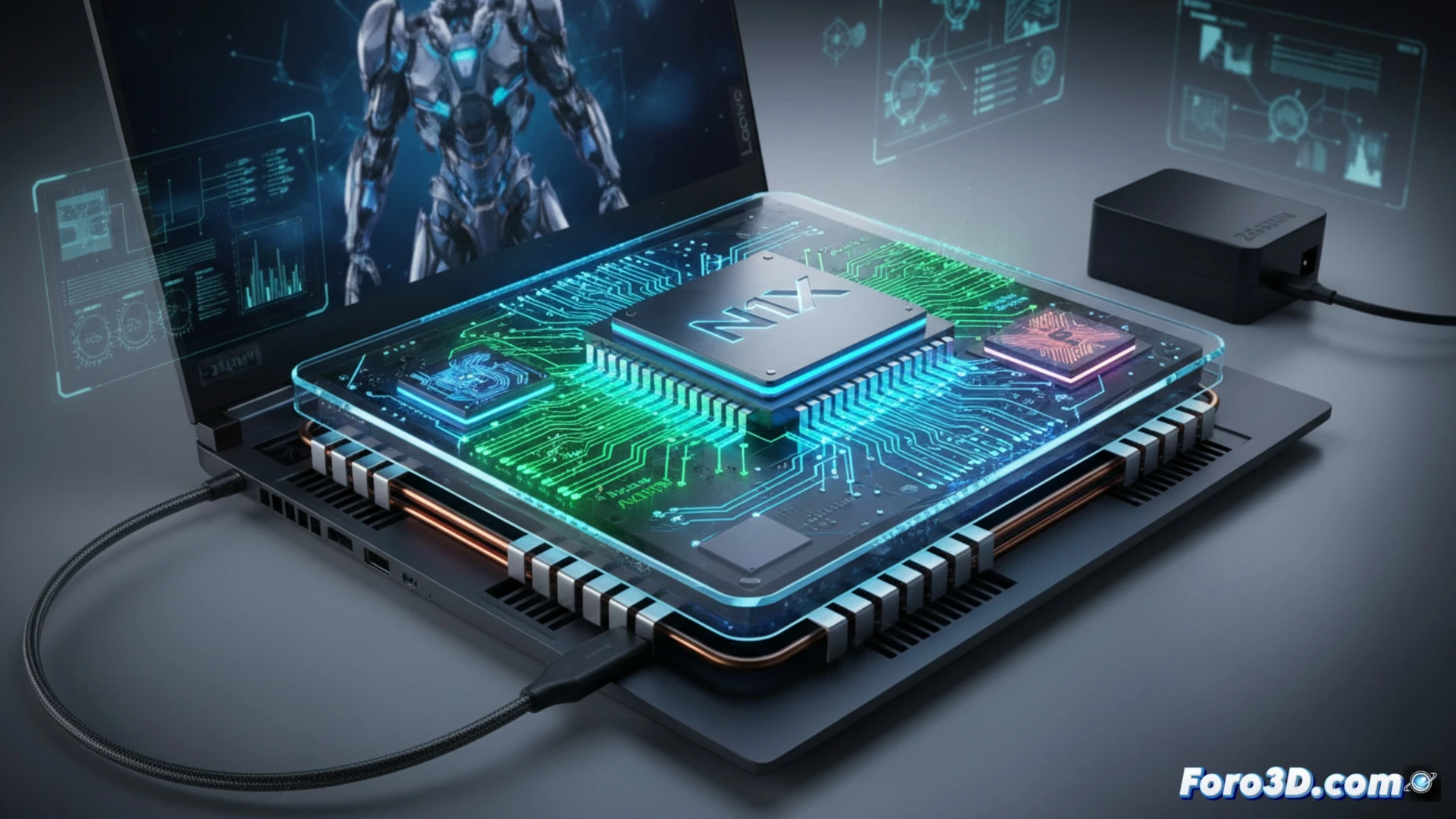
Integrated Blackwell Architecture: Technical analysis for 3D workflows 🔧
The integration of Blackwell graphics cores into an ARM SoC represents a paradigm shift for applications like Blender, Autodesk Maya, or Unreal Engine. Unlike x86 solutions with discrete GPUs, the N1X shares unified memory and an ultra-fast data bus, reducing latency in complex geometry operations and particle simulation. With an estimated TDP close to that of a mobile RTX 5070 (around 115W on the GPU), rasterization performance could be comparable, although the real advantage may lie in artificial intelligence and denoising tasks, where Blackwell's Tensor Cores offer a generational leap. However, compatibility with CUDA and OptiX libraries in the ARM environment remains a critical point that will determine its adoption in 3D production studios.
A real alternative for the nomadic 3D professional? 🎒
The promise of the N1X is clear: extreme portability with workstation power. If the leaks are confirmed, a Legion 7 with this SoC could offer rendering sessions in Cycles or V-Ray with times close to those of a laptop with an RTX 5070, but with much greater battery life thanks to ARM efficiency. For the 3D professional working on the go, this eliminates the dependency on a power outlet during hours of modeling. However, the software ecosystem will need to mature: certified drivers for CAD applications and specific plugins will be the true measure of success. For now, the N1X is a breath of fresh air in a market dominated by Intel and AMD.
Can the ARM SoC N1X from Lenovo and NVIDIA deliver stable performance in intensive 3D rendering and real-time modeling workflows without sacrificing thermal efficiency compared to a laptop RTX 5070?
(PS: remember that a powerful GPU won't make you a better modeler, but at least you'll render your mistakes faster)