The Myrmoteras sp., known as the diamond trap-jaw ant, represents a fascinating challenge for scientific visualization. Native to Indonesia (2024), this species possesses disproportionately large eyes and mandibles capable of opening 280 degrees. Its hunting mechanism, which occurs in milliseconds on the jungle floor, requires advanced 3D animation techniques to break down its biomechanics and offer a faithful representation for biologists and entomologists.
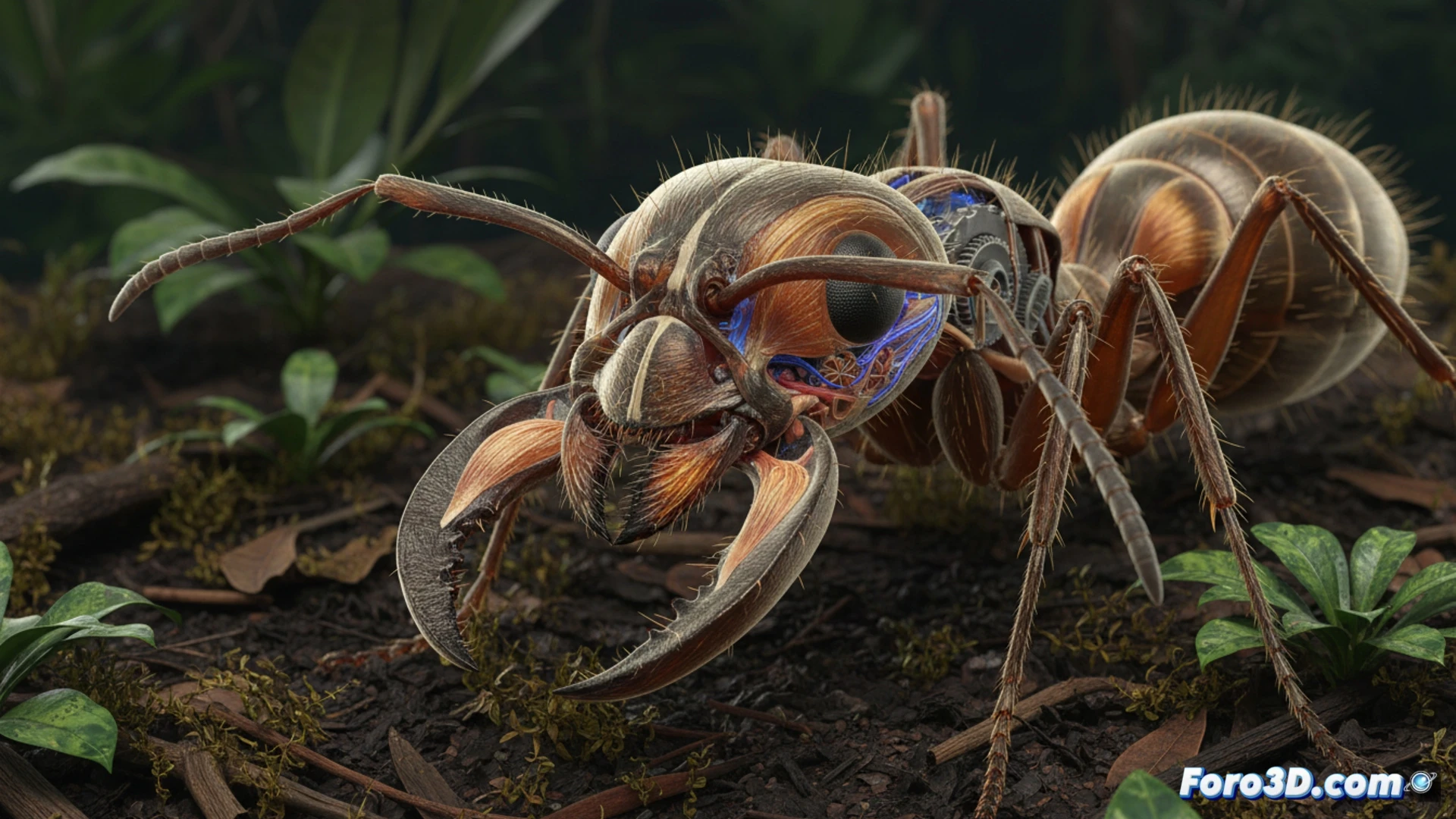
Biomechanics and kinetic simulation in 3D environments 🐜
To model the Myrmoteras sp., the first step is to reconstruct its exoskeleton using high-resolution photogrammetry, paying special attention to the mandibular joint. The 280-degree opening angle requires non-linear rigging with extreme rotation constraints, simulating a latch-spring mechanism. The animation must calculate acceleration in milliseconds, using physics engines like Bullet or PhysX to replicate the impact. Comparing this model with that of the Odontomachus (common trap-jaw ant) reveals key differences: Myrmoteras lacks internal teeth, suggesting a grip by hydraulic pressure rather than piercing, a crucial detail for interactive documentaries.
The eye as a window into predatory behavior 👁️
The compound eyes of Myrmoteras are 40% larger than those of other trap-jaw ants, indicating active visual hunting in low-light conditions. In the 3D model, it is possible to simulate its field of vision using insect eye shaders (ommatidia) and map how the ant calculates the prey's jump distance. This representation not only educates about sensory evolution but also allows researchers to virtualize behavioral experiments without disturbing the Indonesian habitat, turning the model into a digital conservation tool.
Is it possible to capture the ultrafrenetic biomechanics of the Myrmoteras sp. mandible in a 3D model to accurately simulate its ballistic closure and energy transfer to the exoskeleton?
(PS: if your manta ray animation doesn't excite, you can always add documentary music from channel 2)