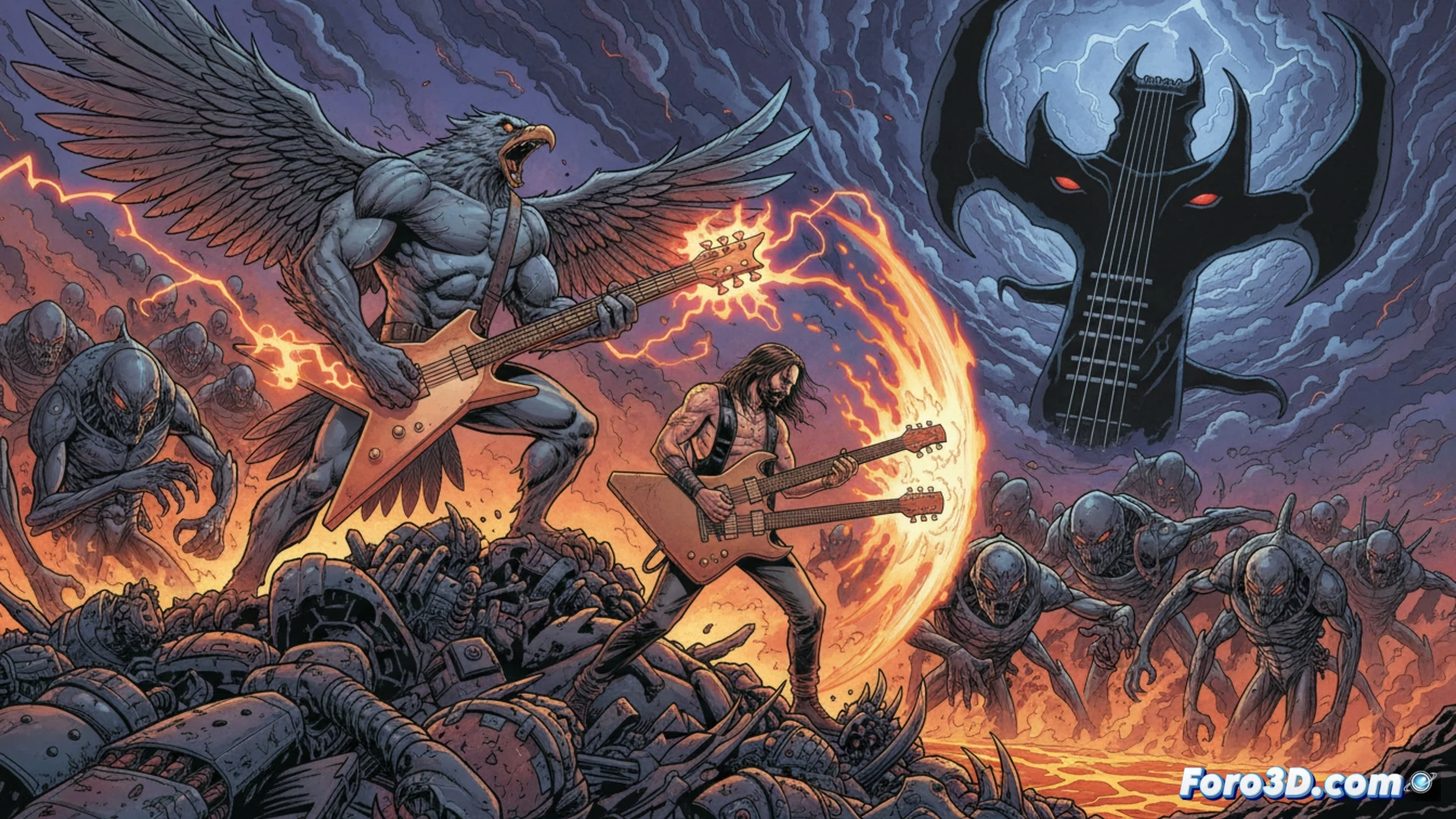
Daniel Warren Johnson delivers a work that transcends mere entertainment. Murder Falcon is not just a monster comic; it is a visual manifesto where music becomes the last line of defense against oppression. The narrative, which feels like a constant guitar solo, uses heavy metal aesthetics to channel a visceral energy that speaks of resistance, trauma, and the strength of finding one's own voice amidst chaos.
From Panel to Polygon: Translating a Guitar Solo into 3D 🎸
For a 3D modeler, the technical challenge of adapting Murder Falcon lies in capturing its kinetic fluidity. The action scenes, where the protagonist destroys creatures to the rhythm of imaginary riffs, demand dynamic rigging that conveys weight and speed. The falcon's silhouette, with its angular and aggressive design, is perfect for a stylized low-poly modeling approach, while the apocalyptic backgrounds require digital sculpting techniques that mimic Johnson's loose and smudged strokes. Volumetric lighting will be key to recreating the atmosphere of a metal concert: intense spotlights, haze, and hard shadows that accentuate the drama.
Activism Through Noise: Metal as a Tool for Change 🔥
Beyond the technique, the work functions as an act of symbolic activism. In a digital world where passivity is the norm, Murder Falcon reminds us that resistance can be loud and cathartic. Adapting this story into an immersive 3D environment, whether a video game or a VR experience, allows the viewer not only to observe the struggle but to inhabit it. The message is clear: art, in any format, is a weapon against hopelessness. The fusion of music and stylized violence is not gratuitous, but a powerful metaphor for the fight for identity and freedom.
How does the representation of heavy metal as an engine of visual resistance in Murder Falcon transform the perception of digital activism in contemporary art?
(PS: at Foro3D we believe all art is political, especially when the computer freezes)