The discovery of a new species of lobster in the ocean depths, Munidopsis sp., has revolutionized marine biology. This crustacean exhibits two extreme evolutionary characteristics: reduced, almost vestigial eyes and a pair of disproportionately long claws relative to its body. For the scientific community, the next step is not just dissection, but visualization. At Foro3D.com, we analyze how three-dimensional modeling allows for the digital reconstruction of this creature, offering a vital tool for studying its morphology without relying on fragile specimens.
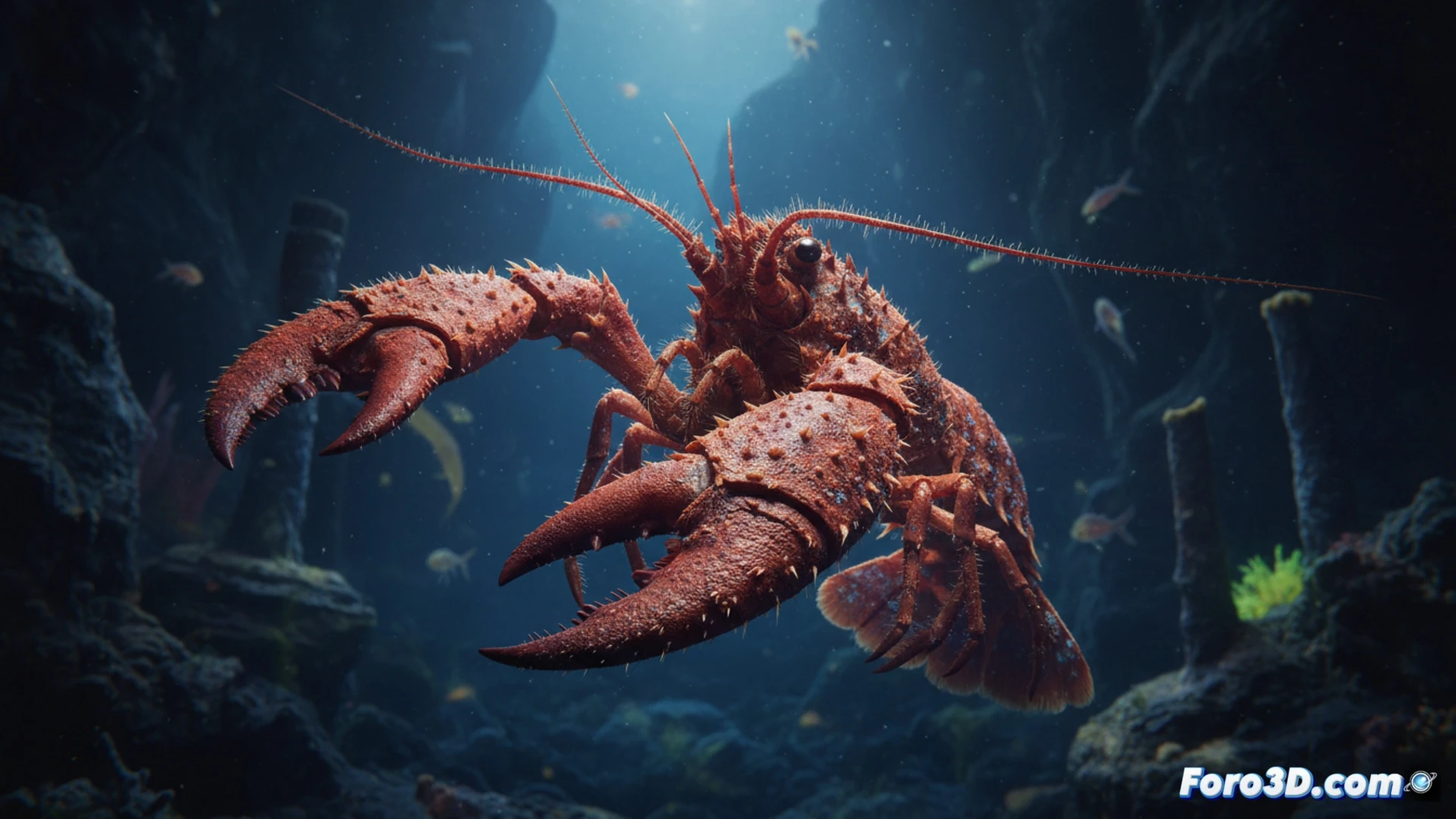
Digital reconstruction and simulation of the abyssal habitat 🦞
The 3D model of Munidopsis sp. requires a precise technical approach. Since the species lacks pigmentation and has a semi-translucent exoskeleton, shading must simulate organic materials under bioluminescent lighting. The geometry of the claws, which can exceed twice the length of the cephalothorax, requires specialized rigging to avoid unrealistic deformations. The real challenge is recreating the environment: a simulation of hydrostatic pressure and total darkness. Using rendering engines like Cycles or V-Ray, we can emulate light scattering in water at 3000 meters depth, showing how the lobster uses its claws to probe the seabed in absolute blackness.
Scientific visualization as an evolutionary bridge 🔬
Beyond aesthetic realism, the 3D visualization of this lobster addresses crucial evolutionary questions. Why develop such long claws if the eyes don't work? Thanks to animation, biologists can simulate the species' tactile behavior, observing how the claws act as sensory extensions. This interactive model allows researchers to modify variables, such as cheliped length, to predict how an ancestor might have behaved. Thus, Foro3D.com demonstrates that digital art not only documents biodiversity but becomes a virtual laboratory for understanding extreme adaptation in ocean trenches.
What specific technical challenges does detailed 3D modeling of Munidopsis sp. present, such as texturing its exoskeleton and simulating its claws at abyssal scale, for use in scientific visualization?
(PS: if your manta ray animation isn't exciting, you can always add documentary music from channel 2)