Naoki Urasawa, master of suspense, surprises us with Mujirushi: The Sign of Dreams, a work that transcends mere entertainment to become a visual analysis of precarity. The story follows a ruined man and his daughter, guided by an enigmatic Frenchman toward an impossible heist at the Louvre Museum. Far from being a simple adventure, the comic uses Parisian architecture and museum art as metaphors for class struggle and cultural resistance in times of economic crisis.
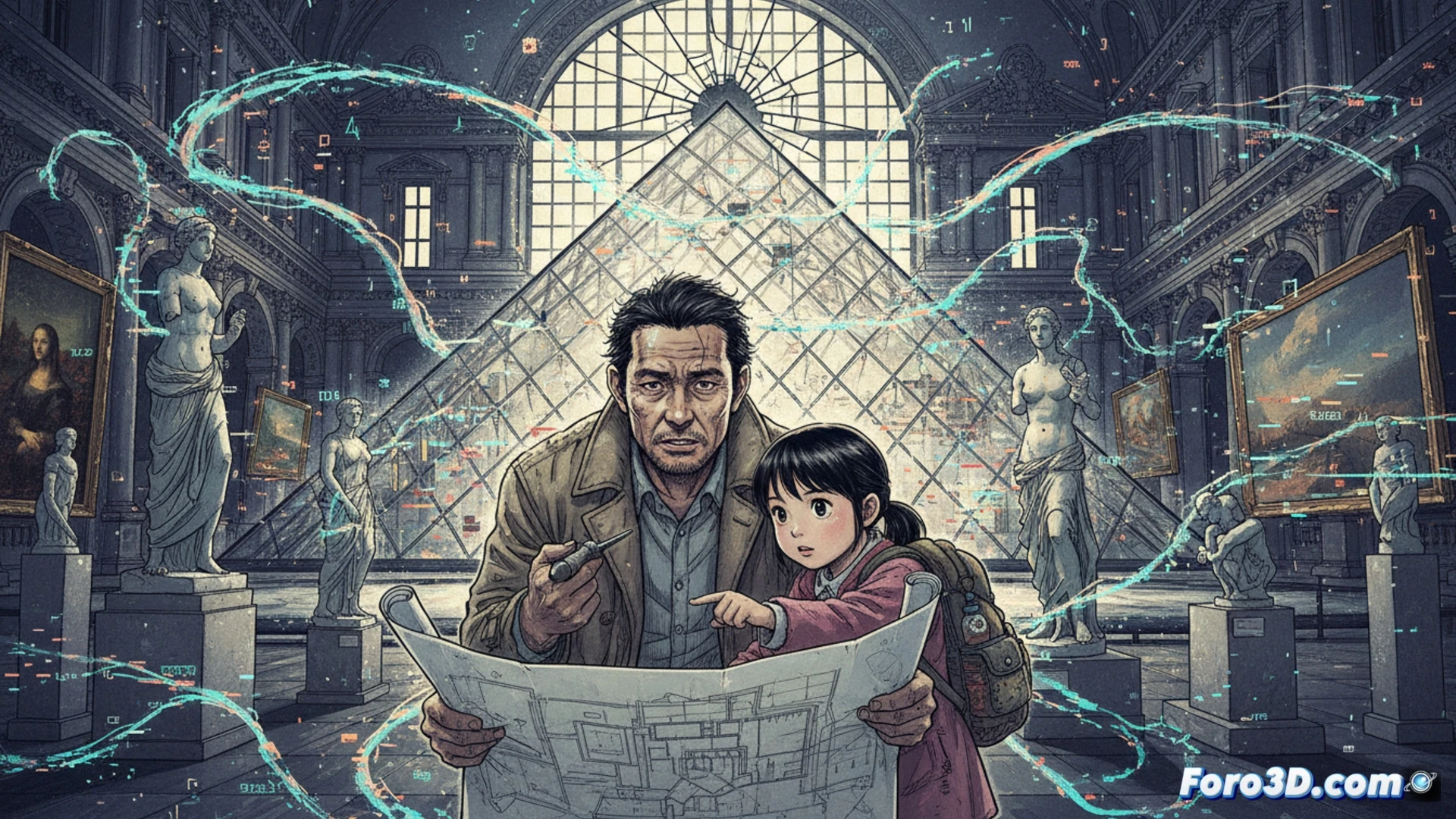
3D representation techniques in architectural backgrounds and sequential narrative 🏛️
Urasawa displays impeccable technical mastery by merging traditional drawing with the precision of architectural backgrounds that seem rendered in 3D. The perspectives of the Louvre, with its vaulted galleries and the glass Pyramid, are not mere settings; they are silent characters that impose a monumental scale against the vulnerability of the protagonists. This digital treatment of spaces allows the reader to experience the magnitude of the museum as a labyrinth of power and symbolism. The author's technique, alternating between caricatured faces and hyperrealistic backgrounds, generates a visual contrast that reinforces the absurdity of the plot and human fragility in the face of institutions.
The impossible heist as symbolic activism in the digital age 🎭
In the niche of Art and Digital Activism, Mujirushi proposes a powerful reflection: the act of stealing a work of art in a space as guarded as the Louvre is not a crime, but a political statement. The economic crisis that ruins the protagonist becomes the engine of a resistance that uses art as a weapon of social denunciation. Urasawa reminds us that, in a world saturated with digital images, the physical space of the museum remains the last bastion to challenge the system, turning each panel into a visual manifesto against inequality.
How does Mujirushi: The Sign of Dreams use the Louvre setting as a symbol of institutional crisis and artistic resistance in the context of digital activism?
(PS: pixels also have rights... or at least that's what my latest render says)