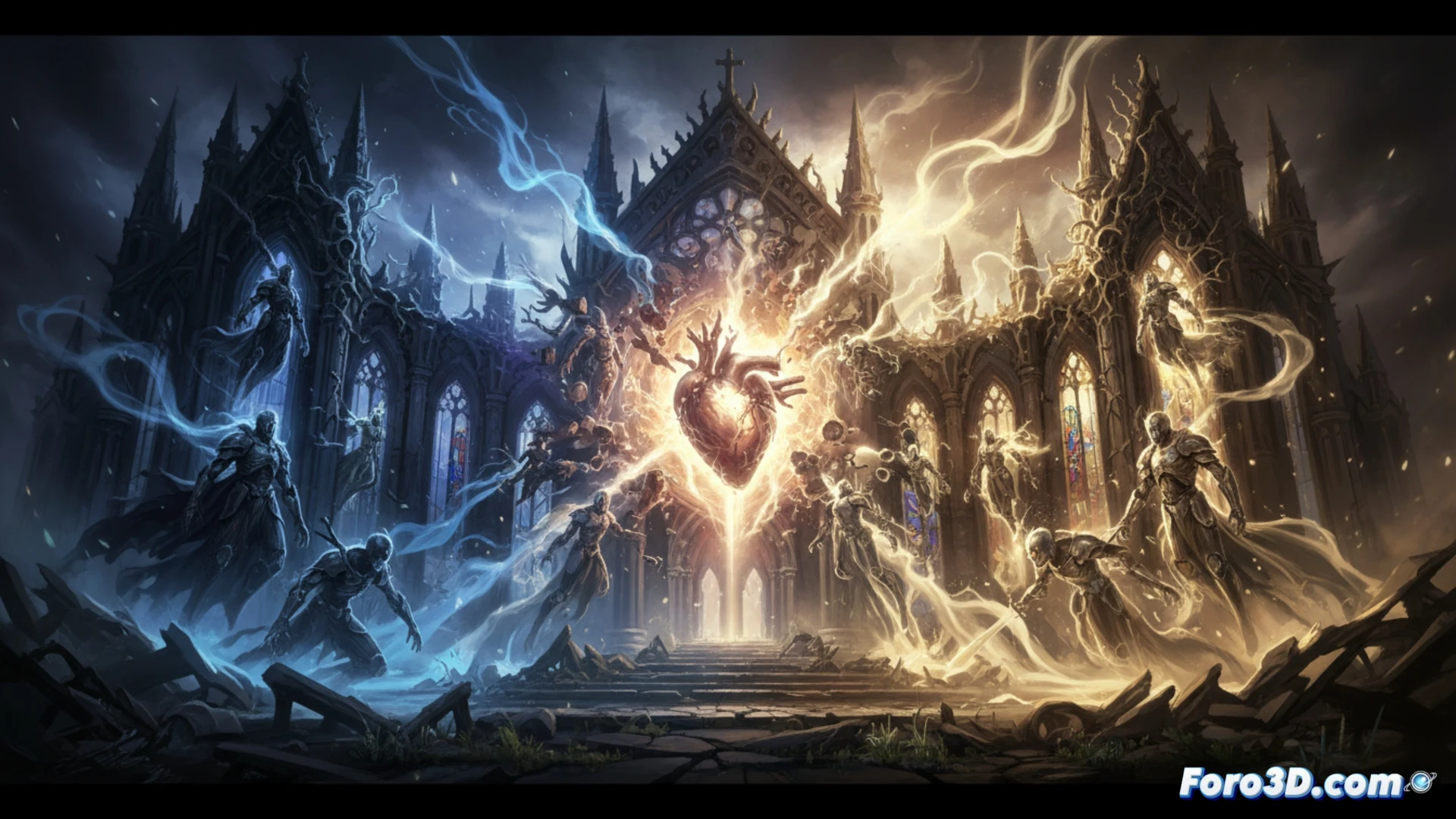
The studio behind Deathbound has opted for Unreal Engine 4 to build a dark fantasy world where the core mechanic, the Morph, dictates the rhythm of combat. This title stands out not only for its gameplay proposal but also for a visual finish that blends gothic architecture with dramatic lighting. We analyze how the team has managed to translate high-density models into real-time experiences, a technical challenge many developers face when seeking stylized realism without sacrificing performance.
Asset Pipeline: From ZBrush to Real-Time in UE4 🎨
Deathbound's artistic workflow begins in ZBrush, where characters receive a level of sculptural detail that must then be retopologized in Maya to ensure an efficient mesh. The real challenge lies in the integration with Substance 3D, whose smart materials allow simulating wear on armor and organic textures that react to Unreal Engine 4's dynamic lighting. For the Morph mechanic, the team uses complex particle effects triggered by animation sequences. A crucial technical tip for indies: when working with morph targets in UE4, it is vital to limit the number of vertices affected by the transition to avoid frame drops; using vertex masks instead of modifying the entire geometry is an optimal practice to maintain smoothness.
Optimization Lessons for Gothic Worlds ⚙️
Deathbound's greatest technical achievement is how it manages visual overload without saturating the GPU. Instead of using extremely detailed normal maps for every brick in its cathedrals, the studio prioritizes the use of decals and volumetric lighting systems to create depth. For an indie seeking this style, I recommend embracing the engine's limitations: using UE4's Post Process Volume to adjust contrast and saturation globally can achieve a gothic look without needing 4K textures. The key is that the Morph is not just an animation, but a particle event; this disguises potential transition imperfections and adds visual impact that justifies the computational cost.
How did they manage the smooth transition between death and rebirth states in Deathbound's technical pipeline without generating visible loading cuts or performance loss in Unreal Engine 4?
(PS: game jams are like weddings: everyone is happy, no one sleeps, and you end up crying)