The MSI Spatium M580 Frozr arrives on the market with a proposal that combines the maximum performance of the PCIe 5.0 interface with a completely passive cooling solution. With sequential read speeds reaching 12,400 MB/s, this SSD promises to eliminate data handling bottlenecks for 3D professionals, all without the need for active fans that introduce noise or mechanical failure points into the workstation.
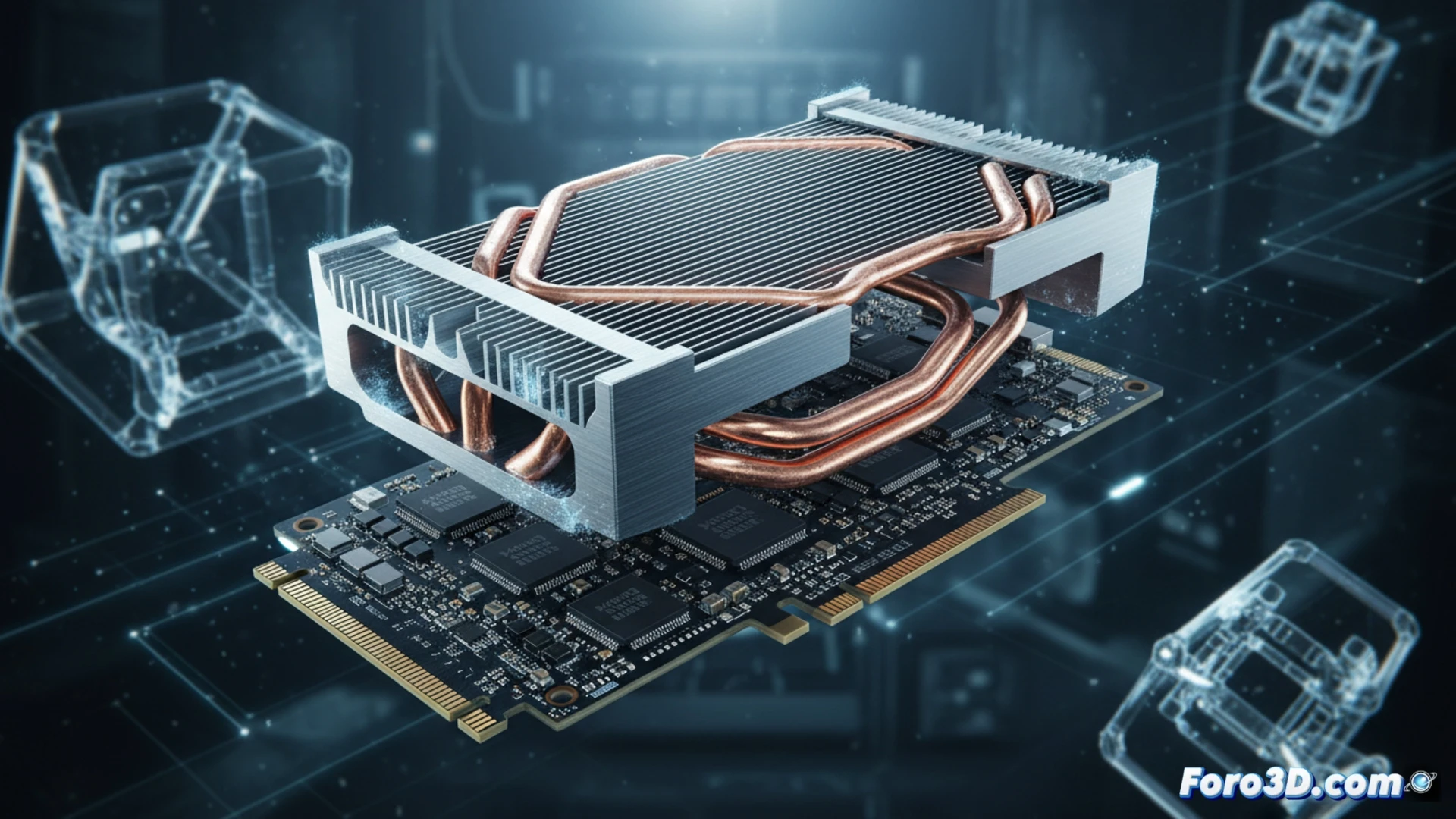
Sustained performance without thermal throttling in complex viewports 🔥
The heart of the M580 Frozr lies in its massive passive heatsink, which integrates three copper heat pipes to transfer thermal energy to a large-surface aluminum fin stack. This architecture is critical for workflows in software like Blender or 3ds Max, where loading 4K/8K textures and dense geometry saturates the storage bus. Unlike SSDs with active fans, which may reduce speed for thermal safety or generate audible vibrations, this model consistently maintains 12,400 MB/s. This translates into instant opening of complex projects in Unreal Engine and smooth navigation in viewports with high polygon density, eliminating loading pauses that break the creative flow.
The silent workstation as a competitive advantage 🎧
For the modeling and simulation professional, the absence of noise is not a luxury, but a precision tool. The M580 Frozr allows building workstations where the only perceptible sound is that of the graphics processor's cooling system. In nighttime rendering environments or prolonged editing sessions, not having an SSD fan spinning reduces auditory fatigue and the possibility of dust accumulating on moving components. If we add to this its export speed, which drastically reduces asset compilation times in engines like Unity or Unreal, the MSI Spatium M580 Frozr positions itself as the ideal choice for those seeking thermal reliability and uncompromising performance in silence.
Considering that the MSI Spatium M580 Frozr opts for a passive heatsink to achieve 12.4 GB/s under PCIe 5.0, how does this thermal solution affect the stability of sustained workloads in 3D modeling and rendering, compared to active SSDs with an integrated fan?
(PS: RAM is never enough, like coffees on a Monday morning) ☕