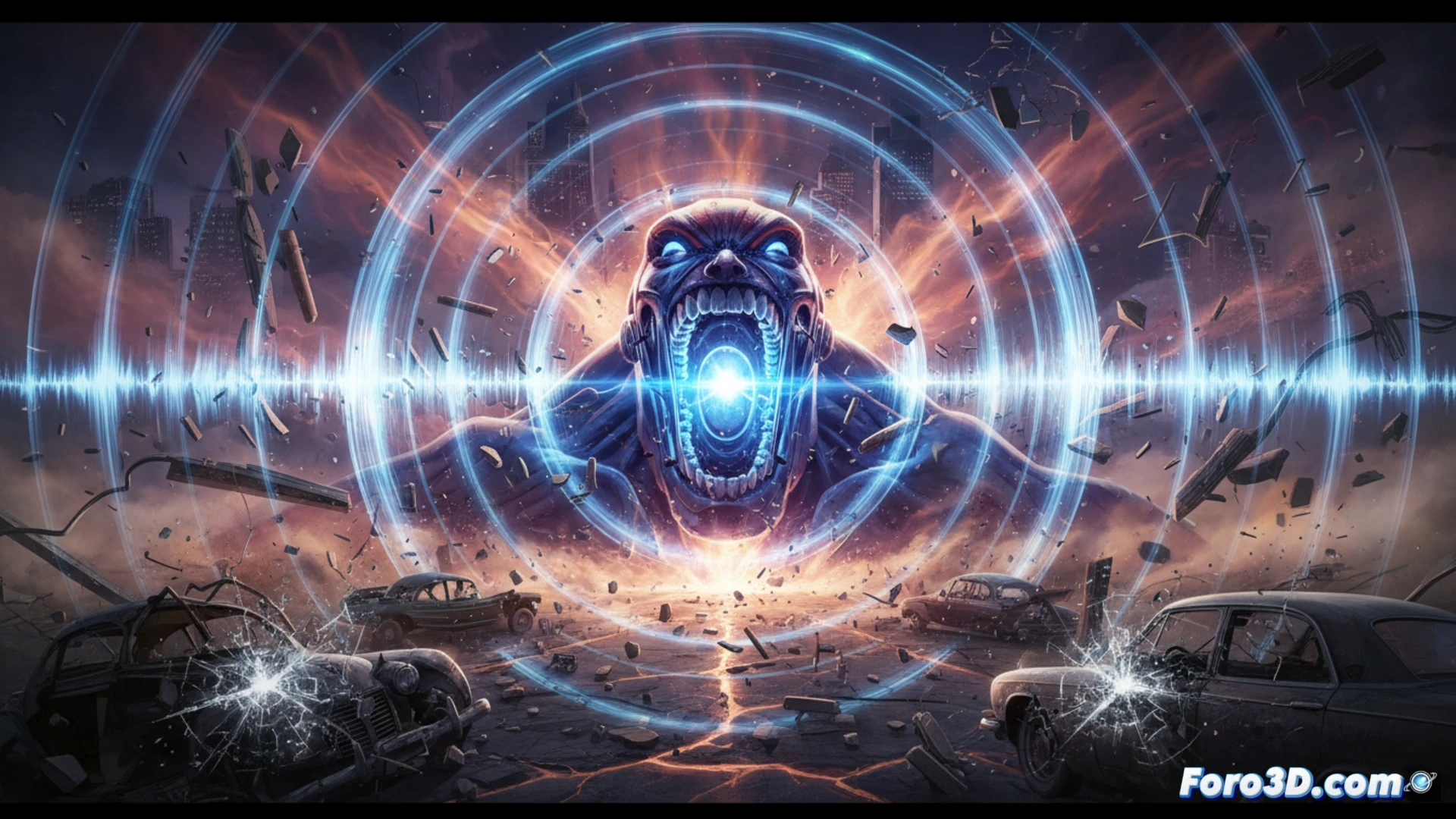
The Marvel universe introduces us to Motormouth, a young British woman whose device transforms her voice into sonic shockwaves capable of pulverizing steel. For a visual effects artist, this power represents a fascinating technical challenge: translating the frequency and amplitude of sound into visible physical forces. It's not just a scream, but a deformation of space and matter that requires a multidisciplinary approach involving fluid simulations, rigid body dynamics, and distortion shaders.
Technical Pipeline: From Frequency to Fracture 🛠️
In Houdini, the process would begin with generating an animated spherical density field. The character's voice frequency would modulate the scale and expansion speed of this field. To simulate the impact on steel, we would use an RBD (Rigid Body Dynamics) solver with pre-fracturing. The trick lies in the Voronoi Shatter: if the shockwave exceeds a pressure threshold, we activate an Attribute Transfer that applies a radial force from the epicenter. The destruction is not random; debris particles must inherit the wave's velocity, creating a silent explosion effect where the metal disintegrates in a conical pattern. In Unreal Engine, we could replicate this with a Niagara System emitting debris particles and a Radial Force applied to destructible meshes.
The Physics of Visual Sound 🔊
Beyond destruction, the real challenge is visualizing the wave itself. The human eye doesn't see sound, but we can trick it using animated displacement maps in the air. A common technique in superhero movies is the shock diamond, where air ionizes and distorts light. For Motormouth, we would use a Volume Rasterize with turbulent noise that increases its amplitude at the center. The result is a sphere of distorted glass that, upon colliding with steel, ceases to be a visual effect and becomes a physical force. It's the frontier where VFX stops being magic and becomes engineering.
What is the most effective technical approach to simulate the interaction between sonic waves and fragmentation destruction in a physics engine like Houdini or Unreal Engine, considering the scale and style of the Motormouth character?
(PS: VFX are like magic: when they work, no one asks how; when they fail, everyone sees it.)