The development of Record of Lodoss War: Deedlit in Wonder Labyrinth demonstrates how a lesser-known engine, the Mogura Engine, can emulate the iconic fluidity of Castlevania through meticulous pixel art. This technical analysis breaks down the workflow between Aseprite and Photoshop to achieve animations with dynamic trails, offering practical tips for indie developers looking to optimize 2D assets without sacrificing performance.
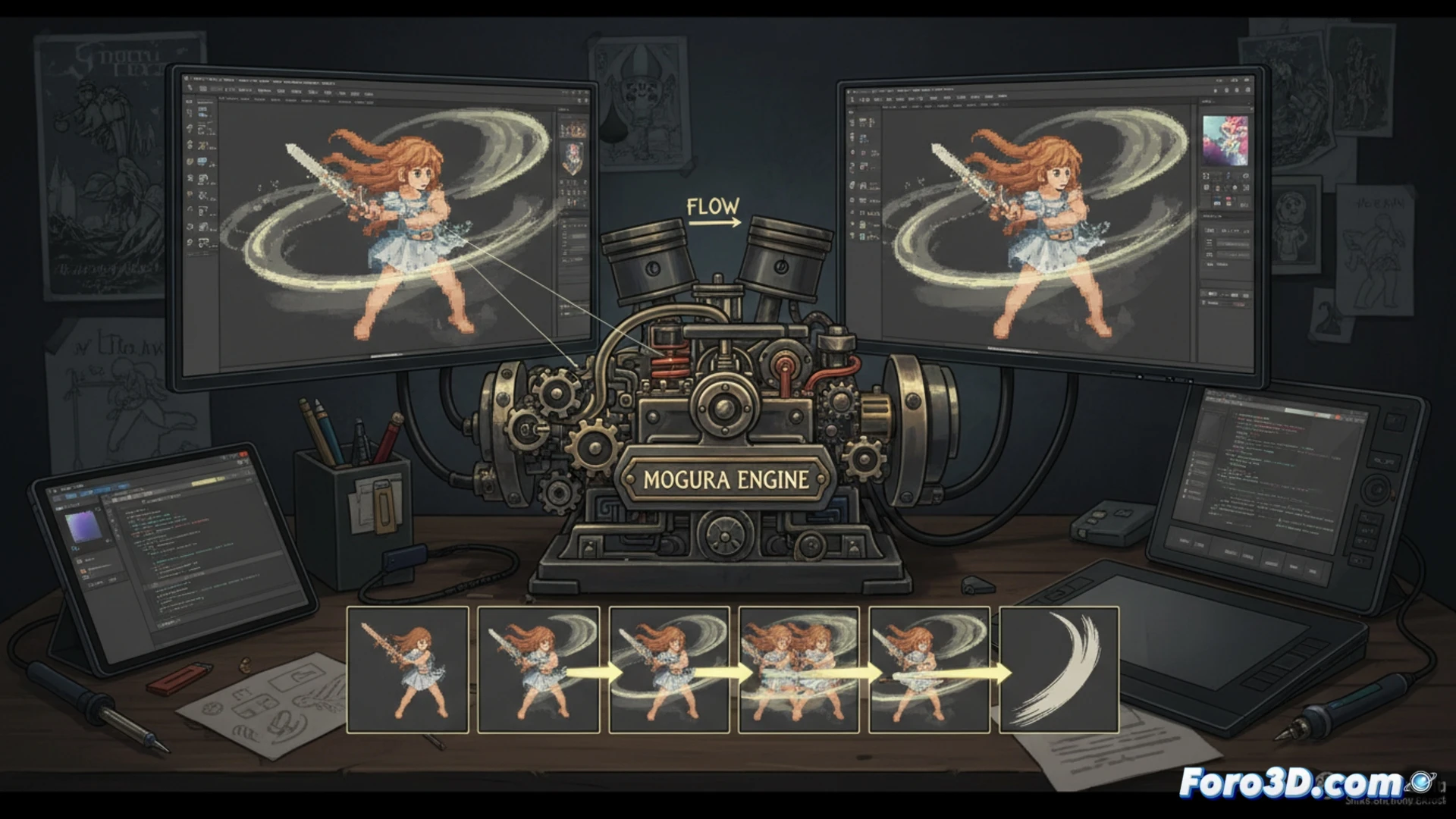
Workflow: Aseprite for sprites, Photoshop for effects 🎮
The process begins in Aseprite, where animation frames are created with a limited palette to maintain visual consistency. Each sprite is designed with a focus on silhouette, key for dynamic trails (like those of Deedlit's sword) to appear sharp in motion. Then, Photoshop is used to apply post-processing: directional blur filters on separate layers, which are exported as additional sprites. The key is to optimize the number of frames: instead of full 60 fps, keyframes are interleaved with position interpolation in the Mogura Engine. This reduces texture memory weight, allowing the engine to render trails without frame drops. For developers, I recommend keeping each sprite under 128x128 pixels and grouping animations into sprite sheets with 1-pixel margins to avoid edge artifacts.
Why Mogura Engine is ideal for this visual style ⚙️
The Mogura Engine, although less popular than Unity or Godot, offers a lightweight pipeline for 2D. Its render layer system allows overlaying dynamic trails as particle effects without needing complex shaders. To emulate Castlevania's fluidity, the engine synchronizes sprite interpolation with the output buffer, achieving smooth movement even at 30 fps. The final tip for indies is to prioritize idle and attack animations, as they are the most viewed; investing time in smooth transitions between these improves quality perception more than adding dozens of unnecessary frames.
What specific technical challenges did the use of the Mogura Engine present in achieving fluid pixel art animation in Deedlit in Wonder Labyrinth, and how were they resolved?
(PS: optimizing for mobile is like trying to fit an elephant into a Mini Cooper)