The hadal zone, encompassing the planet's deepest ocean trenches, remains one of the least explored environments on Earth. The recent sighting of Pelagomacellicephala sp., a translucent, gelatinous worm that swims freely at over 6,000 meters in the Mindanao Trench, presents a unique challenge for scientific visualization. With no direct access, 3D modeling becomes the key tool for studying its biology.
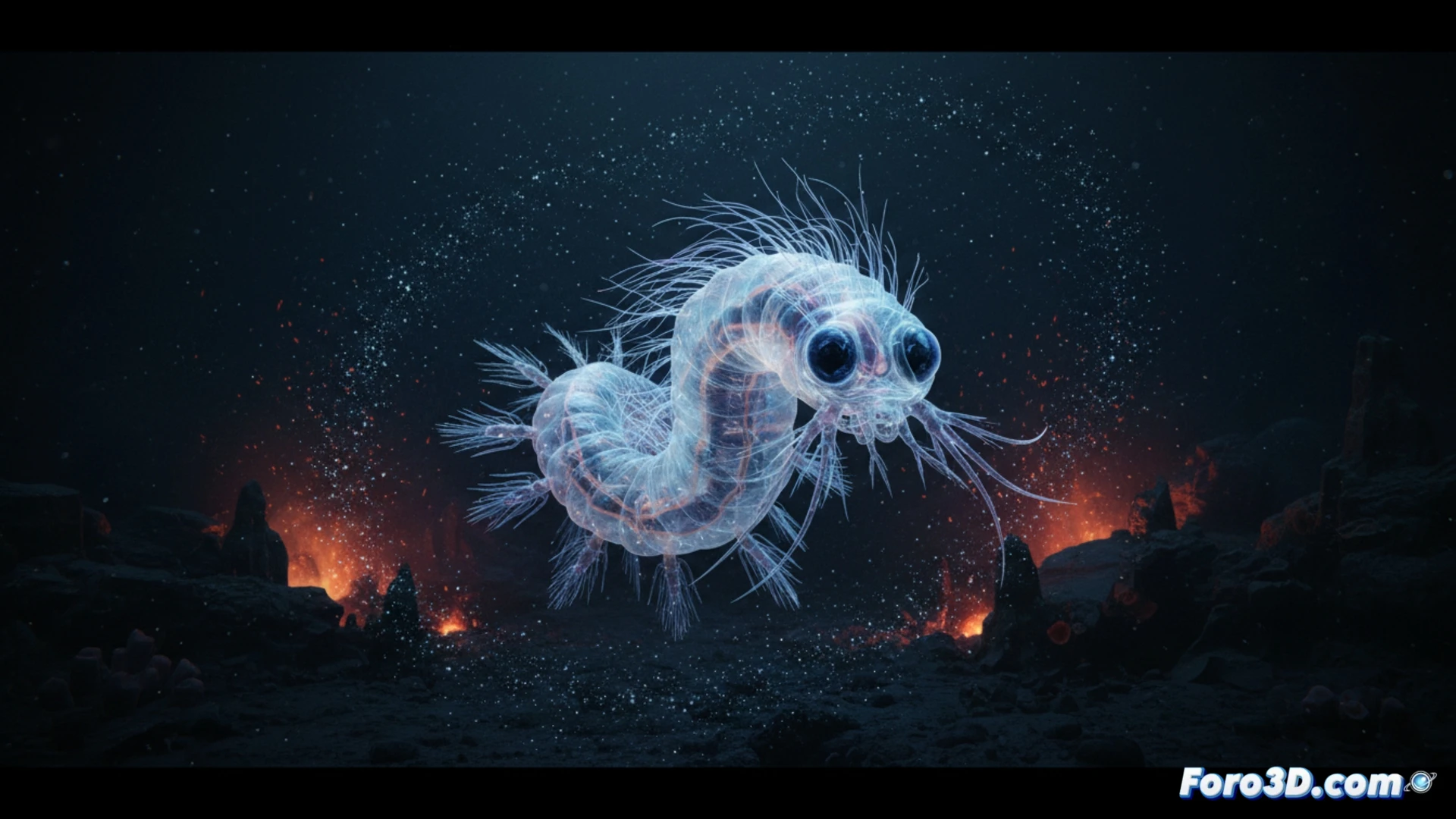
Anatomical reconstruction from spectral data 🐍
The absence of light and extreme pressure make collecting intact specimens difficult. To model the ghost worm, specialists rely on high-resolution video photogrammetry and computed tomography of fragmented samples. The main technical challenge is replicating the translucency and gelatinous consistency of the tissue. In engines like Blender or Houdini, this is achieved through subsurface scattering (SSS) shaders and low-viscosity fluid simulations, which allow recreating how light diffuses through the animal's body in the hadal darkness.
The value of visualization for science and outreach 🔬
Beyond aesthetics, these 3D models allow marine biologists to analyze swimming biomechanics under high-pressure conditions without the need for costly expeditions. For the general public, a photorealistic animation of this creature is the only window into an otherwise inaccessible ecosystem. Thus, scientific visualization not only documents extreme biodiversity but also inspires new questions about the limits of life on Earth.
What specific technical challenges were faced when reconstructing the translucent and gelatinous anatomy of the Mindanao ghost worm in a detailed 3D model for scientific visualization under extreme darkness and pressure conditions?
(PS: if your manta ray animation doesn't excite, you can always add some documentary music from channel 2)