Ecologist Suzanne Simard revolutionized forest biology by discovering that trees are not isolated entities, but nodes of a vast underground network. Beneath our feet, the hyphae of mycorrhizal fungi weave an intricate mesh connecting the roots of different species, allowing the exchange of carbon, nutrients, and alarm signals. This network, dubbed the Wood Wide Web, not only redefined ecology but also inspired the representation of nature in films like Avatar. 🌳
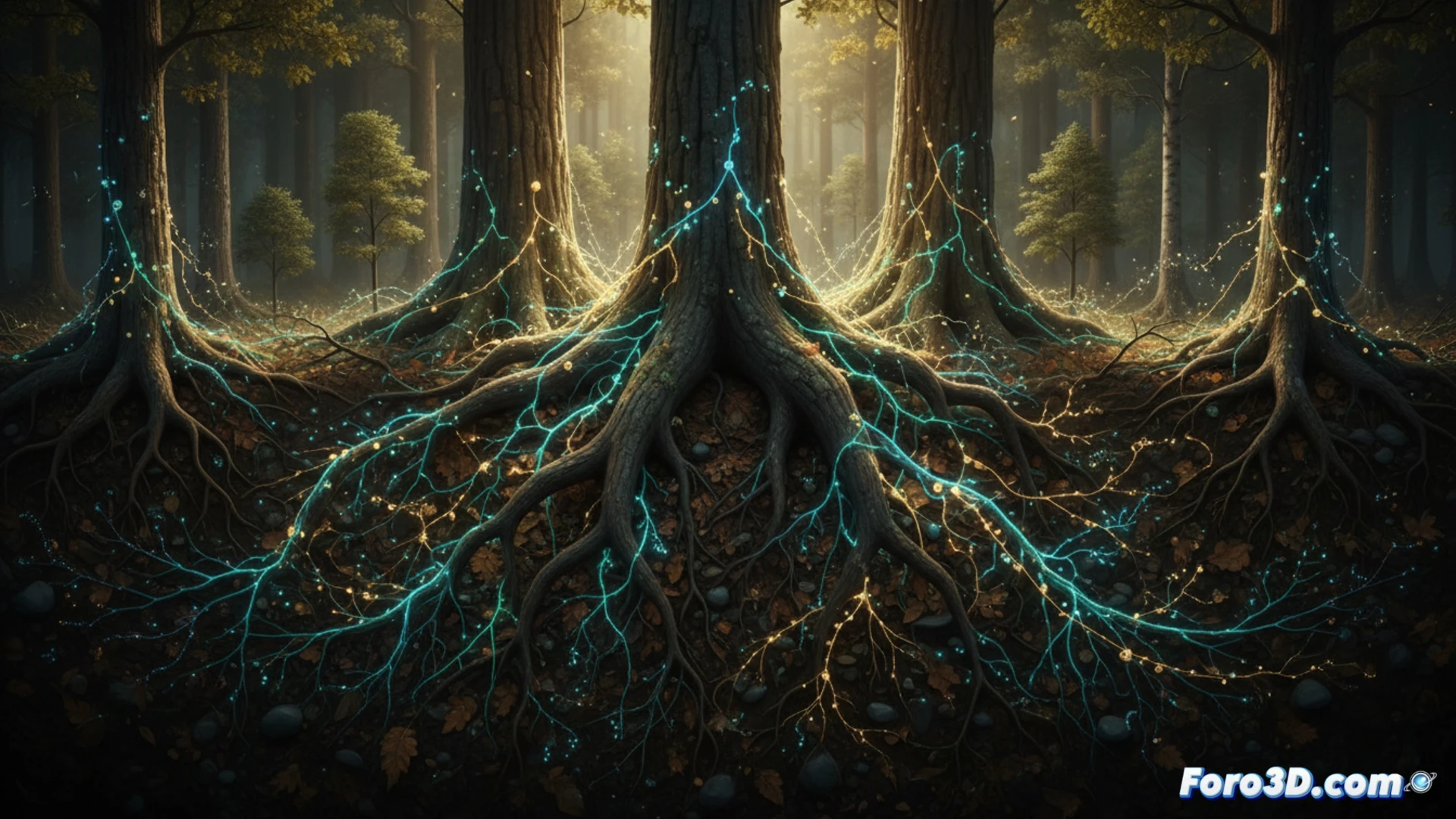
Signal Flow and Biological Data Visualization 🔬
For scientific visualization experts, modeling this network presents a fascinating challenge. The three-dimensional structure of mycelium is chaotic yet functional; it requires fractal growth algorithms and particle simulation to represent the flow of compounds like carbon-13 or electrical signals. We can generate interactive infographics where users explore a soil cross-section, seeing how molecules travel from a stressed birch tree to a neighboring pine. The key lies in translating mass spectrometry data and isotope analysis into animated trajectories in 3D space, showcasing chemical cooperation without falling into the anthropomorphism initially criticized in Simard's work.
From Pandora to the Lab: Scientific Rigor in Fiction 🎬
Remarkably, James Cameron's team contacted Simard to shape the ecology of Pandora. By comparing their 3D models of mycorrhizae with the luminescent roots of Avatar, we can highlight where science fiction anticipates or diverges from reality. While in the film the connection is instantaneous and almost magical, in nature the exchange is slow but constant. A good technical article should point out this difference, using comparative graphics to educate the public about the true complexity of ecosystems, where survival depends on a silent and perfectly modelable network.
As a 3D modeler, what key visual details should I prioritize to accurately represent the transfer of carbon and nutrients through the hyphae of the mycorrhizal network, differentiating biochemical signals from purely structural connections?
(PS: fluid physics for simulating the ocean is like the sea: unpredictable and you always run out of RAM)