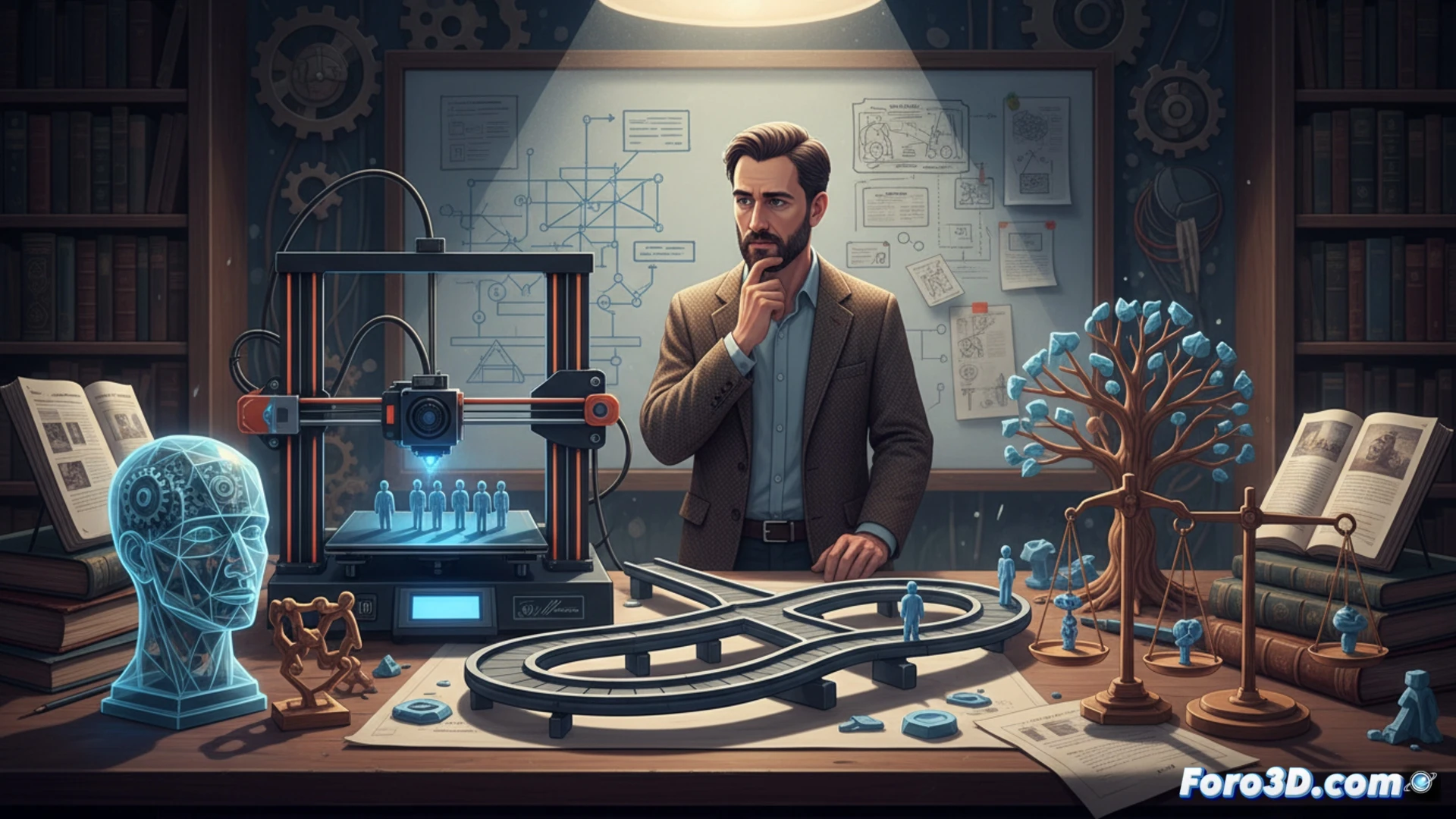
Philosophy deals with abstract concepts, but sometimes a tangible object helps to better understand them. 3D technology allows arguments or ethical dilemmas to be materialized into physical models. A philosopher can create a representation of the trolley problem for a debate, using printed pieces that illustrate the options. This does not replace reflection, but anchors it to reality.
Software and hardware for thinking in three dimensions 🤖
To model concepts, a CAD program like Fusion 360 or Blender is needed, which allows designing everything from a Platonic sphere to a Weberian iron cage. Then, a mid-range FDM printer, such as the Creality Ender 3, is sufficient for prototyping. The philosopher can thus manufacture objects for their classes or to visualize paradoxes, like a Necker cube in three dimensions.
From the agora to the slicer: printing methodical doubt 🧠
Imagine a philosopher printing a replica of Plato's cave. While the printer hums, they meditate on whether the PLA is the shadow of an idea or the idea itself. In the end, they have a paperweight shaped like a dilemma. Less useful than a book, but more effective for silencing that friend who says philosophy is useless. At least now you have an ornament that has some weight.