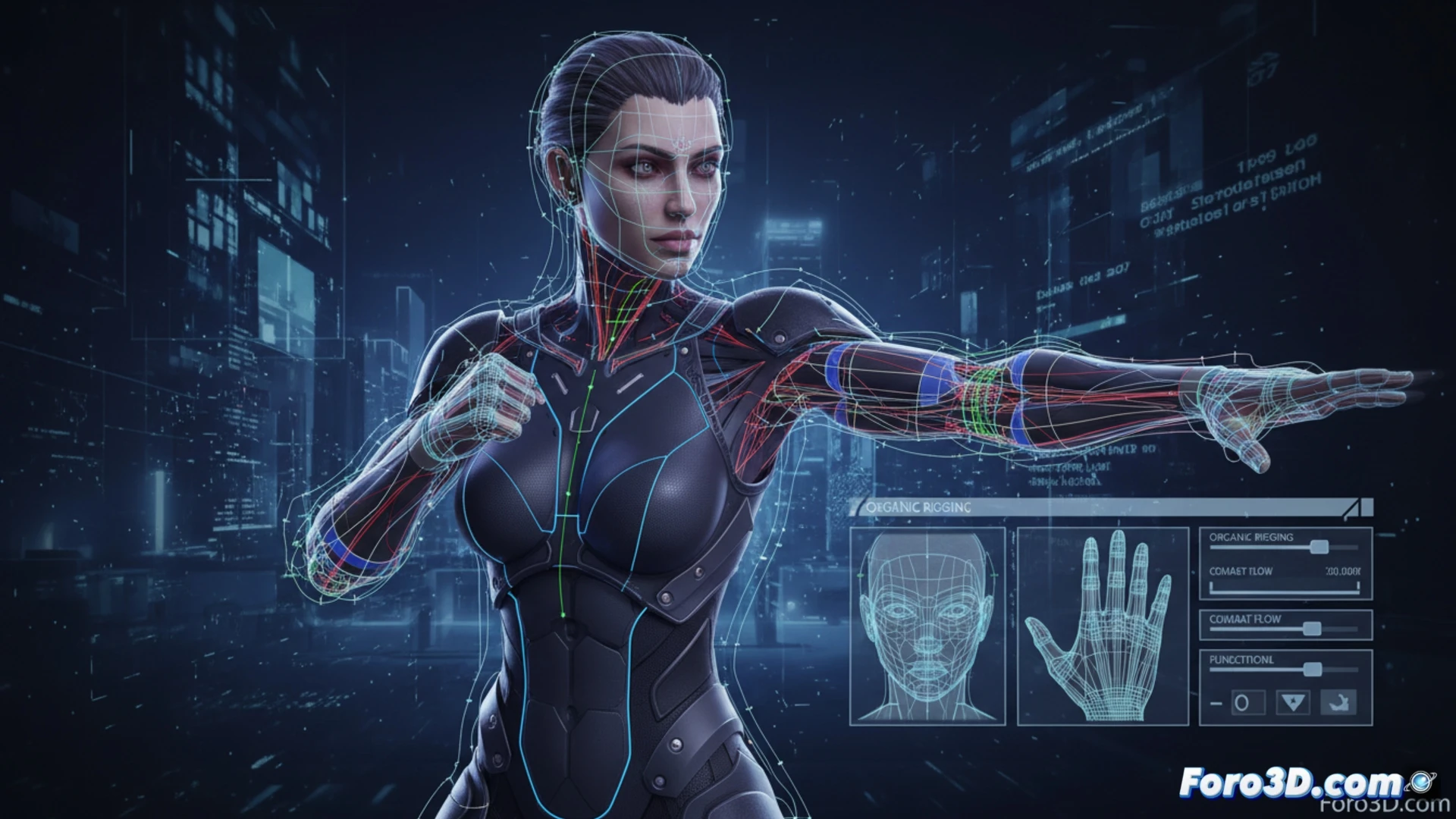
Finesse, the adopted daughter of Wilson Fisk in Marvel comics, represents a fascinating technical challenge for 3D modeling. Her ability, kinetic polymathy, allows her to replicate any physical movement just by observing it. For a digital humanoid, this involves designing a rigging system that is not only organic but capable of executing complex combat sequences without visible transitions. Her lack of empathy, a key psychological trait, must be translated into a cold and calculated facial animation, where every gesture is functional and not emotional.
Reflex Rigging and Emotional Void Blendshapes 🎯
To replicate her photographic reflexes, the rigging must prioritize inverse kinematics (IK) in limbs and spine, allowing the model to adopt martial arts stances or acrobatics with a single controller. An animation layer system is essential to overlay instant reaction movements on a neutral base. On the face, blendshapes must be designed for minimal but precise expressions: slightly raised eyebrows to indicate analysis, and a relaxed mouth that never forms a genuine smile. The lack of empathy is modeled by removing morph targets for complex emotions like compassion or fear, leaving only variants of concentration and controlled surprise. This is ideal for fighting video games, where Finesse could read the opponent's attacks and activate an exact counter animation, like a predictive parry engine.
The Paradox of the Emotionless Digital Soul 🤖
Modeling Finesse forces us to ask how to represent intelligence without feeling. In digital animation, the lack of empathy is not a flaw, but a style: it is the face of a perfect algorithm. Her fluid and calculated movement recalls NPCs in stealth games or science fiction androids. By eliminating the micro-expressions that humanize a character, we create an unsettling yet fascinating figure, a mirror of how technology can imitate life without understanding it. For an animation studio, Finesse is the perfect case study to demonstrate that realism does not always reside in emotion, but in the mechanical precision of movement.
How to achieve rigging that preserves the integrity of photographic reflexes on Finesse's digital skin when simulating her signature acrobatic movements without generating real-time visual artifacts?
(PS: Digital humanoids have the advantage that they never complain about the rigging.)