The Spiders studio has released Steelrising, a title that combines the French Revolution with bronze automatons. The Silk Engine manages an alternate Paris where metallic reflections and soft shadows are key. To achieve this realism, the team used Maya for gear modeling and Substance Painter for texturing oxidized metals. We analyze the technical workflow behind these assets. ⚙️
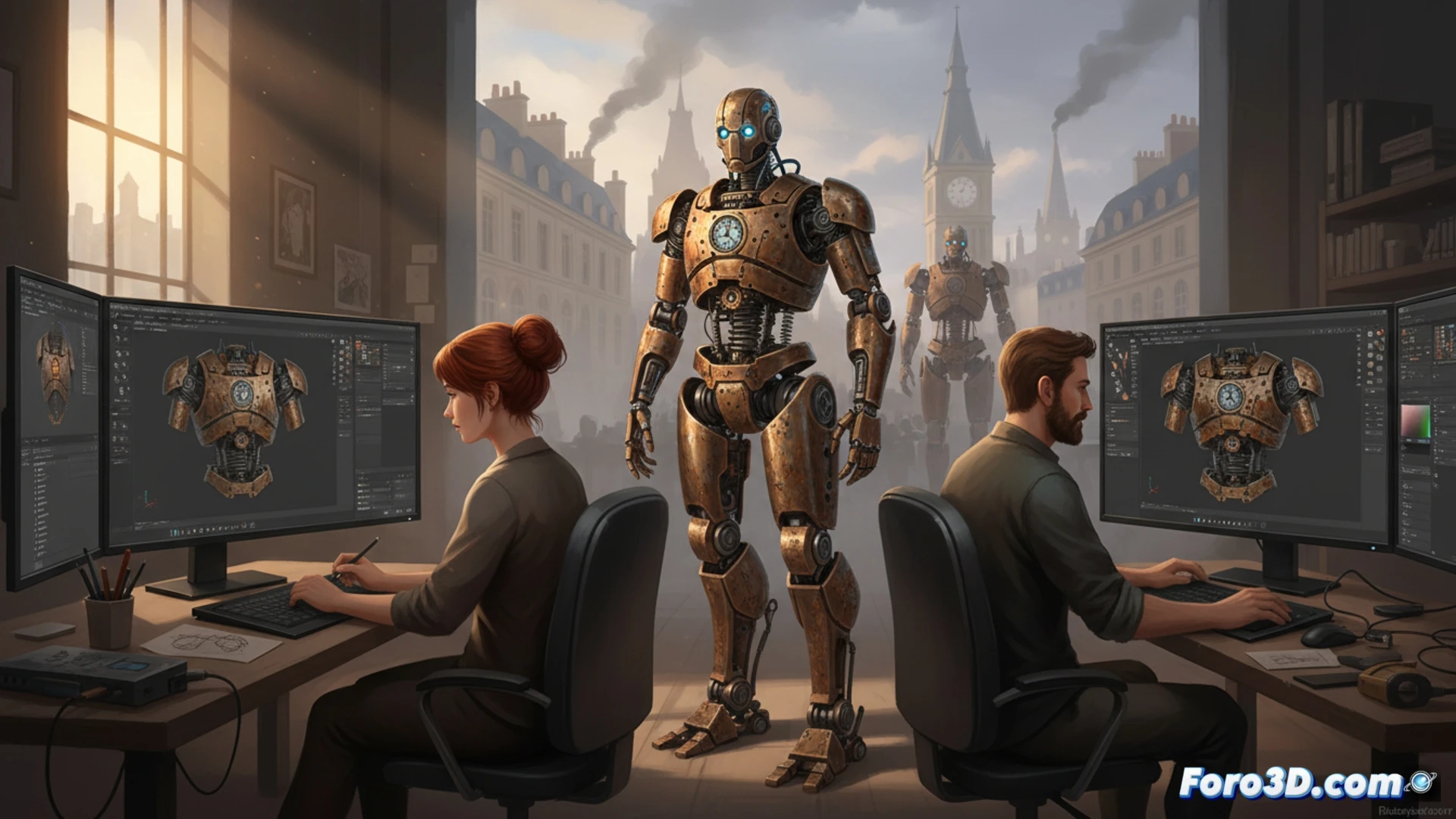
Optimization of metallic assets for Silk Engine 🔩
In Maya, modelers built the internal mechanisms of the automatons using high-density polygonal geometry, focusing on toothed gears and articulated joints. Each piece was designed to maintain visual readability even in motion, with clean topology that facilitated rigging. Subsequently, in Substance Painter, layers of rust and wear were applied using procedural masks, simulating years of abandonment in a revolutionary Paris. The challenge was balancing the metal's reflectivity with the engine's soft shadows, adjusting roughness maps to avoid excessive glare in real-time.
Lessons on real-time detail 🛠️
Spiders' approach demonstrates that mechanical detail should not be sacrificed for performance. By using normal maps generated from high-resolution models in Maya, they made the gears appear complex without saturating the geometry. Substance Painter enabled fast texturing with rust variations that give each automaton a history. For other developers, the key lies in planning optimization from the base modeling stage, using procedural tools to avoid losing graphical quality in engines like Silk Engine.
As a technical artist, how did you manage the balance between the historical accuracy of the French Revolution and steampunk fantasy in the modeling and texturing of the bronze automatons for Steelrising?
(PS: shaders are like mayonnaise: if they break, you start all over again)