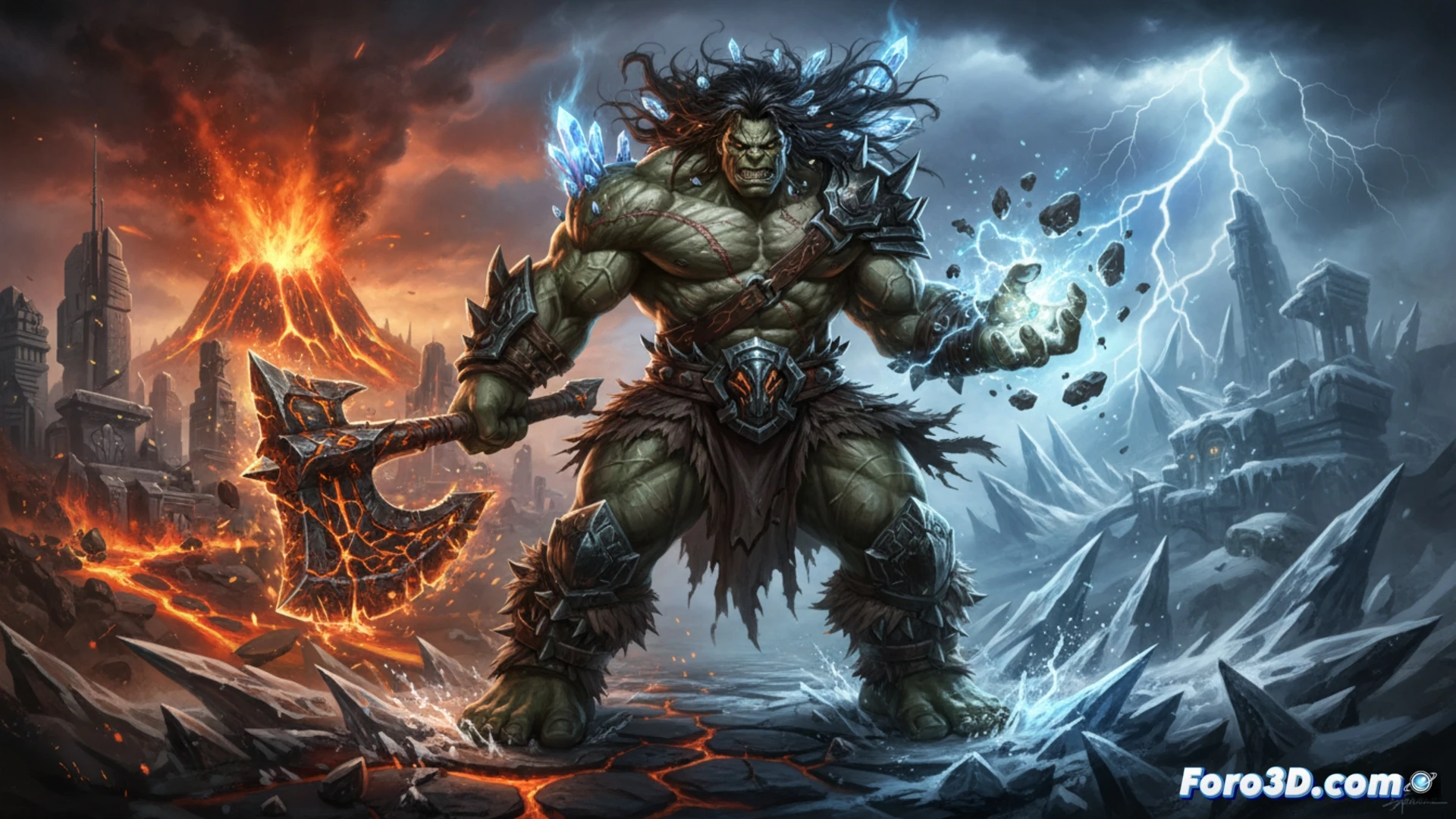
Skaar, the son of Hulk and Caiera, represents a unique technical challenge for video game development. His hybrid design combines his father's immense muscle mass with his mother's tectonic energies. When modeling him in 3D for engines like Unreal or Unity, we must prioritize a readable silhouette that communicates raw power and elemental control. This article analyzes the polygon, UV mapping, and rigging decisions necessary to capture his essence in real-time, using titles like Marvel's Avengers or Capcom's fighting games as references.
Polygonal optimization and hybrid texturing 🎮
For a playable character, the triangle limit usually ranges between 15k and 30k. In Skaar, the highest density should be concentrated on the torso, shoulders, and hands, key areas for his attack animations. The green skin must be textured with a variable roughness channel: brighter on scars and more matte on volcanic stone areas. The marks of his elemental control, such as the fire or rock lines on his arms, require an independent emission map. For the long, dark hair, I recommend using cards with alpha, avoiding solid geometry to not overload the render. The outfit, inspired by his Sakaaran armor, should have a low metalness map to simulate leather and poor alloys.
Rigging for contained fury ⚡
Skaar's rigging must resolve two contradictions: the rigidity of a tank and the fluidity of an elementalist. The arm bones should have an IK system with wide rotation limits, allowing his ground pounds to use the weight of the entire torso. For fire or rock powers, it is practical to add auxiliary bones on the hands and feet, acting as particle emitters. The face needs at least 20 morph targets to express everything from Hulk's rage to his mother's calculated serenity. In fighting games, like Marvel vs. Capcom, his rig should prioritize anticipation: a charge frame before impact, using the deformation of the deltoid muscles as a visual cue.
How to manage muscle deformation and texture transitions in Skaar's rigging to maintain his brute strength and the chaotic elemental energy during real-time combat animations?
(PS: 90% of development time is polishing, the other 90% is fixing bugs)