We analyze the technical process for integrating Surge (Noriko Ashida) into a fighting or RPG video game. This Marvel mutant character, who absorbs ambient electricity to enhance her speed and fire bursts, presents unique challenges in modeling, particle effects, and animation. We will cover everything from creating her iconic gauntlets to implementing her super speed through shaders and cinematics.
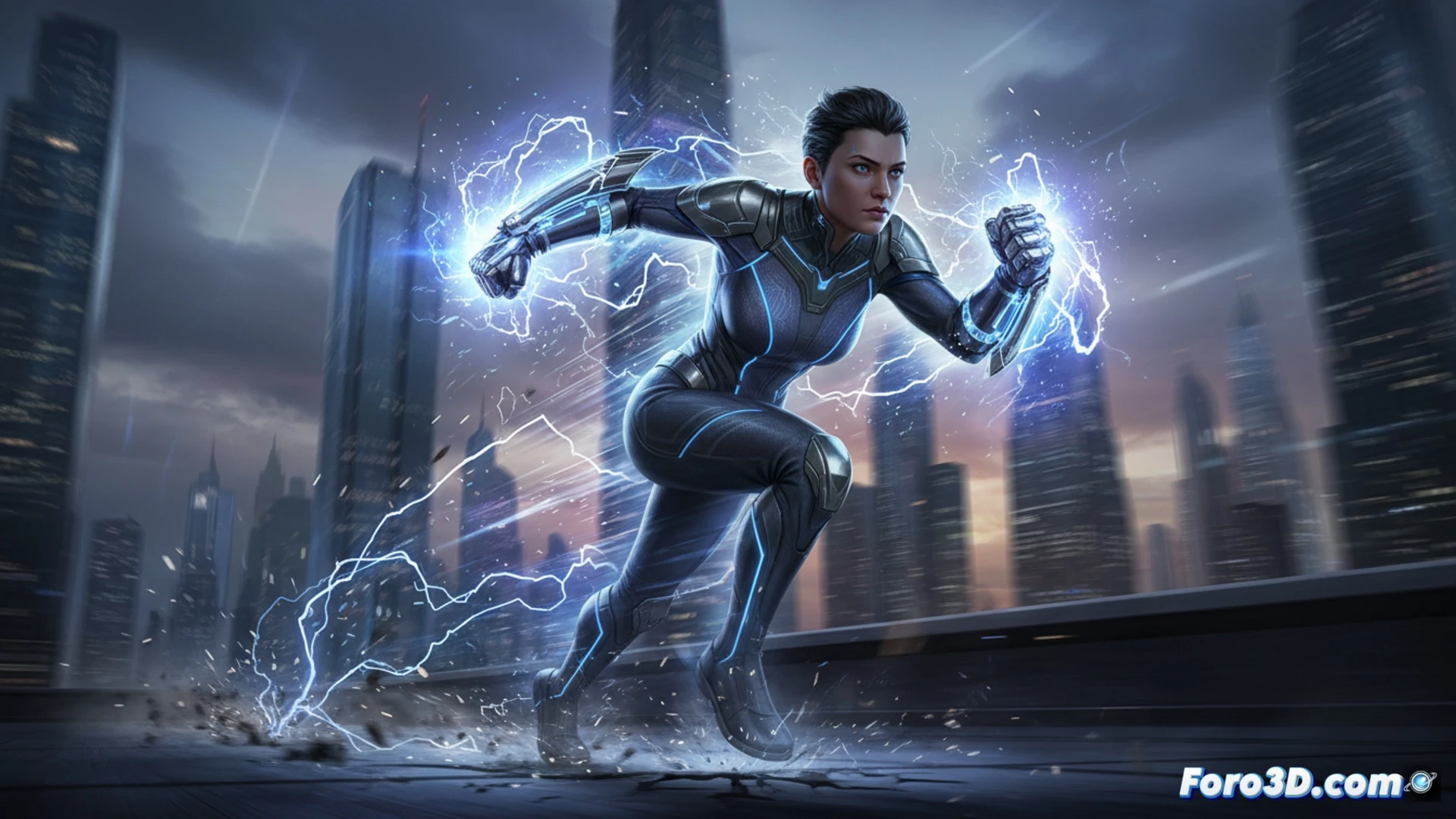
Technical pipeline for gauntlets and energy bursts ⚡
To model Surge's gauntlets, a low-polygon topology (between 3k and 5k tris each) with a normal map simulating the energy conduits is recommended. The burst emission requires a particle system with additive shaders and UV distortion. Super speed animation is achieved through a pose blend, combined with a lateral displacement (stretch) shader that elongates the mesh along the movement axis. For the electrical absorption effect, procedural decals that react to the environment can be used, emitting spark particles from predefined contact points on the stage.
The challenge of visual identity in gameplay 🎮
Beyond the technique, Surge's design must communicate her power without cluttering the screen. The key lies in the quick readability of her attacks: using cool colors (electric blue) for absorption and warm tones (white/cyan) for bursts. Super speed should feel like a state of flow, not just a simple frame rate increase. Making the player feel the inertia and control over ambient electricity is the real challenge for a game designer seeking comic fidelity.
What is the most efficient approach to animating the transition between Surge's super speed and energy gauntlet attacks without causing clipping on her 3D model?
(PS: shaders are like mayonnaise: if they break, you have to start all over again)