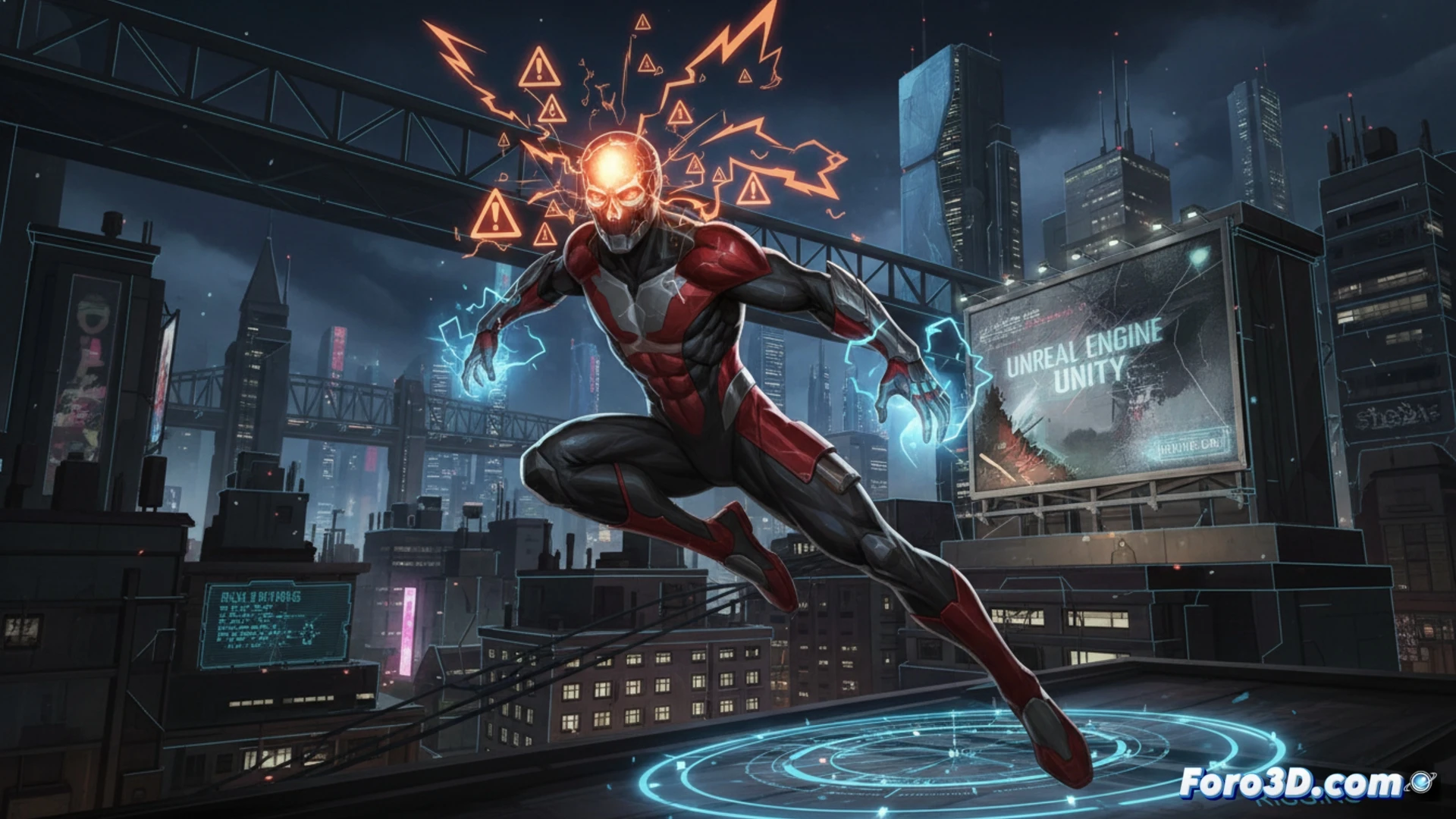
We analyze the technical process to bring Ricochet, Marvel's acrobatic mutant, to a game engine like Unreal Engine or Unity. His design, created by Joseph Harris and Adam Pollina, presents a unique challenge: combining an agile silhouette with the mechanics of bouncing discs of surgical precision. We will address the creation of his polygonal mesh, rigging for acrobatic movements, and the implementation of his danger sense as a real-time visual alert system.
Implementation of the bouncing discs and the prediction system 🎯
The core of the character is his discs. For modeling them, a low-polygon geometry (between 300 and 500 triangles) with a physical material based on polished metal is recommended, using a normal map to simulate the bevel. The bounce animation requires a projectile physics system with raycast collision detection. The technical key is to program a bounce parabola that calculates incidence and reflection angles, similar to a breakout game. For surgical precision, a prediction gizmo must be implemented that draws a trajectory line in the UI, allowing the player to adjust the throw. The danger sense translates into a post-processing shader that tints the screen red and slows down time (bullet time) when an enemy attack is within 1.5 meters of the character.
Rigging optimization for superhuman agility 🤸
To capture Johnny Gallo's agility, the rigging must prioritize flexibility in the spine and hips. A skeleton with 25 bones is recommended, including additional bones in the pelvis for extreme twists and in the wrists for disc rotation. Animations should be non-linear blends: quick transitions of 0.1 seconds between a jump and a somersault. To avoid visual popping, cubic interpolation curves should be used in the animation editor. Finally, the LOD (Level of Detail) should have three stages, reducing the geometry of hair and clothing in LOD2 to maintain 60 FPS in crowded scenes.
How the bone hierarchy and physics simulation are optimized for Ricochet's acrobatics without sacrificing real-time performance in Unreal Engine or Unity
(PS: game jams are like weddings: everyone is happy, no one sleeps, and you end up crying)