Anole, Marvel's lizard-like mutant, presents a fascinating technical challenge for 3D animation. His design combines a scaly texture, camouflage ability, and limb regeneration with increased size and strength. To capture his essence, we must tackle the skinning of his prehensile tail, the creation of a dynamic shader system for color change, and the implementation of blendshapes that reflect his reptilian physiology.
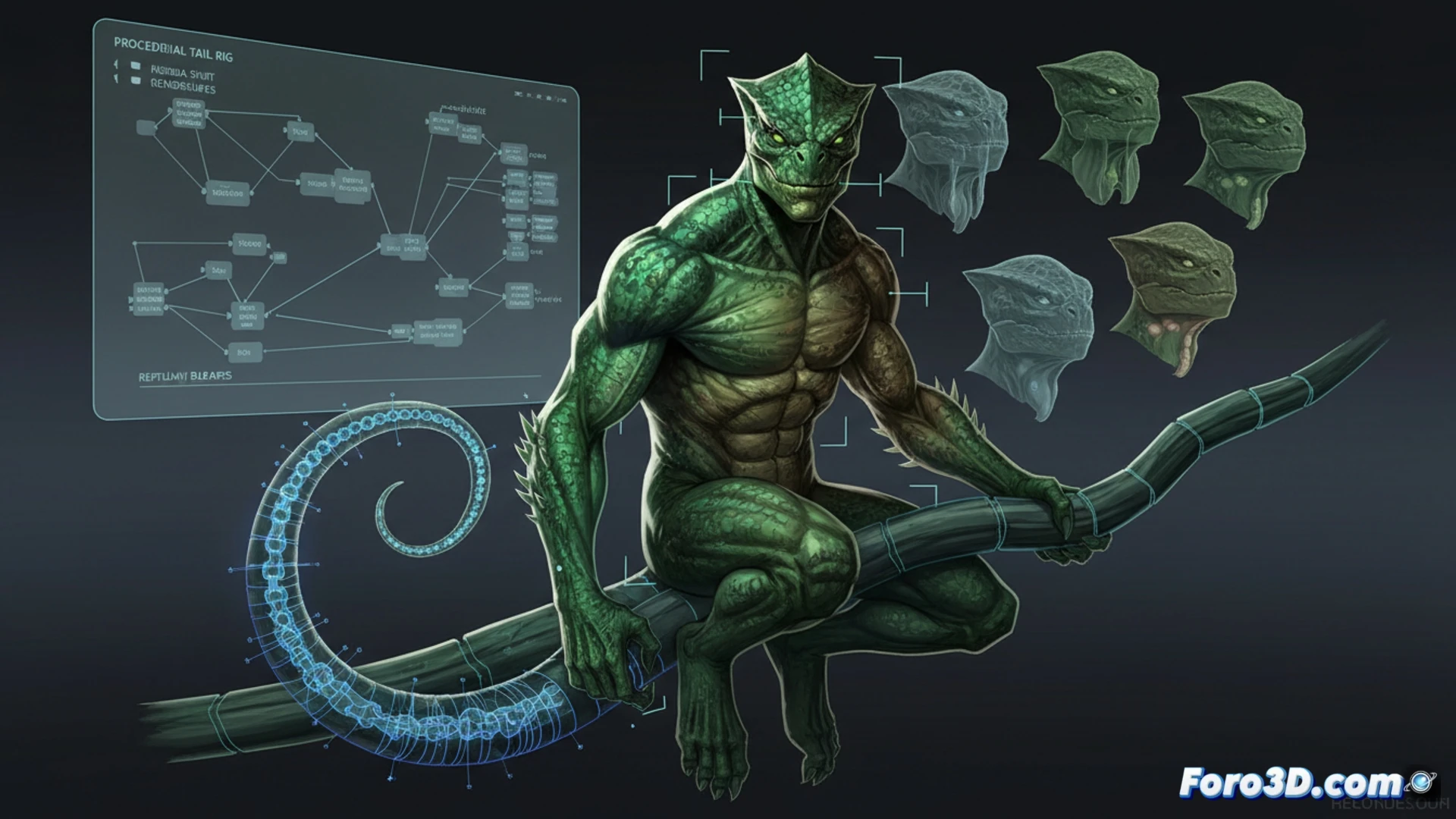
Rigging and Skinning for Regenerated Limbs and Prehensile Tail 🦎
Anole's rigging must prioritize the flexibility of his tail, using a bone chain with spline IK for undulating movements. For the regenerated limbs, which are larger and stronger, we need a system of blendshapes controlled by custom attributes that increases muscle volume and lengthens the foot or hand bones. Skinning requires smooth weight painting in transition areas, especially where the scaly skin stretches. The fingers must have retractable claws, animated via a rotation controller. The scale texture would benefit from a normal-based shader with a hexagonal scale pattern, and for camouflage, a multi-layer shader that blends colors according to a gradient controlled by a blue noise node, mimicking a chameleon's color change in real time.
Reptilian Expressions and the Creature Factor 🐍
Animating Anole involves capturing his creature nature without losing his humanity. Facial blendshapes should prioritize lateral jaw movements and blinking of a third eyelid. His posture must be combined with a walking cycle that drags the tail and a low center of gravity, typical of a bipedal lizard. The key is to use anatomical deformations to narrate his power: when regenerating an arm, the rig must swell and lengthen, while the scale texture reorders itself to cover the new surface, a process that can be automated with mesh deformers.
How would you solve the technical challenge of articulating Anole's prehensile tail so that it retains its structural rigidity in a latent state but deforms organically and realistically during combat movements, without sacrificing real-time rig performance?
(PS: Animating characters is easy: you just have to move 10,000 controls to make them blink.)