The discovery of the Eunectes akiyama, known as the Northern Green Anaconda, has shaken herpetology. Although its appearance is almost identical to the common anaconda, DNA reveals an evolutionary divergence of 10 million years. For the scientific visualization community, this finding represents a fascinating challenge: how to represent a cryptic species, invisible to the human eye, through 3D modeling and genetic dating.
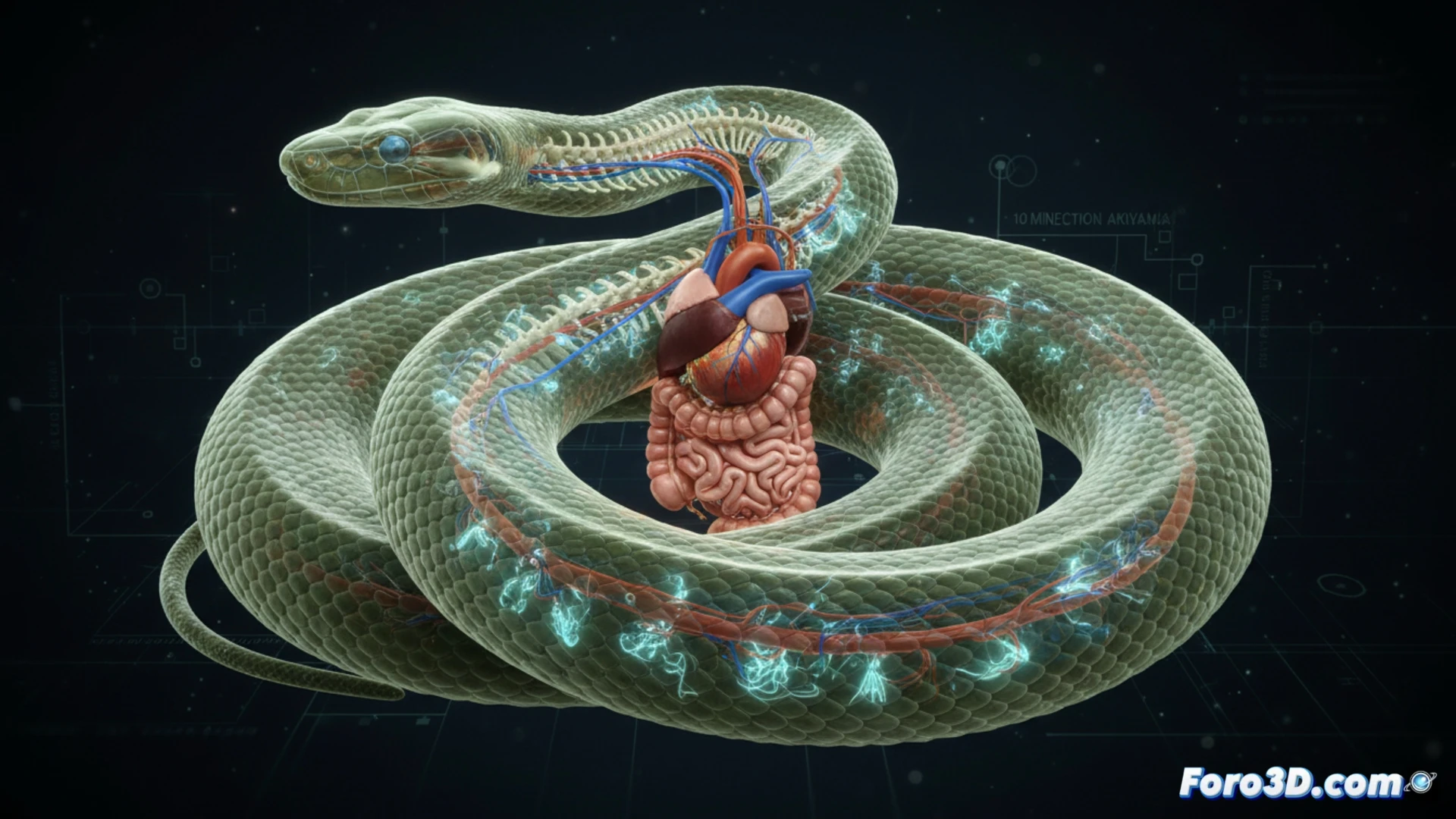
Anatomical reconstruction and phylogenetic divergence in 3D 🧬
The first technical challenge is comparative anatomical reconstruction. 3D artists must model the subtle morphological differences between the Eunectes murinus (common green anaconda) and the new Eunectes akiyama. Using data from CT scans and specimen scans, high-resolution polygonal meshes can be generated that highlight variations in scale arrangement or cranial structure. Additionally, visualizing genetic divergence requires creating interactive 3D timelines. These timelines, based on molecular clocks, allow the user to traverse the 10 million years of separation, showing how changes in the Amazon ecosystem influenced the species' reproductive isolation.
The Amazon ecosystem as a virtual canvas for conservation 🌿
Beyond anatomy, scientific visualization allows recreating the habitat of the Eunectes akiyama in the Ecuadorian Amazon. Modeling the forest canopy, river systems, and potential prey in a photorealistic 3D environment is crucial for outreach. By integrating field data with real-time rendering engines, we can generate ecological simulations that help biologists predict the species' behavior. For the Foro3D community, this project demonstrates that digital art not only beautifies science but becomes an essential tool for the conservation of newly discovered species.
How can 3D modeling based on CT scans of the new northern green anaconda reveal biomechanical differences in its skull and jaw that explain its adaptation to prey different from those of the common anaconda?
(PS: fluid physics for simulating the ocean is like the sea: unpredictable and you always run out of RAM)