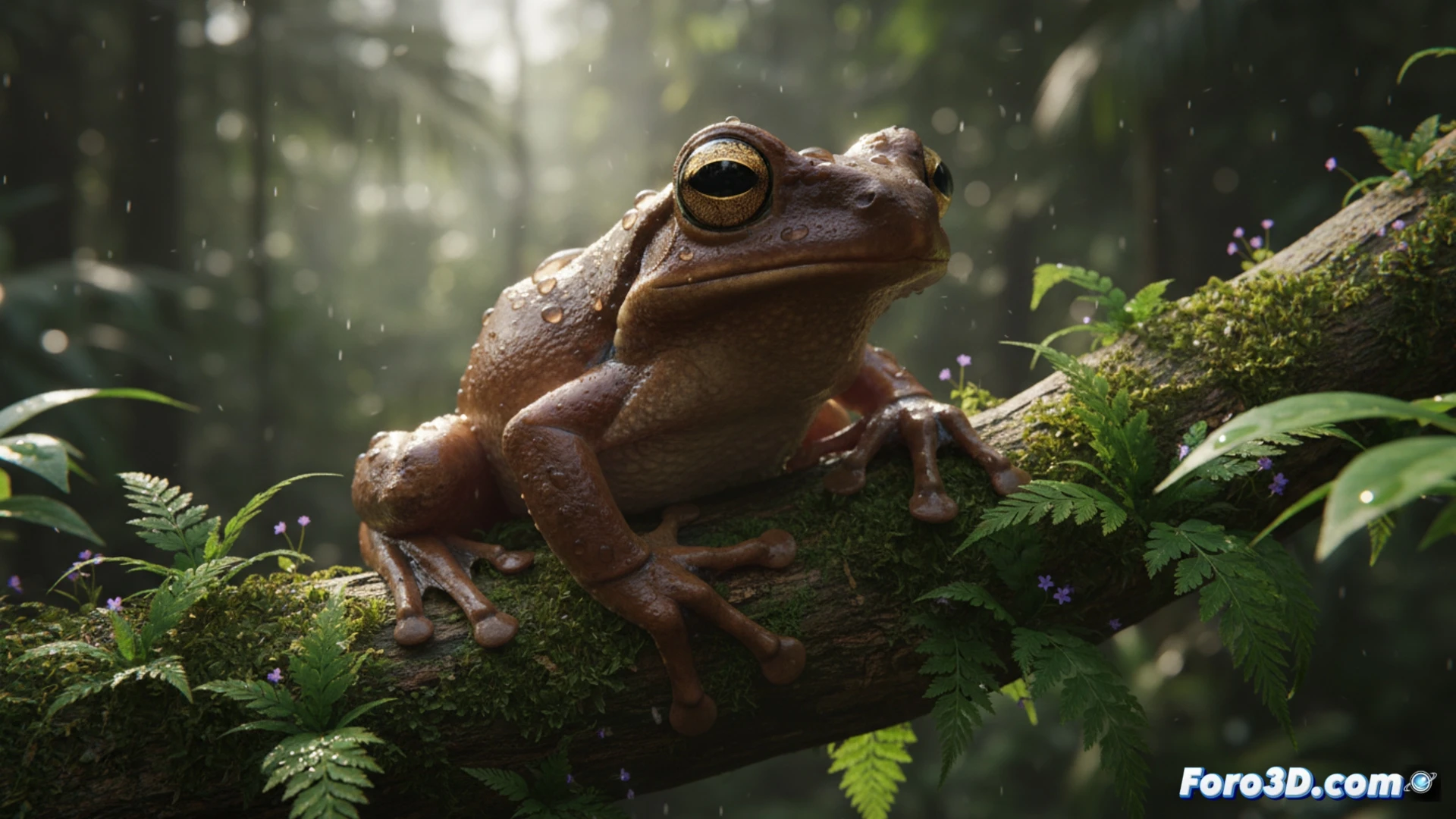
The recent description of the Chocolate Frog (Litoria mira) in the jungles of New Guinea represents a fascinating discovery for herpetology. Its uniform brown coloration and arboreal morphology distinguish it from its green relatives. For the Scientific Visualization niche, this species offers a perfect case study for 3D modeling, allowing exploration of the evolutionary plasticity of the genus Litoria through a precise and detailed digital representation.
Model construction and PBR texturing 🐸
To digitally recreate the Litoria mira, it is crucial to start with a high-resolution photogrammetric scan of a preserved specimen or a multi-angle field photograph. The base mesh must capture the robust build and characteristic adhesive pads of tree frogs. The real challenge lies in PBR (Physically Based Rendering) texturing. The base layer should be a dark, homogeneous brown, without spots or contrasting patterns. Using roughness and displacement maps, the granular and slightly moist texture of its skin should be simulated, avoiding excessive specular reflections to maintain a matte and natural finish. The eyes, with their golden iris and horizontal pupil, require a translucency map to simulate the cornea.
Evolutionary comparison in virtual environments 🌿
The educational value of this model is maximized by integrating it into a comparative scene with the common green tree frog (Litoria caerulea). An interactive 3D viewer allows the user to toggle between both species, highlighting the chromatic difference (brown vs. green cryptic mimicry) and morphological adaptations. While the green frog has more pronounced skin folds, the Chocolate Frog shows a more streamlined body. This resource is ideal for virtual museums and documentaries, as it translates taxonomic data into an immersive visual experience that explains how geographic isolation in New Guinea shaped this unique coloration.
How can a photorealistic 3D model of the Chocolate Frog (Litoria mira) be achieved that captures both its skin translucency and the microtopography of its jungle habitat in New Guinea for scientific visualization applications?
(PS: fluid physics for simulating the ocean is like the sea: unpredictable and you always run out of RAM)