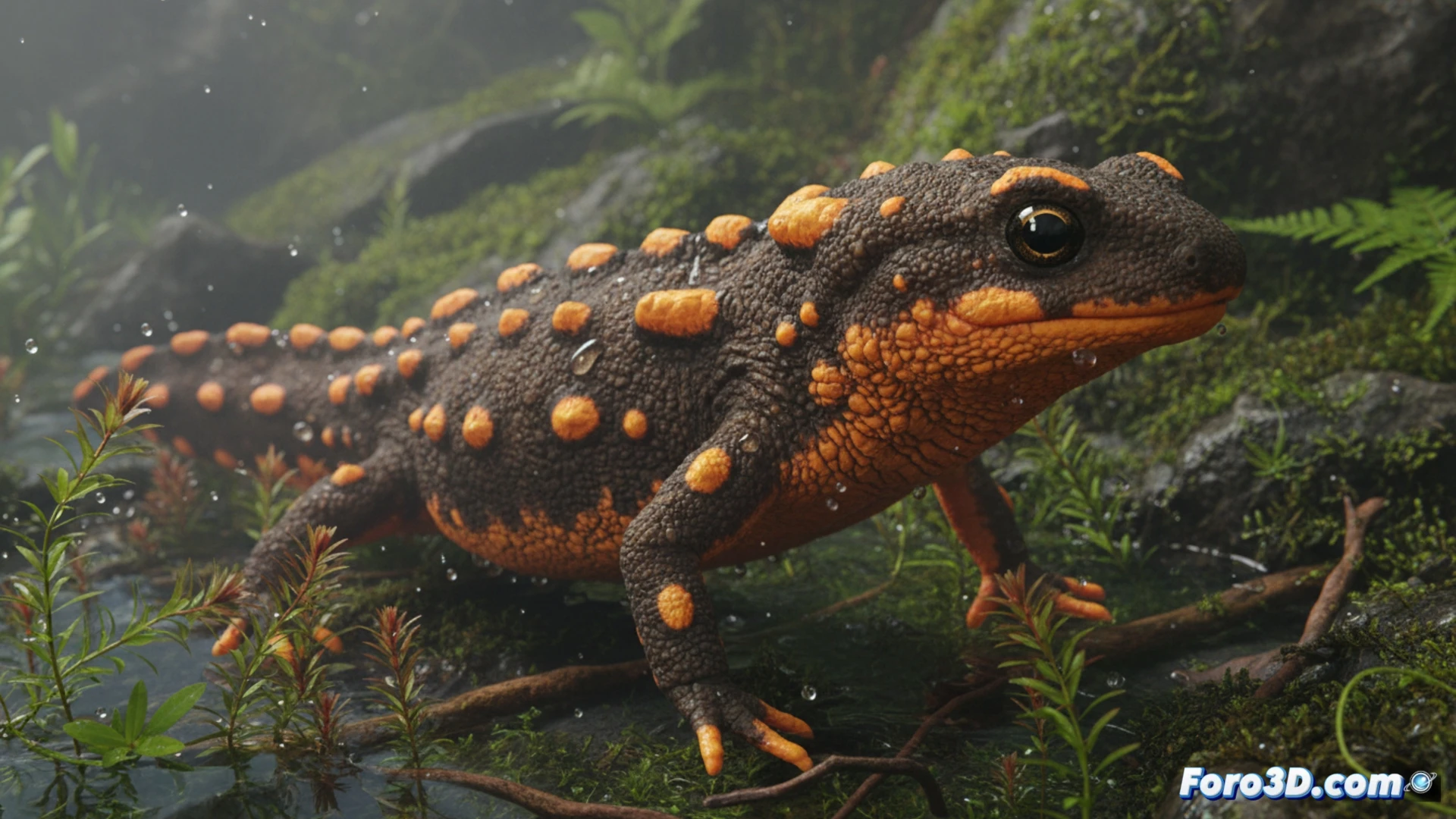
The recent description of the Tylototriton zaimeng in the high-altitude jungle wetlands of India marks a milestone for herpetology. This robust-bodied urodele with dark brown coloration is distinguished by its vibrant orange dorsal protuberances. For the scientific visualization community, this finding represents a fascinating challenge: translating the exact morphology of a newly discovered species into a photorealistic 3D model that serves both anatomical study and public outreach. 🦎
Sculpting and Texturing Process Based on Taxonomic Data 🎨
The development of the model begins with studying the original taxonomic descriptions. The silhouette must reflect the elongated body and robust limbs characteristic of the genus Tylototriton. The greatest technical challenge lies in the parotoid glands and dorsal crests. In ZBrush or Blender, these protuberances are sculpted using dynamic brushes, ensuring a segmented arrangement that mimics the described patterns. Texturing requires a base diffuse map in dark brown tones (almost black) and the application of procedural painting for the orange spots, guaranteeing that the color gradient matches that of living specimens. Lighting with a cloudy forest HDRI is key to avoiding reflections that distort the perception of the amphibian's rough texture.
Ecosystem Visualization as a Conservation Tool 🌿
Beyond the isolated model, the 3D recreation of the high-altitude habitat allows contextualizing the species. Integrating the Tylototriton zaimeng into a virtual environment with ferns, mosses, and waterlogged soils not only validates the model's scale but also educates the viewer about the fragility of its ecosystem. Animating its lateral movement, typical of newts, combined with a close-up of its protuberances, turns abstract scientific data into an immersive experience. This technique demonstrates that 3D modeling not only documents but also protects by bringing the public closer to species that would otherwise be invisible.
As a 3D modeler, what is the greatest technical challenge when reconstructing the skeletal and integumentary structures of Tylototriton zaimeng from limited field data, and how can scientific visualization validate its habitat in high-altitude jungle wetlands?
(PS: if your manta ray animation doesn't excite, you can always add some documentary-style music from channel 2)