Since 1891, residents of Moodus, Connecticut, have reported dull booms and phantom explosions without detectable seismic activity. Known as the Moodus Noises, these phenomena have challenged geologists and physicists for over a century. Now, scientific visualization allows us to unravel this acoustic mystery using advanced simulation tools.
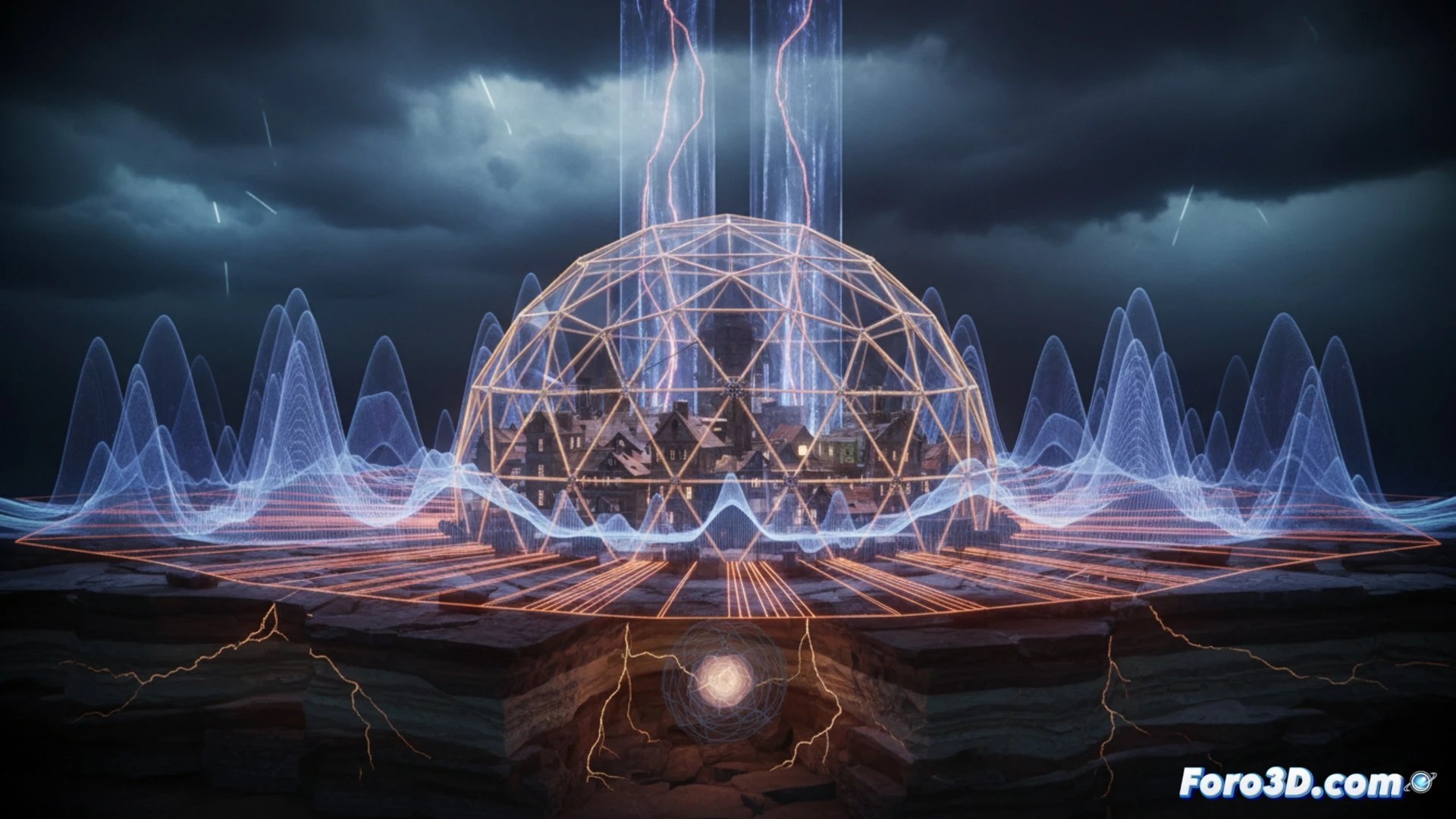
Technical Workflow for Acoustic Propagation 🎧
To model this phenomenon in 3D, three key programs are integrated. First, Actran calculates the propagation of acoustic waves in a digitized terrain model of Connecticut, considering rocky topography and air density. The sound pressure results are exported as data meshes. Then, MATLAB processes these matrices to filter low frequencies (between 20 and 80 Hz) and generate sound intensity maps in spatial coordinates. Finally, ANSYS Fluent simulates the interaction of these waves with wind and thermal stratification of the air, correcting distortions. The result is a volumetric animation that reveals how sound travels and refracts without a visible seismic origin.
Visualizing the Invisible for Outreach 🔍
This model not only explains the Sky Quake but also changes our perception of anomalous natural phenomena. By overlaying acoustic trajectories onto relief maps, the viewer understands that sound can be a geological ghost, shaped by terrain and atmosphere. For the scientific community, it is an analysis tool; for the public, a window into the hidden complexity of the world around us.
Can a 3D model of Moodus's underground geology simulate the propagation of acoustic waves to explain the origin of the Sky Quake without the need for recordable seismic tremors?
(PS: modeling manta rays is easy; the hard part is making them not look like floating plastic bags)