The discovery of Brachycephalus dacnis, known as the Dacnis pumpkin toadlet, shakes the boundaries of biology and scientific visualization. At just 7 millimeters in total length, this amphibian endemic to the Brazilian Atlantic forest holds the title of one of the smallest vertebrates in the world. Its discovery in 2024 not only represents a taxonomic milestone but also a technical challenge for those seeking to represent anatomical structures in 3D at the frontier of the visible.
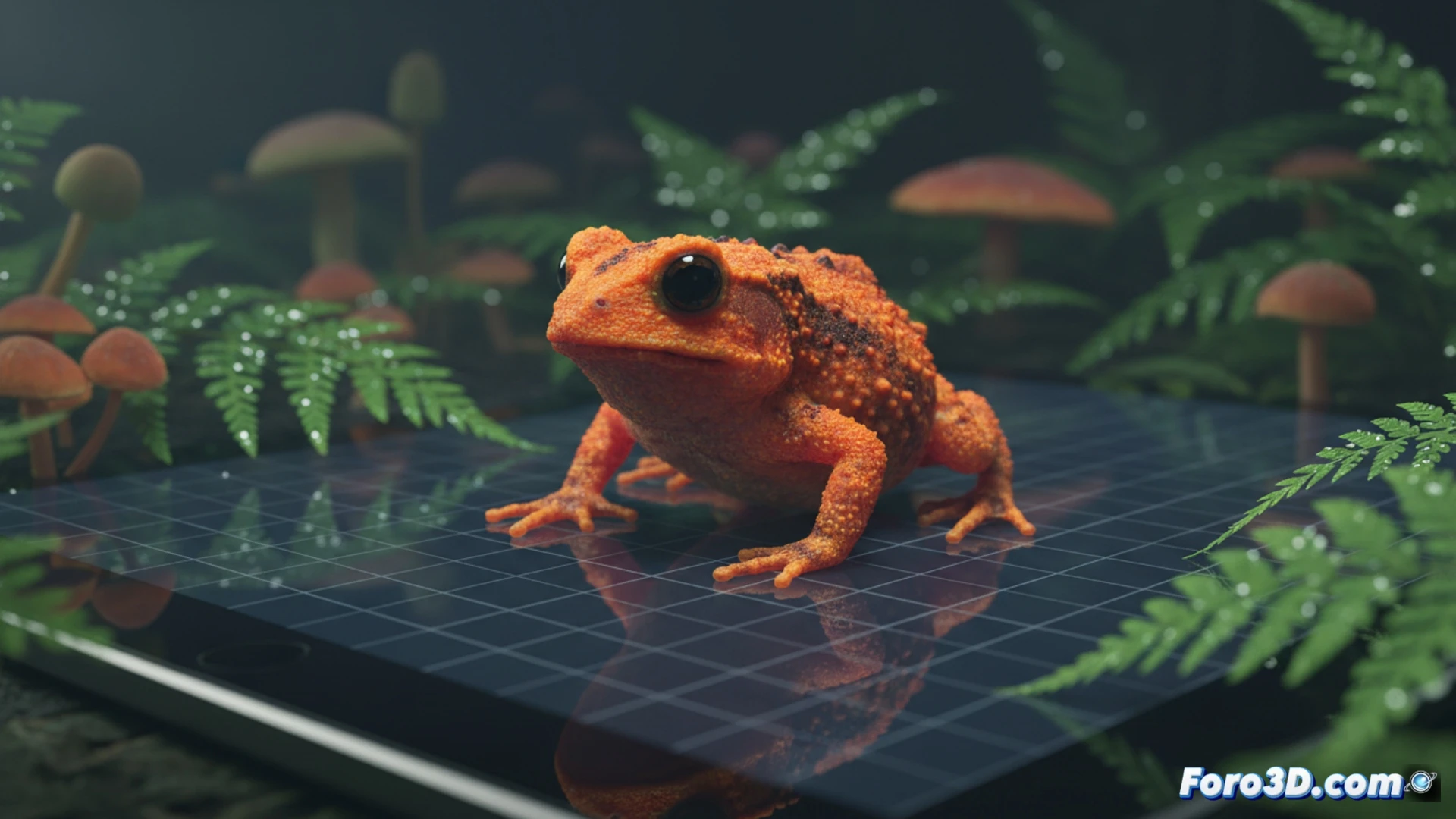
Workflow for hyperrealism at a microscopic scale 🐸
To approach the modeling of this species, it is crucial to work with micro-CT references and high-magnification photography. The base geometry must start from a subdivided volume with an extreme level of detail in the limbs, given that its hind legs lack functional toes; this involves sculpting nearly flat vestigial phalanges. Texturing requires displacement maps that reproduce the skin's granularity, using an SSS (subsurface scattering) material to simulate the translucency of its tiny body. Rigging must be articulated with precise constraints to avoid unrealistic deformations. Habitat animation requires a particle system for leaf litter and a macro camera that, when zooming out, reveals a penny coin or a human finger as the absolute scale of 7 mm.
The paradox of size in science communication 🔬
The fascinating aspect of this project is that by enlarging the pumpkin toadlet to make it visible, we betray its essence: a being that fits on a pinky fingernail. The final interactive infographic must resolve this tension, allowing the user to dynamically scale between the detailed model and its comparison with other titans of miniaturization, such as the frog Paedophryne amauensis. Thus, 3D art not only documents nature but forces us to reflect on the limits of life and our own perception of reality.
How can high-precision 3D modeling of Brachycephalus dacnis, the smallest vertebrate in the world, help visualize its extreme anatomical adaptations that are impossible to observe using traditional microscopy techniques?
(PS: fluid physics for simulating the ocean is like the sea: unpredictable and you always run out of RAM)