The recent discovery of the Indian Fan-Fingered Gecko (Ptyodactylus sp.) in the protected forested areas of central India opens a fascinating door for scientific visualization. Its most notable feature, fan-shaped adhesive pads on its toes, represents a challenge and a unique opportunity for precise anatomical 3D modeling. This technical article explores the workflow for digitally recreating this species and simulating its adhesive capability.
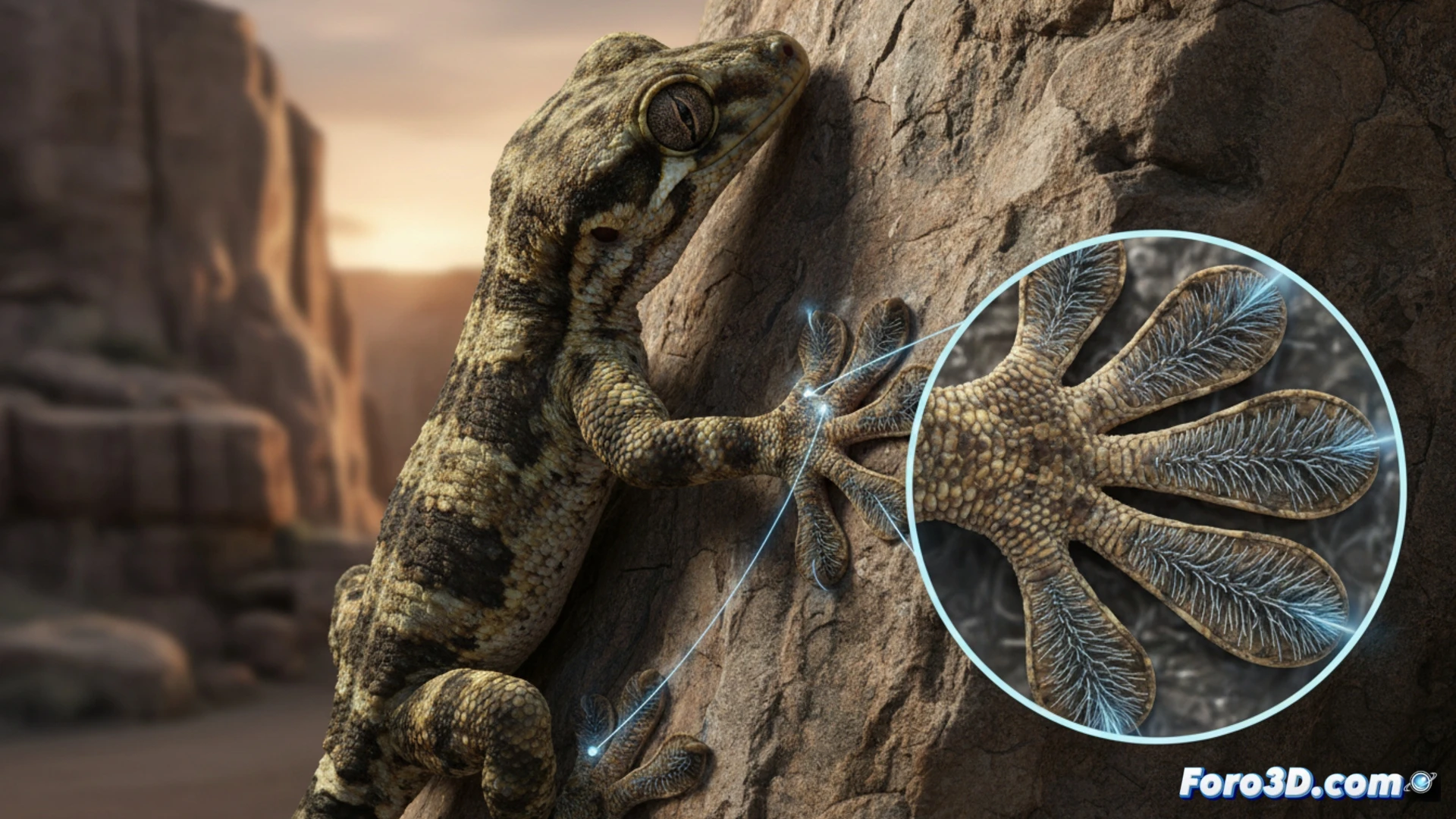
Model construction and biomechanical adhesion simulation 🦎
For modeling Ptyodactylus sp., it is recommended to start with a high-resolution photogrammetric scan of a preserved specimen, capturing the scaly texture and toe morphology. The fan structure requires detailed subdivision modeling, paying special attention to the arrangement of the lamellae. Interactive adhesion simulation can be achieved through advanced rigging that modulates surface tension and the contact angle of the pads with the vertical surface. Tools like Blender's physics engine or Houdini allow recreating the Van der Waals forces that explain their climbing ability. A particle system should be included to visualize pressure distribution in the contact area.
Educational applications and anatomical comparisons 🔬
This model is not only ideal for scientific documentaries but also allows for direct anatomical comparison with other geckos, such as the Tokay Gecko. By visualizing the protected forested habitat of India, the evolution of these unique pads can be contextualized. The resulting 3D representation becomes an interactive educational tool, allowing biologists and students to explore the biomechanics of adhesion without needing a physical specimen, thus promoting outreach and non-invasive research.
What technical challenges does capturing the three-dimensional microgeometry of the adhesive pads of Ptyodactylus sp. through photogrammetry or laser scanning present, and how does this affect the model's fidelity for simulating its adhesive biomechanics in a scientific visualization environment?
(PS: modeling manta rays is easy; the hard part is making them not look like floating plastic bags)