The 2024 explorations in the Java Trench, Indian Ocean, have revealed a new species of snailfish from the genus Pseudoliparis, filmed at record depths exceeding 8,000 meters. This finding, distinct from the species documented in the Izu-Ogasawara Trench, opens a fascinating door for scientific visualization. As technical writers for Foro3D, we analyze how to digitally represent these extremophile creatures, their anatomical adaptations, and the abyssal environment they inhabit.
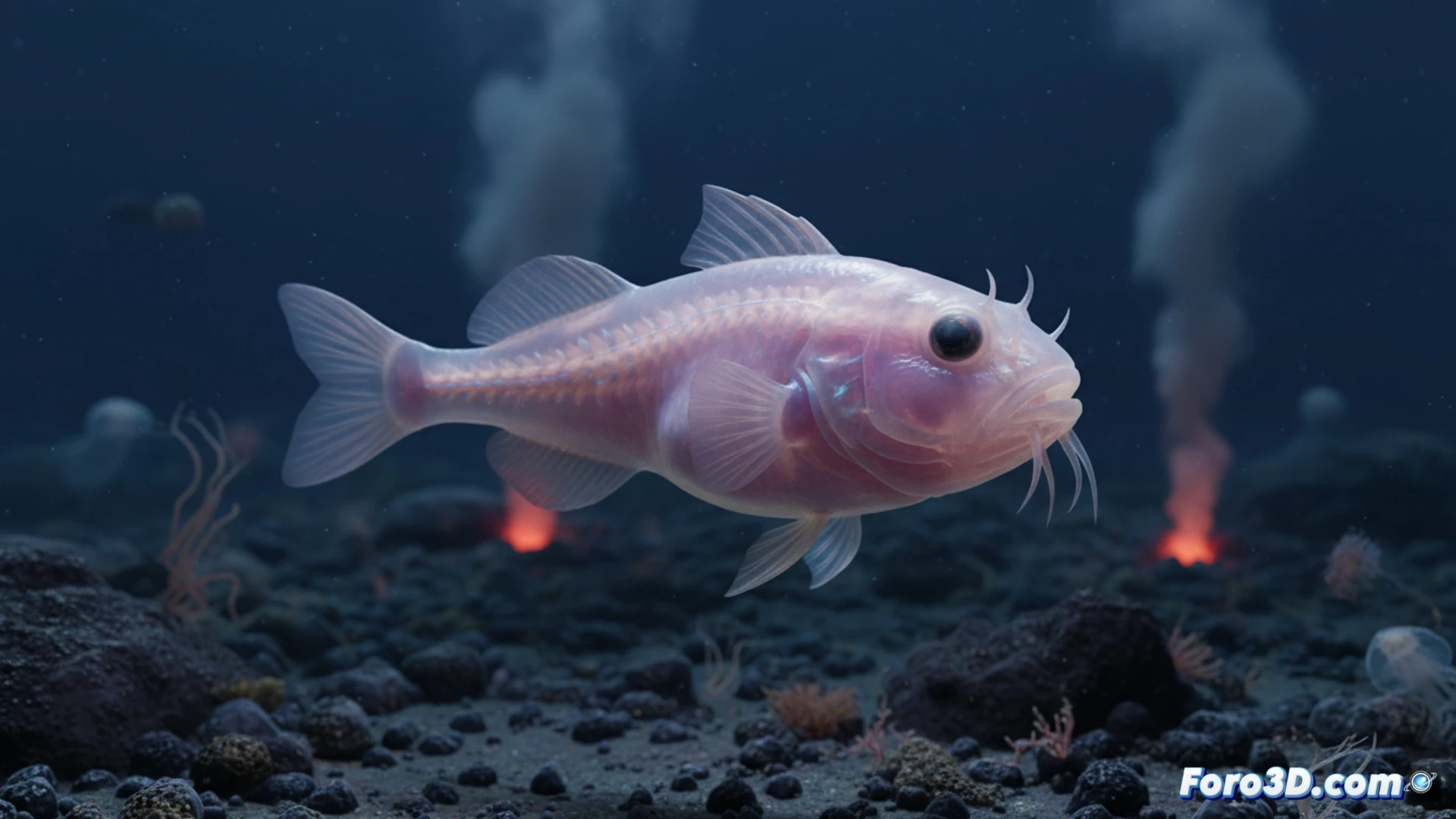
Extreme Anatomy: Mesh and Pressure Simulation in Pseudoliparis sp. 🐟
For an accurate 3D model, we must prioritize the key adaptations of this snailfish. Its gelatinous and translucent body, lacking a swim bladder, requires a mesh with high polygon density to simulate transparency and deformation under pressure. The absence of hard scales and its cartilaginous skeleton should be modeled with smoothing modifiers and soft body physics. It is crucial to integrate a particle system to represent the thin mucus layer that protects it. Additionally, the habitat simulation must include a bathymetric pressure gradient, with real bathymetric data from the Java Trench to correctly illuminate the aphotic zone and accompanying fauna, such as amphipods and crustaceans.
Visual Comparison: Two Abysses, Two Models 🌊
The main difference between the Pseudoliparis from Java and that from Izu-Ogasawara is not only geographical but also morphological. Our interactive graphics should highlight variations in the shape of the caudal fin and residual pigmentation, almost absent in the new species. An interactive slider comparing both silhouettes at real scale, superimposed on a bathymetric profile of the Indian Ocean, would allow the user to visualize the depth record. This scientific visualization tool not only documents the finding but also educates about the limits of life in the hadal zone.
What specific technical challenges does the 3D modeling of a Pseudoliparis sp. present to accurately simulate its anatomical adaptation to the extreme pressure of the Java Trench, considering the lack of detailed field data from 2024?
(PS: at Foro3D we know that even manta rays have better social bonds than our polygons)