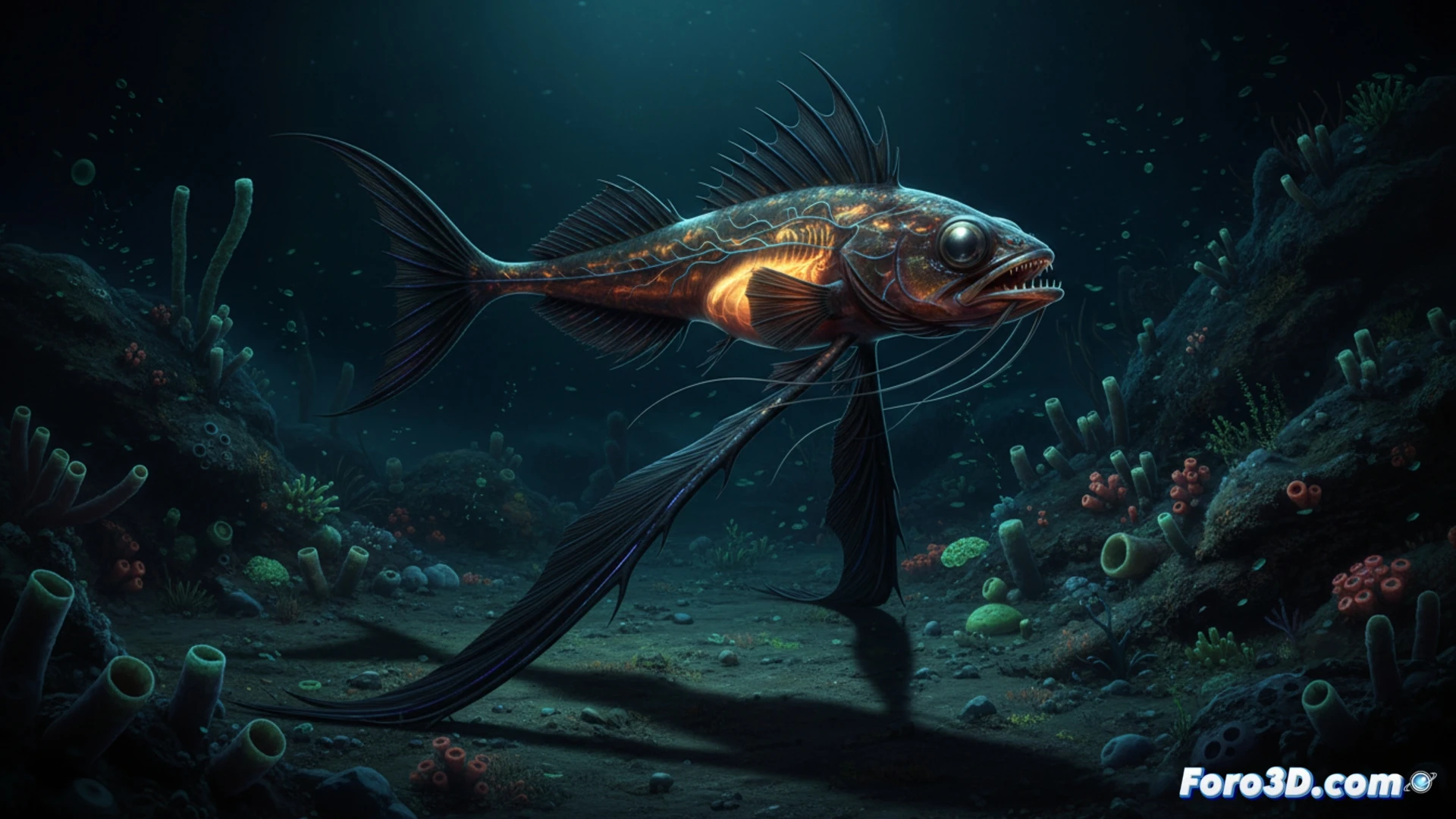
The recent expedition in the abyssal plains of Chile during 2024 has revealed an unusual variant of Bathypterois sp., notable for its extreme dark pigmentation in its fins. For the scientific visualization community, this finding represents a fascinating technical challenge: modeling the anatomy of an ambush predator that inhabits depths where sunlight does not penetrate. This article proposes a workflow to recreate its unique morphology, its bathyal environment, and its hunting strategies through 3D simulation.
Anatomical Reconstruction and Pigmentation Simulation 🐟
The first step is to model the skeletal and muscular structure of Bathypterois sp., paying special attention to its elongated pectoral and pelvic fins, which act as anchoring tripods in the sediment. The 2024 variant requires detailed work on the fin ray shaders, as the concentrated melanin generates almost total light absorption in the visible spectrum. To simulate its behavior, we must program a particle system that mimics benthic plankton, activating the dorsal fins as bioluminescent lures. Integrating bathymetric data from the Chile Trench, with depth maps of up to 4,500 meters, allows correctly positioning the model in a low-temperature, high-pressure environment, using procedural textures for the ocean floor.
The Value of the Unusual in Scientific Visualization 🔬
Documenting this genetic anomaly in 3D not only enriches our asset libraries but also forces modelers to research adaptive biology. Dark pigmentation in a lightless environment could indicate a camouflage strategy against the bioluminescence of prey or predators. By comparing this variant with the standard Bathypterois grallator, we can generate scientific renders that help biologists formulate hypotheses. This project demonstrates that a specific biological finding becomes a catalyst for improving our underwater lighting techniques and particle simulation in extreme environments.
As a 3D modeler, what do you consider the greatest technical challenge when accurately recreating the bioluminescence and fin transparency of the black-finned abyssal tripod fish based on data from the 2024 Chilean expedition?
(PS: if your manta ray animation doesn't excite, you can always add some documentary music from channel 2)