The discovery in 2024 of the Nazca Mouse Fish (Coelorinchus sp.) in the Nazca Trench represents a milestone for ichthyology. Its elongated snout and heavily armored scales present a fascinating technical challenge for scientific visualization. This article explores how to create an anatomically accurate 3D model of this species, using data from recent expeditions to generate renders that highlight its unique adaptations to abyssal depths.
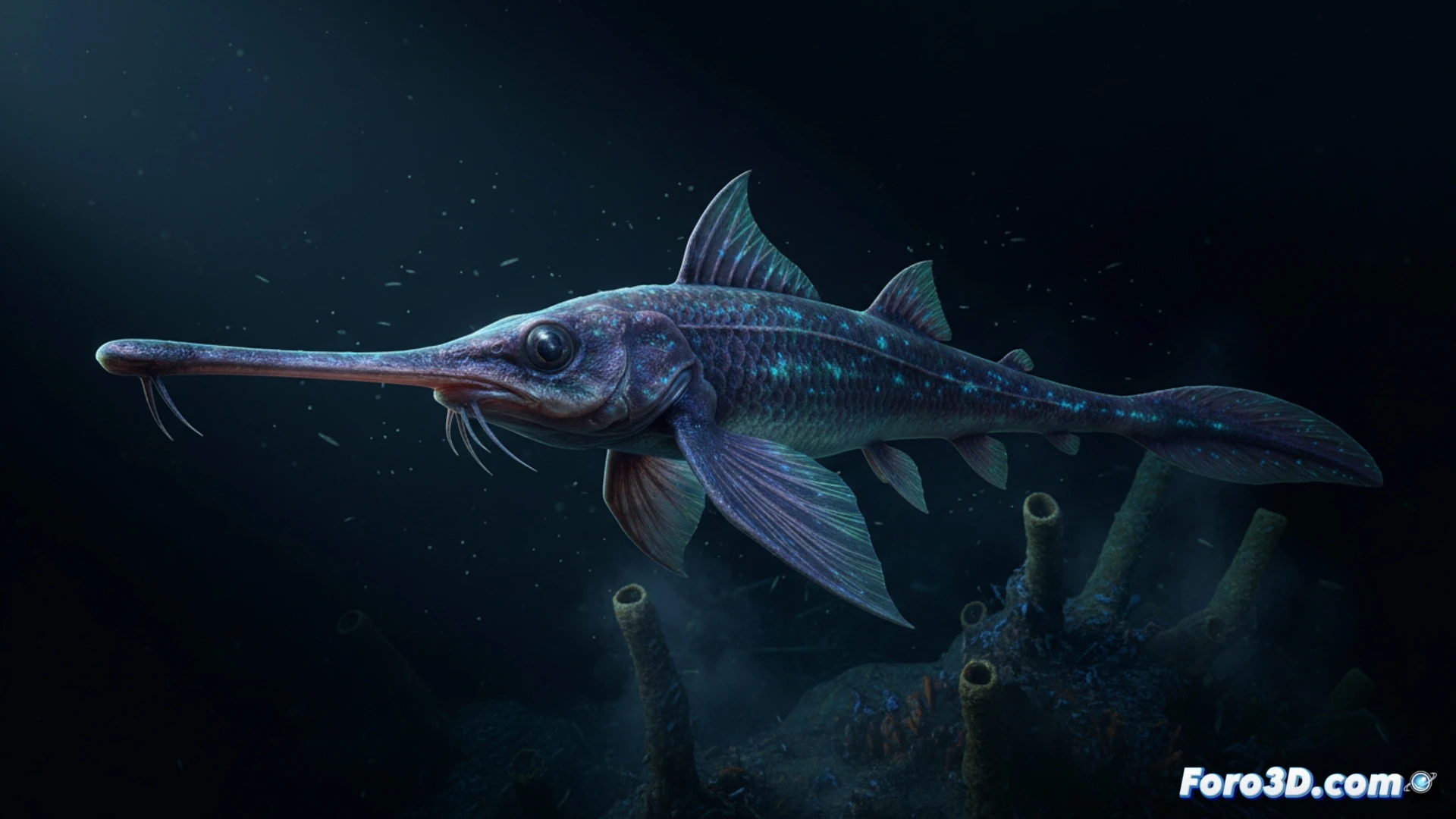
Anatomical Renders and Armored Scales in High Resolution 🐟
To replicate the texture of the ctenoid scales of Coelorinchus sp., it is crucial to employ a workflow based on scanning type specimens or high-resolution photogrammetry. The elongated snout, or rostrum, must be modeled with precise curvature, as it houses key sensory organs for hunting in the dark. I suggest using a particle system for the scales in Blender or Maya, combined with subsurface scattering (SSS) shading to simulate tissue translucency. The habitat animation should include a pressure and temperature gradient, recreating the environment of the Nazca Trench at over 2,000 meters depth.
Scientific Dissemination Through Interactive Modeling 🔬
An interactive 3D model of this grenadier fish not only serves taxonomy but transforms educational outreach. By integrating a 3D infographic of its classification, museums can display in real time the differences from other Coelorinchus species. The ability to isolate the snout or armored scales in a web viewer allows marine biologists and students to analyze the evolution of this species without handling fragile preserved samples. It is an invaluable tool for future expeditions.
How has the unique morphology of the elongated snout of the Nazca Mouse Fish been modeled to ensure scientific accuracy in the 3D visualization of its new species discovered in 2024 in the Nazca Trench?
(PS: fluid physics to simulate the ocean is like the sea: unpredictable and you always run out of RAM)