Scientific visualization has found a new challenge in the Gigantactis paresca, a species of abyssal anglerfish that breaks the mold of its genus by presenting two bioluminescent appendages instead of the characteristic single lure. For 3D modelers, this represents a unique opportunity to recreate a poorly documented evolutionary adaptation, where the symmetry of two lights in the total darkness of the ocean abyss redefines hunting strategies. 🐟
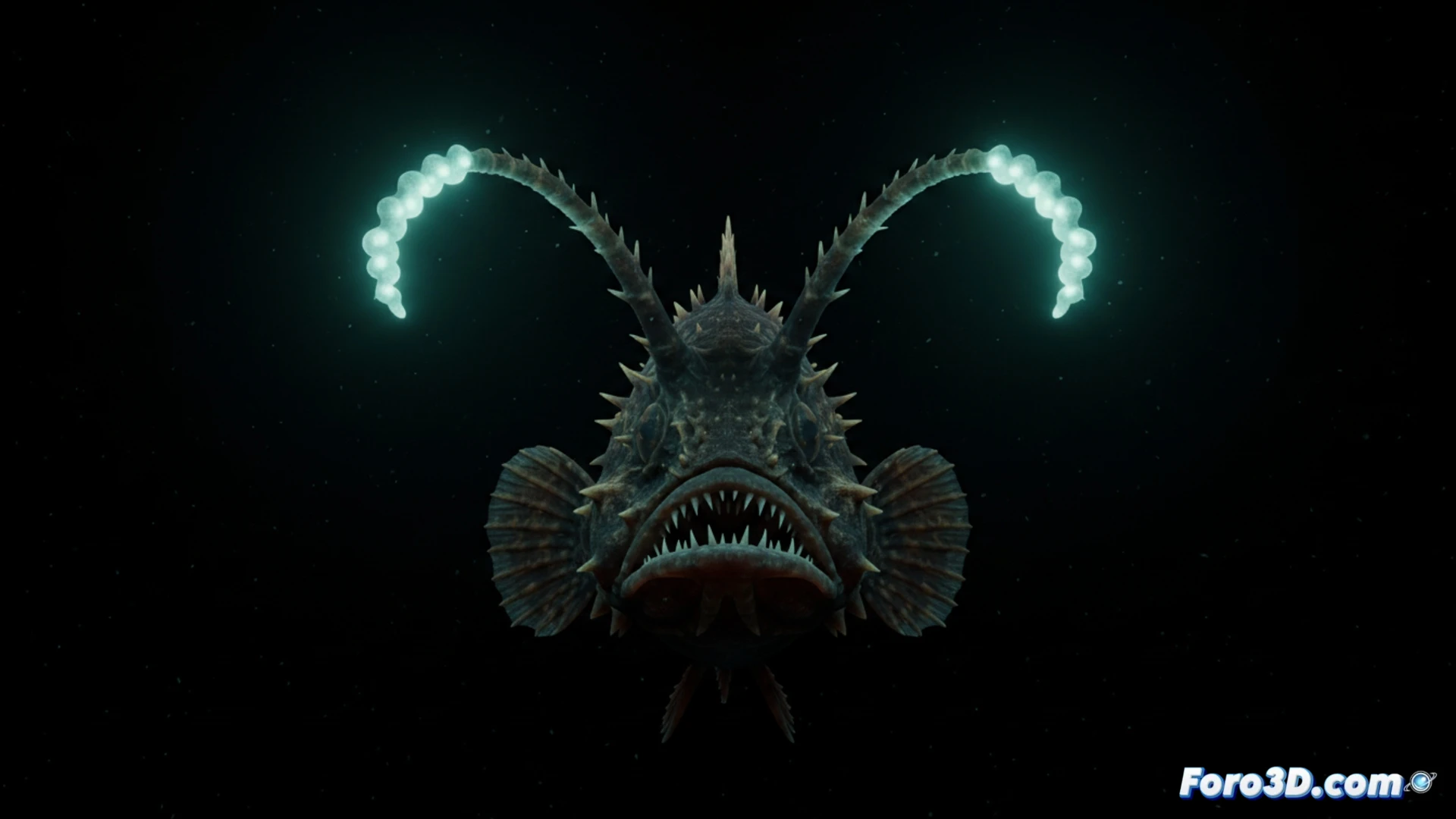
Digital Anatomy and Dual Lighting Strategy 💡
Modeling the Gigantactis paresca must prioritize the structure of the illicium, the modified dorsal appendage that in this species bifurcates into two independent branches. When working in the abyssal habitat, the technical key lies in simulating bioluminescence using emissive textures in engines like Blender or Unreal Engine, avoiding external light sources. For animation, a particle system is recommended to emulate the movement of prey around the lures, while extreme pressure is suggested through rigging that limits the range of motion, giving a sense of water density. Comparatively, when juxtaposing this model with a single-lure Lophius piscatorius (common anglerfish), a greater angular attraction coverage is observed in the double-lure species, a scientific fact that enriches the representation.
The Challenge of Darkness and Biological Precision 🌊
The total absence of sunlight at depths over 1000 meters forces the modeler to think in terms of contrast and silhouette. What is fascinating about the Gigantactis paresca is that its double lure not only doubles the attraction capacity but also creates a stereoscopic light effect that could disorient prey with simple visual systems. By including verifiable data on the wavelength of luciferin (usually blue-green in abyssal species) and the presence of photophores on its rough skin, the 3D model ceases to be an artistic piece and becomes a functional visual hypothesis on how natural selection favored this rare bifurcation.
How would you 3D model the dual bioluminescence of the Gigantactis paresca to represent its ecological function in abyssal darkness without losing scientific precision?
(PS: modeling manta rays is easy; the hard part is making them not look like floating plastic bags)