The discovery of the Ice Ghost Snailfish (Notoliparis sp.) in the abyssal trenches of Antarctica in 2025 has redefined the limits of marine life. Its translucent body and ethereal appearance present a fascinating challenge for scientific visualization. This article explores the 3D modeling techniques necessary to digitally recreate this species, enabling its anatomical study without the need for physical capture, and simulating its behavior in an extreme pressure environment.
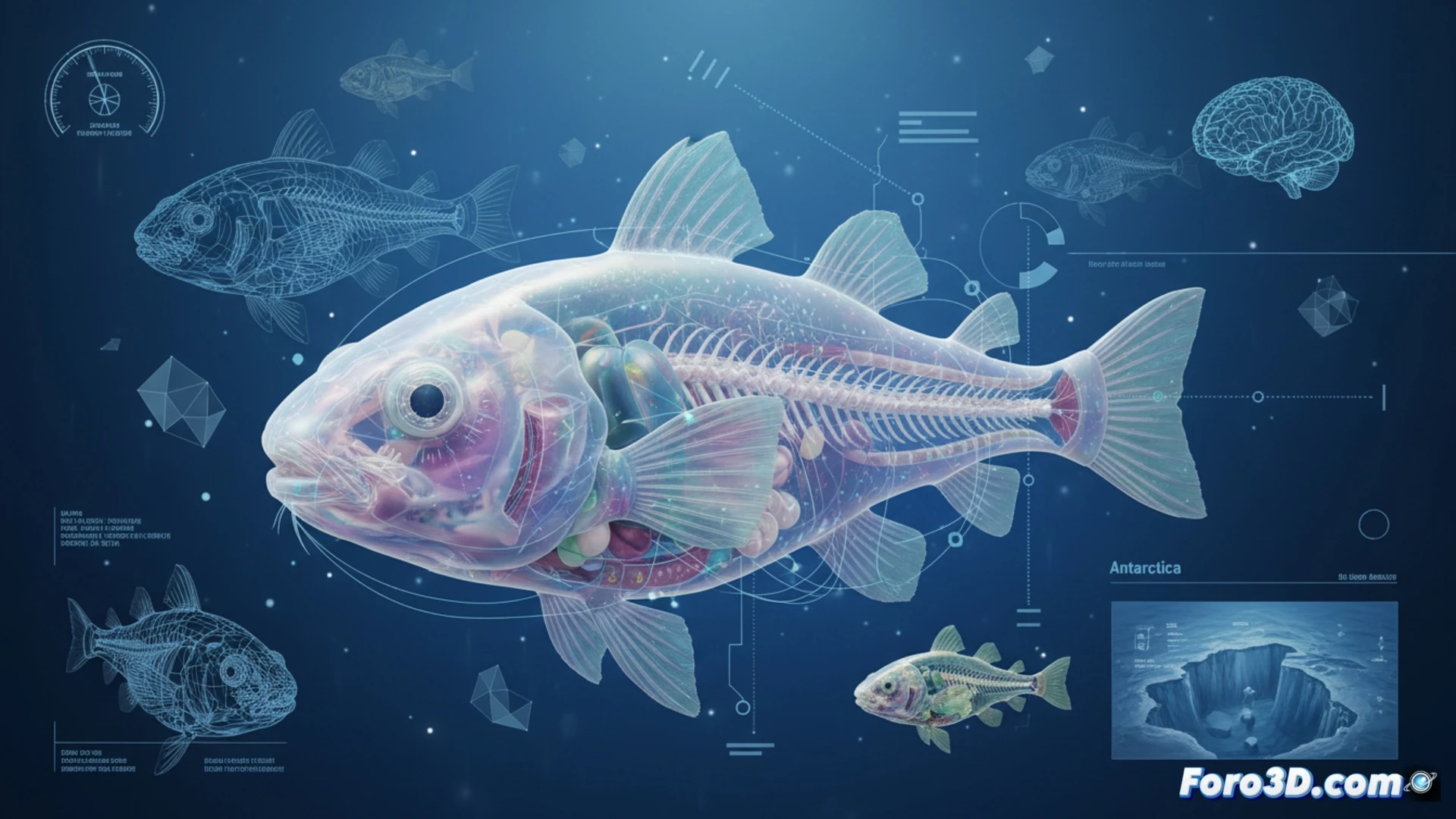
Recreating Translucent Tissues and Hydrostatic Pressure 🧊
To model the Ice Ghost, the greatest technical challenge lies in simulating its transparency and lack of pigmentation. In software like Blender or Maya, one must work with subsurface scattering (SSS) materials and volume nodes, adjusting the refractive index to mimic the gelatinous nature of its tissues. The geometry must be smooth, without scales, with low-polygon fins to simulate its buoyancy. Furthermore, the physics of the environment is crucial; pressure at depths over 7,000 meters deforms any structure. We can use fluid simulators and mesh modifiers to slightly distort the model, replicating the compression the fish undergoes. Bioluminescence scenes are achieved with low-intensity particle emitters at strategic points on the body.
The Value of the Inaccessible in the Digital Age 🌐
Scientific visualization of this fish not only satisfies aesthetic curiosity. By creating a photorealistic and animated 3D model, marine biologists can study the biomechanics of its fins and the structure of its swim bladder (or its absence) without disturbing its habitat. This approach reduces the need for traumatic capture expeditions and allows the discovery to be shared with the global community. The Ice Ghost is a reminder that digital art has become an indispensable tool for documenting and understanding life in the most extreme places on the planet.
How can the extreme transparency and ultra-fluidity of the gelatinous tissue of the Antarctic ice ghost snailfish be technically addressed in 3D modeling to accurately simulate its biomechanics in abyssal environments?
(PS: fluid physics for simulating the ocean is like the sea: unpredictable and you always run out of RAM)