The discovery of Pseudoliparis sp. in the Izu-Ogasawara Trench not only rewrites the limits of marine life but also presents a fascinating technical challenge for scientific visualization. Modeling this world depth record holder (8,336 meters) in 3D requires understanding its extreme adaptations to survive crushing pressures. Its translucent body, lack of a swim bladder, and reduced skeleton are key anatomical features we must translate into digital geometry to create a faithful and educational representation of this inhabitant of the hadal zone. 🐟
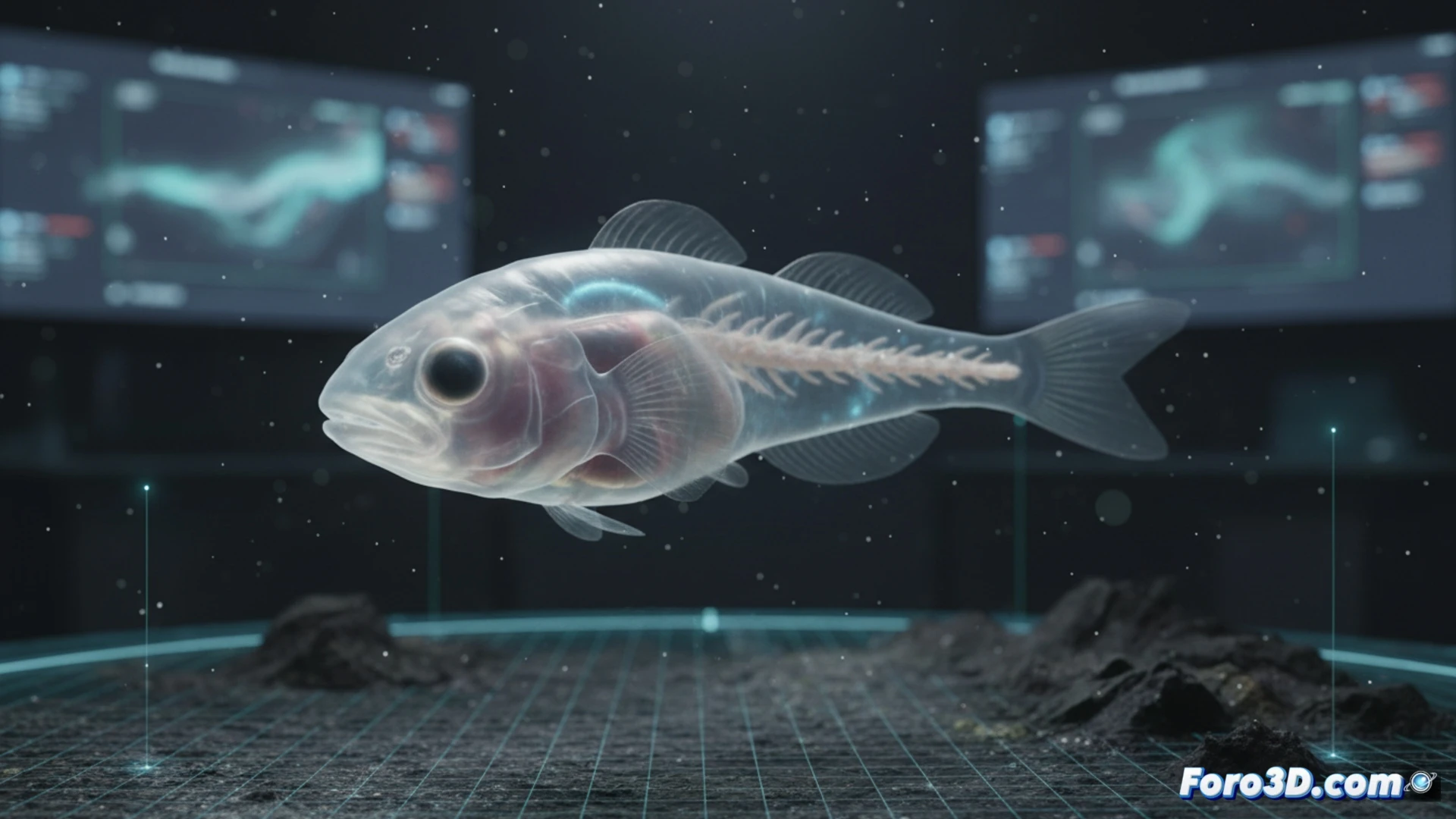
Digital Anatomy: Translucency and Absence of Swim Bladder 🧬
To model the snailfish, we must prioritize simulating its gelatinous tissues. Use a subsurface scattering shader with a high transmission value to recreate the transparency of its skin, allowing internal organs and the cartilaginous skeleton to be visible. It is crucial to omit the swim bladder from the bone structure, as this organ would collapse under pressure; instead, model a simple body cavity. The fins should be thin and undulating, almost like membranes. For the environment, integrate bathymetric data from the Izu-Ogasawara Trench using depth maps (DEM) to deform the terrain, and add dark blue ambient lighting with extreme attenuation to simulate the total absence of sunlight at that depth.
Simulating the Ecosystem in the Hadal Zone 🌊
The true value of this model lies in its context. By placing Pseudoliparis on a muddy, almost lunar seafloor, we generate a powerful educational tool. We can simulate particles of marine snow falling slowly and add amphipods as a size reference to emphasize the actual scale of the fish (about 20-30 cm). This type of visualization not only documents a record but allows biologists and students to virtually explore an inaccessible ecosystem, demonstrating how life thrives at the physical limits of our planet.
What specific technical challenges in lighting and fluid simulation arise when 3D modeling Pseudoliparis sp. to accurately recreate its appearance and behavior under the extreme pressure of 8,336 meters depth?
(PS: if your manta ray animation doesn't excite, you can always add some documentary music from channel 2)