The recent 2024 observation of the Nazca umbrellamouth gulper eel (Eurypharynx sp.) has revealed unprecedented data on its hunting technique in the abyss. For the scientific visualization community, this finding poses a fascinating challenge: translating the biomechanics of an expandable jaw into a precise 3D model. Overcoming the darkness and pressure of the abyss through digital simulation is now possible.
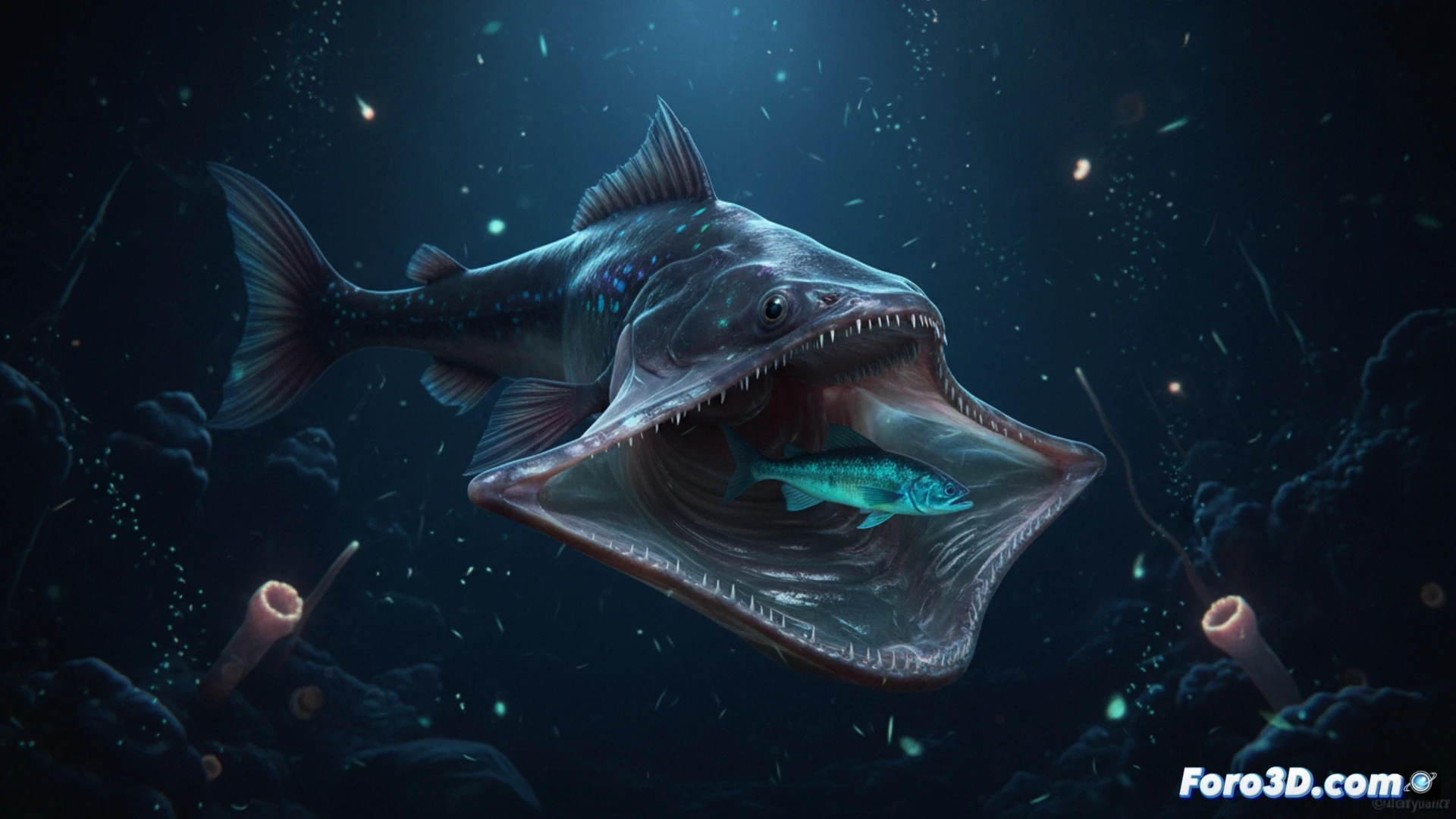
Building the Anatomical Model and Hunting Simulation 🐟
The first technical step involves reconstructing the oral cavity and skull of the Eurypharynx from tomography data. The key is modeling the elastic ligaments and joints that allow the excessive expansion of the mouth. With the new 2024 data, we can animate the ambush sequence: the fish opens its jaw in milliseconds, creating a lethal suction. Real-time simulation allows marine biologists to vary parameters such as hydrostatic pressure and water density to validate hypotheses about its energy efficiency.
The Value of Visualization in Deep-Sea Biology 🔬
Direct observation of the Eurypharynx is extremely rare and costly. An interactive 3D model not only replicates its morphology but also democratizes access to this data. By visualizing the kinematics of the expandable jaw, researchers can study the evolution of predation in extreme environments without disturbing the habitat. This approach transforms isolated data into an indispensable educational and analytical tool for understanding life in the abyss.
What specific technical challenges arise when 3D modeling the expandable jaw of the Eurypharynx from the 2024 observation data, and how can they be overcome to achieve accurate biomechanical animation?
(PS: modeling manta rays is easy; the hard part is making them not look like floating plastic bags)