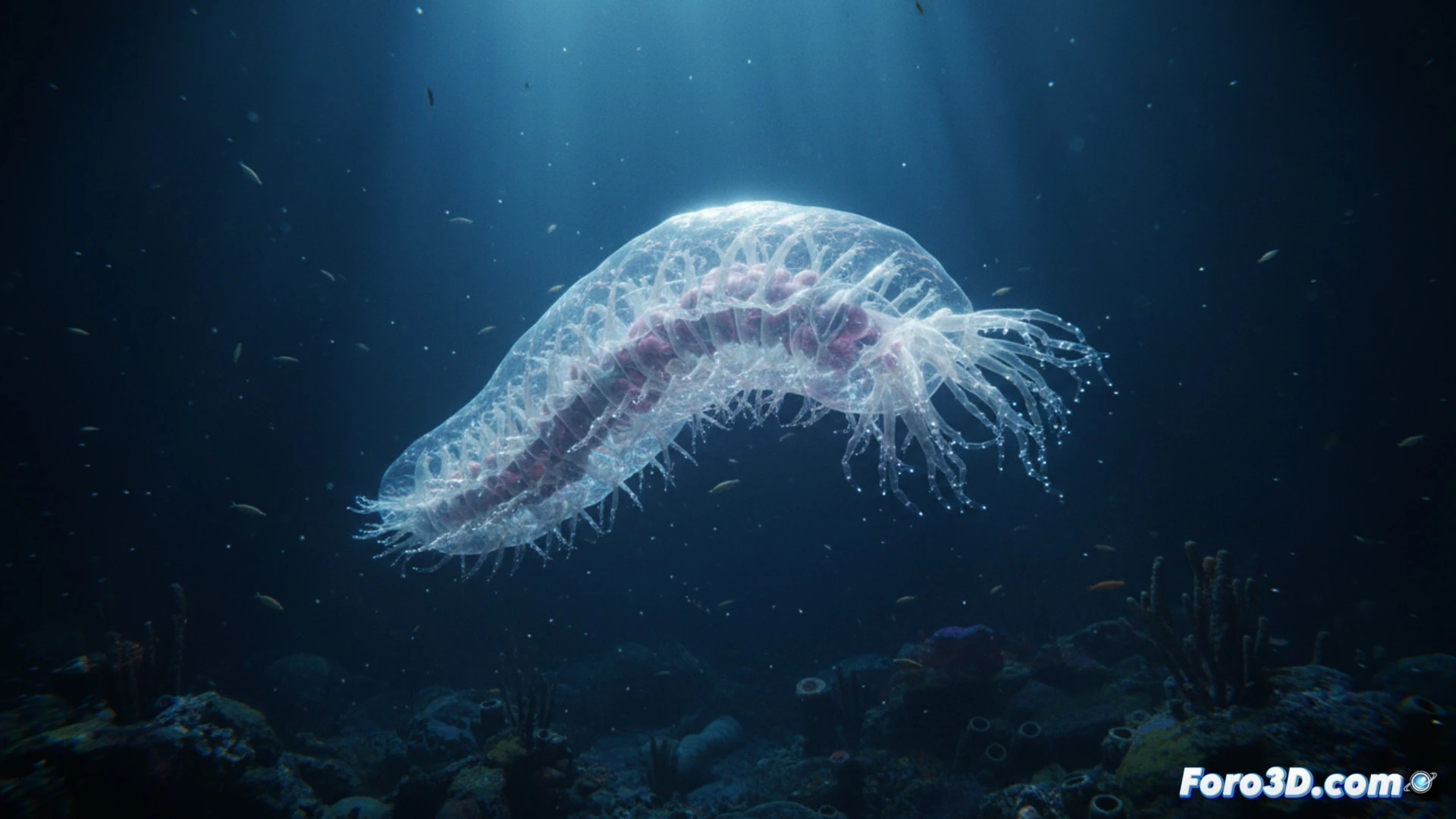
The Ocean Census 2024 expedition has revealed a fascinating creature: the Peniagone Sea Cucumber (Peniagone sp.), a nearly transparent swimming organism with a gelatinous veil. This finding offers a unique challenge for scientific visualization, as it requires advanced shading techniques to capture its transparency and ethereal movement in the depths. In this article, we will explore how to convert the expedition's biological data into a photorealistic and educational 3D model.
Model Construction and Transparency Simulation 🌊
To recreate the Peniagone in 3D, the first step is to model its elongated body and gelatinous veil, based on the expedition's images. We will use a smooth polygonal mesh approach for the body, applying a material with a high refractive index and low opacity, key to achieving transparency. The veil is modeled as a separate surface with a subsurface scattering (SSS) shader to simulate the jelly. The animation of its swimming is achieved through a sinusoidal wave deformation system, mimicking the undulating movement of its body. Finally, interactive labels, detailing its visible digestive system and habitat, are integrated through a node system in the render engine, allowing the user to explore the organism's anatomy without obstructing the visualization.
The Challenge of the Invisible in Science Communication 🔬
This project forces us to reflect on how to represent what we can barely see. The transparency of the Peniagone is not just a visual effect, but an evolutionary adaptation to abyssal darkness. By modeling this being, we not only reproduce its form but translate scientific data into an immersive experience that reveals the fragility and complexity of deep ecosystems. Scientific visualization here acts as a bridge between remote observation and public understanding, demonstrating that 3D art can be a vital tool for the conservation of newly discovered species.
As a 3D modeler, what specific technical challenges does the digital reconstruction of a transparent and abyssal organism like the Peniagone Sea Cucumber present, considering the lack of surface texture and lighting in a virtual environment?
(PS: if your manta ray animation isn't exciting, you can always add documentary music from channel 2)