The discovery of Callicebus miltoni in the Brazilian Amazon represents a milestone for primatology. This primate, identified by its vibrant fire-colored tail and a distinctive band of light gray fur on its forehead, offers a unique opportunity for scientific visualization. Below, we present a technical analysis of its 3D anatomical reconstruction, designed to educate and disseminate the richness of Amazonian biodiversity through advanced digital tools.
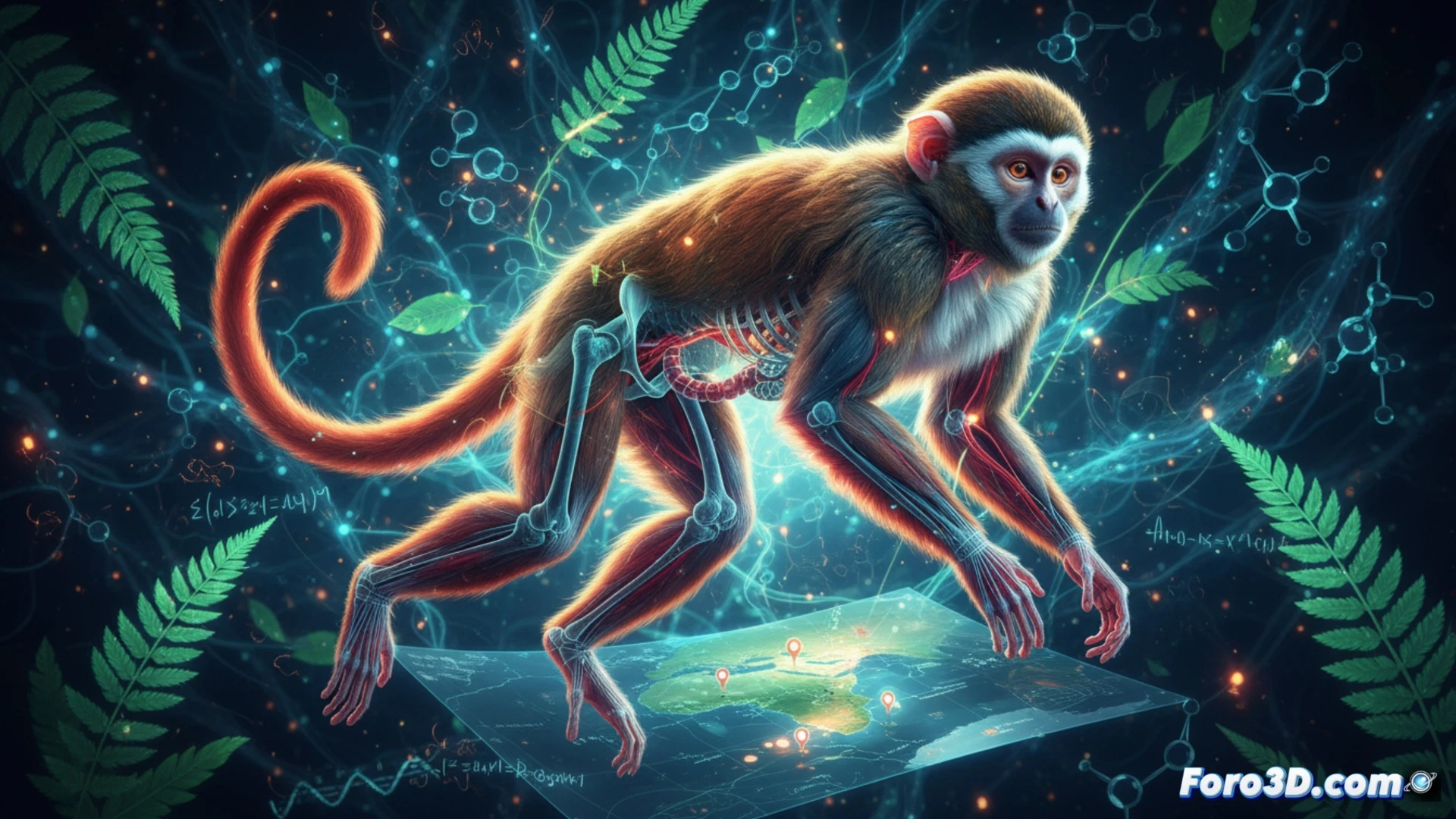
Anatomical Reconstruction and Digital Modeling 🐒
To generate a faithful 3D model of Callicebus miltoni, two key diagnostic traits were prioritized: caudal coloration and the frontal mark. The tail, an intense orange hue reminiscent of fire, was modeled using texture maps with color gradients that mimic fur reflectance under natural light. The contrasting light gray frontal band was integrated through high-resolution digital sculpting in software such as Blender or ZBrush. The general body morphology follows that of titi monkeys from the Callicebus group, but cranial proportions and limb lengths were adjusted according to biometric data from collected holotypes. The use of global illumination and PBR (physically based) shading is recommended to simulate the Amazonian understory, where light filtered through the forest canopy highlights these unique color patterns.
The Role of 3D in Species Conservation 🌿
Scientific visualization of Milton's Titi Monkey transcends aesthetics. By creating an interactive digital twin, researchers can compare this species with others of the same genus, such as Callicebus cupreus or Callicebus brunneus, without the need to handle live or preserved specimens. Furthermore, simulating its habitat in virtual reality environments allows for the study of movement patterns and social behavior. This approach not only accelerates the identification of new species but also democratizes access to knowledge, enabling anyone to explore the anatomy of a newly discovered primate from their screen, thereby fostering awareness of the urgent need to protect the Amazon.
How can 3D modeling of Callicebus miltoni contribute to the identification of cryptic morphological variations that are not detectable in museum specimens or field photographs?
(PS: at Foro3D we know that even manta rays have better social bonds than our polygons)