The recent description of Pristimantis ledum, known as the Ledum Rain Frog, opens a fascinating door for scientific visualization. Discovered in the cloud forests of Ecuador in 2024, this small frog has the ability to slightly modify its dermal pigmentation to blend into its surroundings. This phenomenon, far from being simple camouflage, represents a technical challenge for 3D modeling, requiring dynamic material systems that respond to simulated environmental variables.
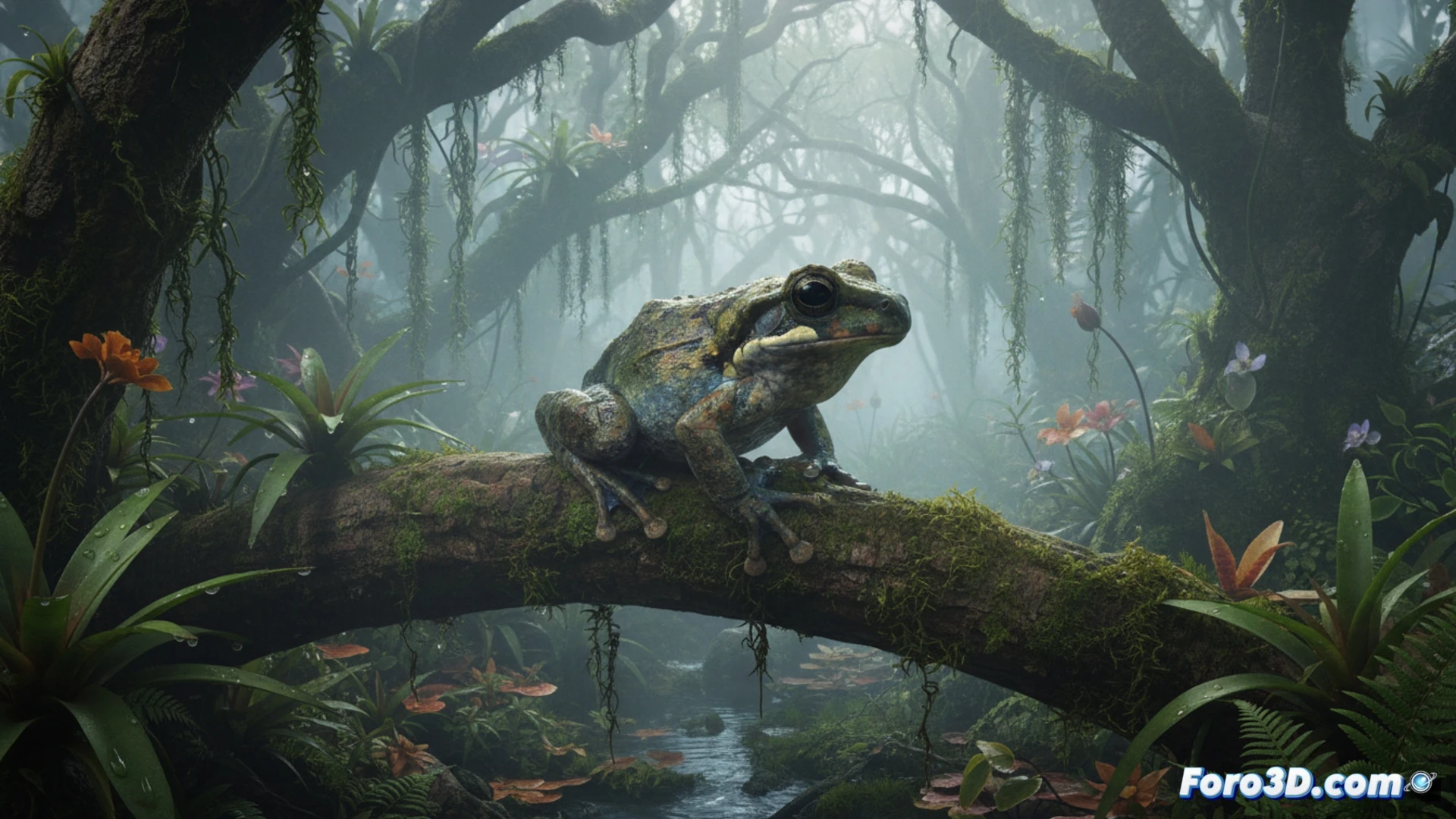
Digital reconstruction and animation of chromatic change 🦎
To faithfully represent Pristimantis ledum, the workflow must prioritize the anatomical precision of the genus Pristimantis, characterized by its direct development without an aquatic larval stage. Texturing requires a node-based approach, where diffusion and translucency maps are controlled by humidity and luminosity parameters. The animation of chromatic change is achieved through a system of morph targets that interpolate between base coloration states (moss brown) and active states (lichen green). Recreating the habitat, a cloud forest with high density of epiphytes and volumetric fog, requires the use of scattering and particles to simulate filtered light. This model is ideal for interactive applications in museums, allowing the user to alter the virtual lighting to observe the frog's chromatic reaction in real time.
From biological data to immersive experience 🌿
The true value of this project transcends mere aesthetics. By visually comparing P. ledum with other species of the genus, such as Pristimantis unistrigatus, differences in skin granularity and chromatophore distribution can be highlighted. Scientific visualization here not only documents but educates: it allows the viewer to understand how such a subtle evolutionary adaptation can be the key to survival in a fragile ecosystem. It is a powerful tool for outreach, transforming a taxonomic discovery into an interactive lesson on biodiversity and natural selection.
How would you 3D model the chromatic camouflage mechanism of Pristimantis ledum to simulate its visual adaptation in the cloud forest canopy?
(PS: if your manta ray animation doesn't excite, you can always add documentary music from channel 2)