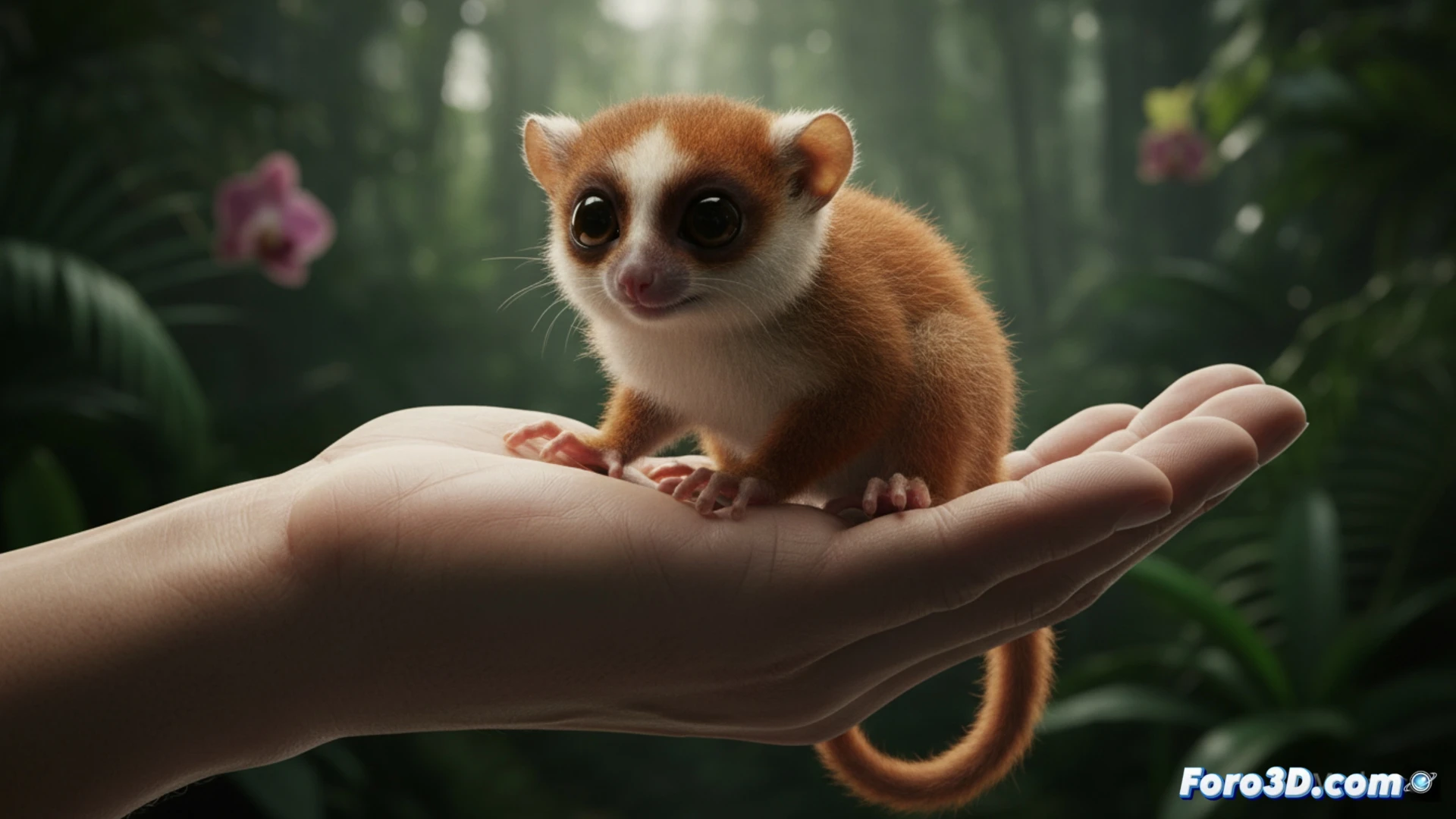
The discovery of Jonah's Mouse Lemur (Microcebus jonahi) in the fragmented forests of northeastern Madagascar represents a milestone for primatology and a technical challenge for scientific visualization. This primate, which fits in the palm of a hand, demands extremely high-precision 3D modeling to capture anatomical details that are imperceptible to the naked eye. The digital recreation of this species not only allows for its study without interfering with its fragile habitat but also serves as a key tool for disseminating information about its critical conservation status.
Anatomy, scale, and reconstruction of the fragmented habitat 🐒
To develop a faithful 3D model of the Microcebus jonahi, it is essential to start from real biometric data: a body length between 8 and 12 centimeters and a weight of around 30 grams. In the modeling software, the scale must be calibrated with visual references such as an open human hand to convey its tiny size. Texturing requires maps of fine fur and eyes adapted for night vision, as it is a crepuscular species. Furthermore, the recreation of the environment must include the fragmentation of the dry deciduous forest, with patches of vegetation and clearings generated by deforestation. Satellite data from Madagascar is integrated as height maps to simulate the real topography and risk zones.
The paradox of modeling what is going extinct 🌿
When rendering the Microcebus jonahi in its virtual environment, one cannot help but feel that we are documenting a digital ghost. Every polygon of its fur and every texture of its fragmented habitat are a testament to vanishing biodiversity. Scientific visualization allows us to get close to this creature without altering its environment, but it also confronts us with the urgency of its conservation. Modeling its small body is a reminder that, sometimes, the smallest things reveal the most about the fragility of life.
Since the Microcebus jonahi inhabits a dense and fragmented jungle environment, what specific lighting and visibility challenges would a 3D modeler face to accurately recreate its fur and tiny anatomy in a scientific context?
(PS: fluid physics for simulating the ocean is like the sea: unpredictable and you always run out of RAM)