The scientific community has confirmed the existence of a new feline species in the cloud forests of Central and South America: the Cloud Tiger Cat (Leopardus pardinoides). This discovery, based on genetic and morphological analyses, redefines the taxonomy of oncillas. For scientific visualization, this finding represents a fascinating challenge: digitally recreating an animal adapted to extreme cold climates, with dense fur and unique patterns that distinguish it from its lowland relatives.
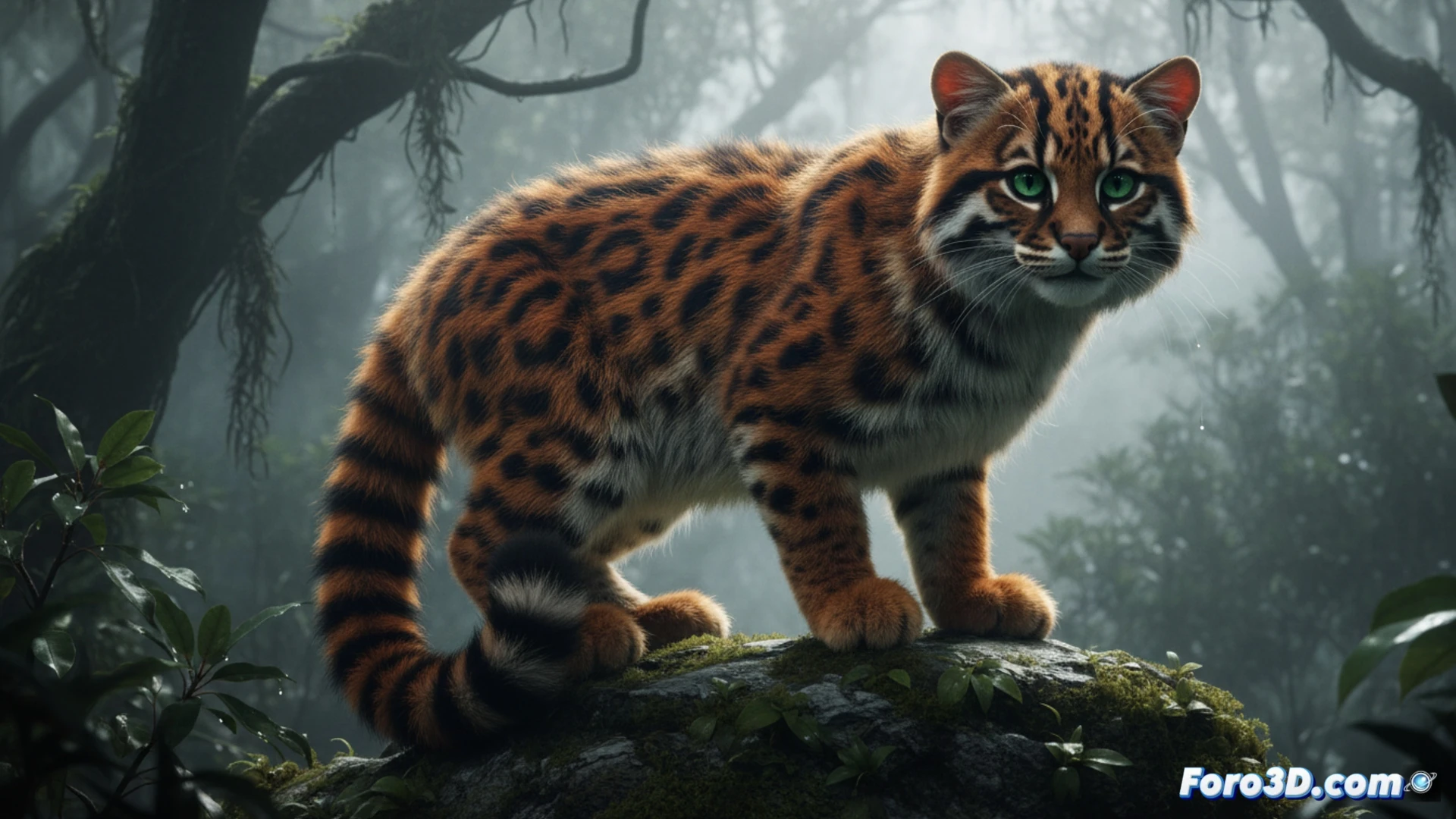
Anatomical reconstruction and fur simulation in cold environments 🧊
The 3D modeling of Leopardus pardinoides must prioritize two key aspects: cranial morphology and fur structure. Unlike other oncillas, this species has a more robust skull and slightly shorter limbs, typical adaptations of high-altitude mammals. For scientific visualization, it is crucial to use volumetric scanning and photogrammetry techniques on museum specimens. Fur simulation requires modified fluid dynamics algorithms to represent hair density, showing how the air trapped between the hairs insulates the animal in sub-zero temperatures. Additionally, distribution maps generated by GIS (Geographic Information Systems) are integrated into the model to show the fragmented habitat in cloud forests, from Costa Rica to the Peruvian Andes.
The challenge of visualizing cryptic biodiversity 🔍
This case demonstrates that scientific visualization not only documents but also discovers. By digitally separating Leopardus pardinoides from similar species, 3D modelers help biologists identify camouflage patterns and sexual dimorphism that are invisible to the naked eye. Creating a digital twin of this feline allows for behavioral simulations in high-altitude ecosystems, such as hunting on rocky slopes. For the science communicator, the 3D model is a powerful tool: it allows the public to explore an animal that literally lives in clouds and understand how evolutionary pressure shapes form and function in extreme conditions.
What 3D modeling techniques and polygonal topology do you recommend to accurately represent the fur and anatomy of Leopardus pardinoides, considering the limited photographic and field information of this new high-altitude feline species?
(PS: modeling manta rays is easy; the hard part is making them not look like floating plastic bags)