The discovery of Microcebus manitatra, a new species of mouse lemur identified in the fragmented forests of southeastern Madagascar in 2022, represents a milestone for scientific visualization. This tiny primate, whose name means the one that jumps between branches, was confirmed through genomic analyses that revealed key differences from neighboring species. For the 3D modeling community, this finding opens the door to creating precise anatomical representations that merge genetic data with digital morphology.
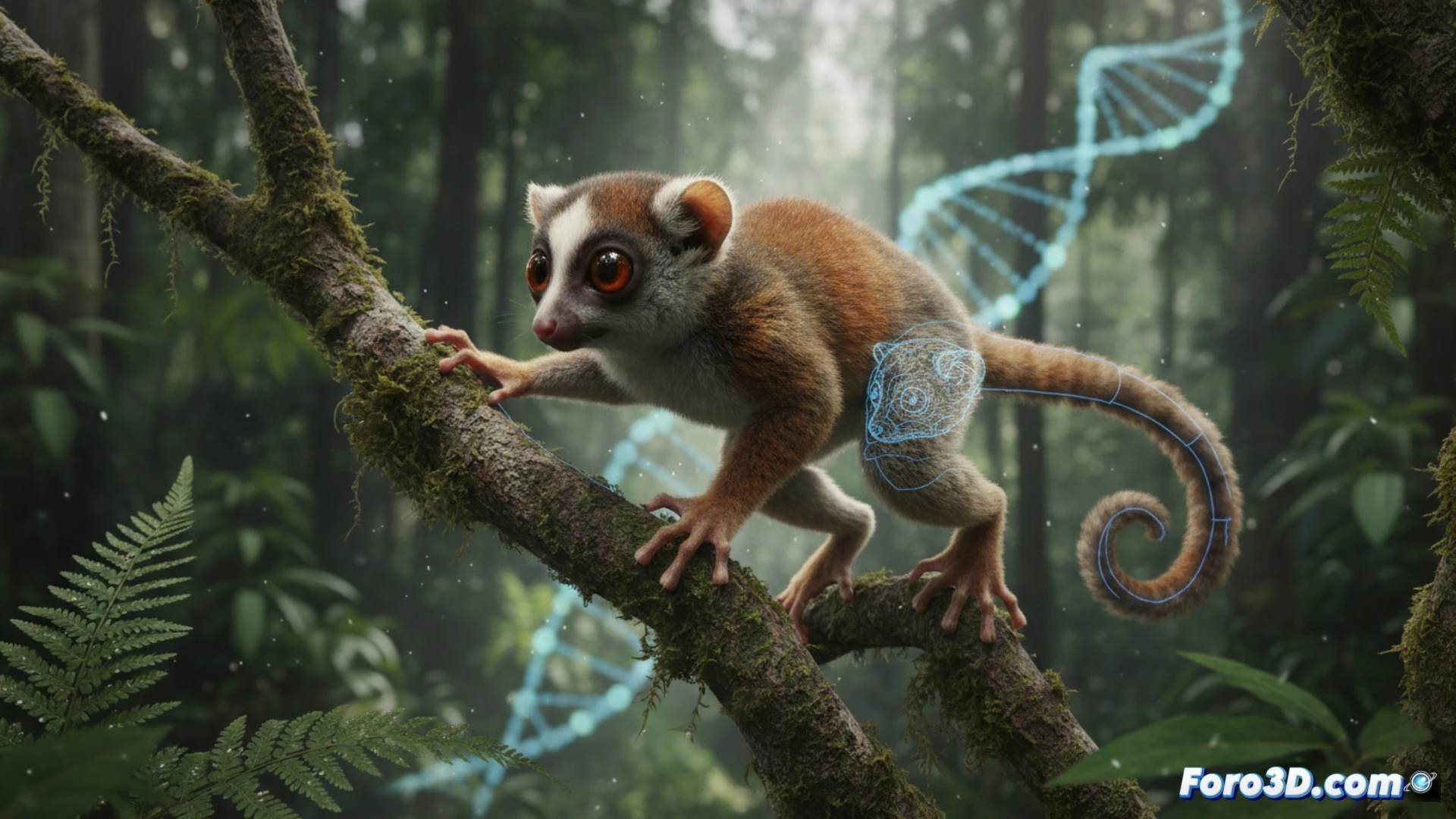
Photogrammetry and Virtual Reconstruction of Specimens 🧬
The documentation of this species directly benefits from 3D scanning technologies applied to museum specimens and live individuals. Through high-resolution photogrammetry, it is possible to capture every skin fold and every detail of the mouse lemur's fur, which weighs only 60 grams. Genomic data, integrated into parametric modeling software such as Blender or ZBrush, allows adjusting the cranial morphology and limb proportions, offering a scientifically validated virtual representation. This reconstruction is essential for biomechanics and ecology studies, as the fragmented habitat of southeastern Madagascar requires models that explain its jumping ability and adaptation.
Visualization of Fragmented Ecosystems in 3D 🌿
Beyond the primate, the environment of Microcebus manitatra demands a three-dimensional representation of its fragile ecosystem. The forest fragments of southeastern Madagascar, isolated by deforestation, can be mapped using LIDAR and satellite data to create interactive virtual environments. This visualization not only serves scientific outreach, showing the public the small size of the lemur in its habitat, but also assists researchers in planning biological corridors. 3D modeling thus becomes a critical tool for conservation, allowing the simulation of the impact of fragmentation before a newly discovered species disappears.
Since the new species Microcebus manitatra was identified through genomics, what specific 3D modeling challenges arise when reconstructing its anatomy from genetic data rather than complete physical specimens?
(PS: at Foro3D we know that even manta rays have better social bonds than our polygons)