The recent identification of Microcebus boraha on Sainte Marie Island represents a milestone in the taxonomy of Malagasy primates. For scientific visualization, this finding offers a unique opportunity to integrate genomic data with three-dimensional models. By digitally reconstructing its anatomy, we can highlight the subtle morphological differences that separate this new species from its continental relatives, facilitating its study in museums and virtual classrooms.
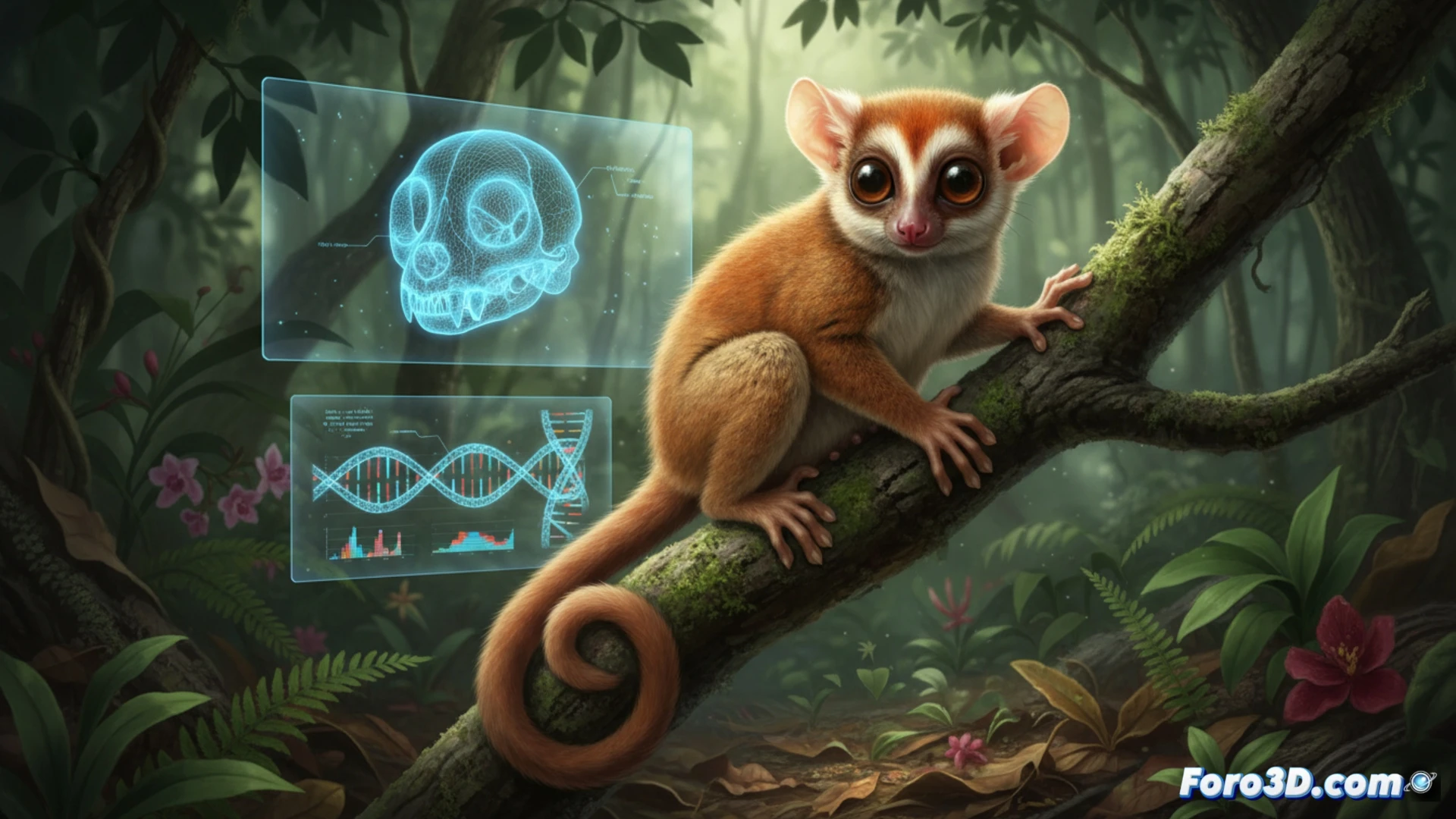
Anatomical reconstruction and interactive phylogeny 🧬
The 3D model of Microcebus boraha is built from high-resolution computed tomography scans and field photographic references. The technical key lies in mapping the cranial and dental variations that distinguish it, such as the shape of the olfactory bulb. To complement the visualization, a volumetric phylogenetic tree is generated where branches represent real genetic distances. This interactive graph allows the user to rotate the space and observe how the Boraha mouse lemur evolutionarily separates from species like Microcebus lehilahytsara, offering a clear perspective of its insular isolation.
Habitat as a narrative setting 🌿
Beyond anatomy, scientific visualization must contextualize the species. A terrain model of Sainte Marie Island, textured with satellite and vegetation data, serves as a setting to explain endemism. By overlaying genetic heat maps onto the 3D landscape, the viewer understands how geography isolated this population. This technique transforms a scientific article into an immersive experience, ideal for documentaries and exhibitions aimed at disseminating Madagascar's hidden biodiversity without resorting to excessive technical jargon.
As a 3D modeler, what specific topology and scale challenges should I consider when accurately recreating the cranial features of Microcebus boraha for scientific visualization, given that its recent genomic identification reveals subtle morphological differences from similar cryptic species?
(PS: at Foro3D we know that even manta rays have better social bonds than our polygons)