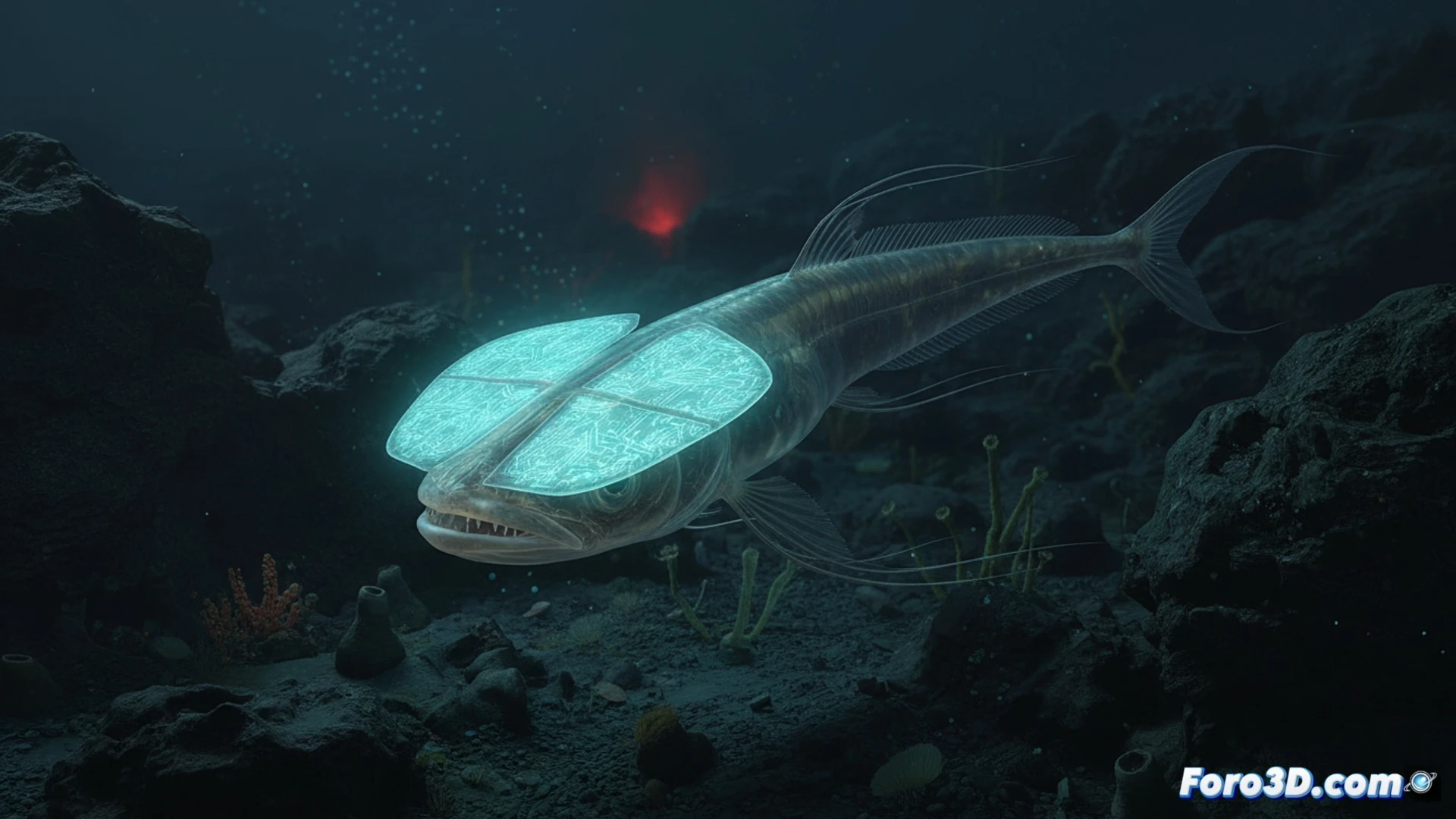
In 2024, a new observation of the dome-headed fish (Ipnops sp.) has rekindled scientific interest in one of the most extreme adaptations in the animal kingdom. This inhabitant of the abyssal depths has replaced its traditional eyes with two flat photosensitive plates located on the top of its skull. As editors of Foro3D, we explore how scientific visualization can capture this anatomical uniqueness for use in documentaries and educational environments in marine biology.
Technical strategy for anatomical and environmental modeling 🐟
To faithfully represent Ipnops sp., the first step is to model its translucent skull, paying special attention to the two dorsal plates. These structures, lenticular in appearance and brownish in color, must be simulated with materials of low reflectance but high light absorption capacity. The technical challenge lies in recreating the physiology of a flat retina that detects bioluminescence from above. At the environmental level, the scene must be immersed in the total darkness of the abyssal zone (below 2000 meters). It is recommended to use dim volumetric lighting and a particle system to simulate marine snow. Extreme pressure can be suggested through rigging that limits body articulation, giving the model a gelatinous and semi-rigid texture.
The value of rarity in scientific communication 🌊
Including a visual comparison with other deep-sea fish, such as the lanternfish or the viperfish, allows contextualizing this divergent evolution. While most abyssal species develop large eyes or bioluminescence, Ipnops sp. demonstrates a passive and minimalist solution. This 3D model is not only a tool for interactive museums but a key piece to understand how selective pressure shapes morphology. By rendering this rarity, we offer the public a direct window into the limits of biological adaptation on Earth.
As a 3D modeler, which lighting and texturing technique do you consider most effective for accurately simulating the bioluminescence of the photosensitive plates of Ipnops sp. in an abyssal environment?
(PS: if your manta ray animation doesn't excite, you can always add documentary music from channel 2)