The recent confirmation of sightings of the enteropneust Tergivelum sp., nicknamed the Yoda acorn worm for its prominent lateral flaps that emulate the Jedi Master's ears, opens a unique opportunity for scientific modeling. This article details the workflow for creating an accurate anatomical 3D reconstruction, integrating data from the new benthic locations discovered in 2024. The goal is to generate an interactive tool that allows biologists and science communicators to explore the morphology of this rare species.
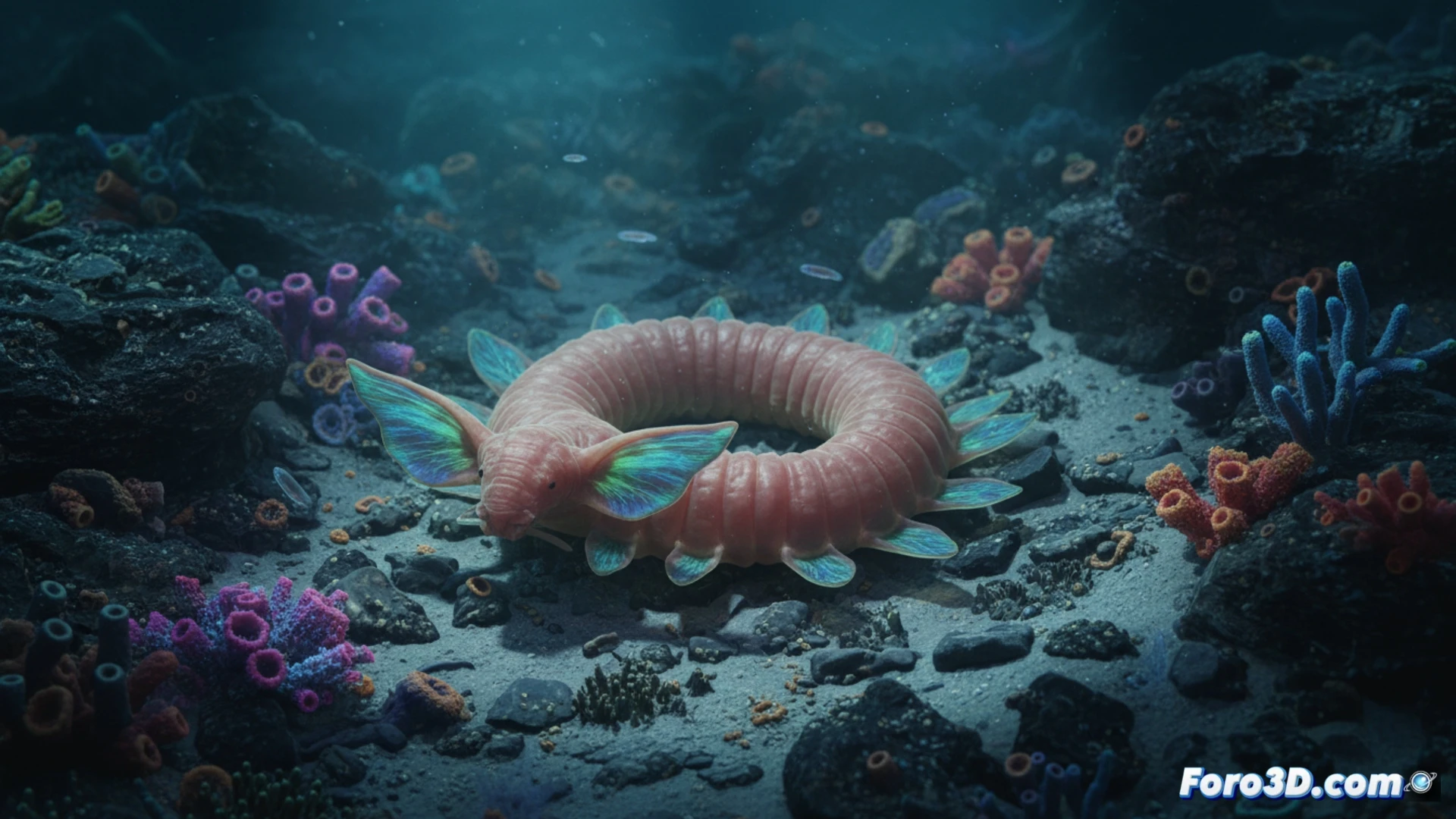
Volumetric reconstruction and topology of the lateral flaps 🐙
For the base model, photogrammetry of preserved specimens and ROV videos from the 2024 expeditions in the western Pacific are used. The mesh must prioritize the geometry of the two large lateral structures that define the species. These flaps are not simple folds; they present intricate musculature and a pattern of faint bioluminescence. In Blender or ZBrush, they are modeled as extensions of the collar (proboscis), with a smooth transition towards the vermiform trunk. The texture requires a translucent shader to simulate the gelatinous epidermis, mapping the new locations (abyssal trenches between 2000 and 3000 meters) as reference points in the 3D habitat viewer.
Comparative and ecological visualization of the enteropneust 🌊
Beyond anatomy, the project should include a comparative scene with other genera of enteropneusts such as Saccoglossus or Ptychodera, highlighting differences in gill structures and snout shape. The final visualization places Tergivelum sp. in a recreated benthic ecosystem, with particle currents and muddy substrate. This representation not only satisfies curiosity about the pop culture resemblance but also serves as a morphological atlas for future field identifications, validating the expanded geographic distribution reported in 2024.
How can the lateral flaps of the Yoda worm, Tergivelum sp., be accurately modeled to simulate its biomechanics in the 2024 habitat and validate hypotheses about their function in locomotion and feeding?
(PS: if your manta ray animation doesn't excite, you can always add documentary music from channel 2)