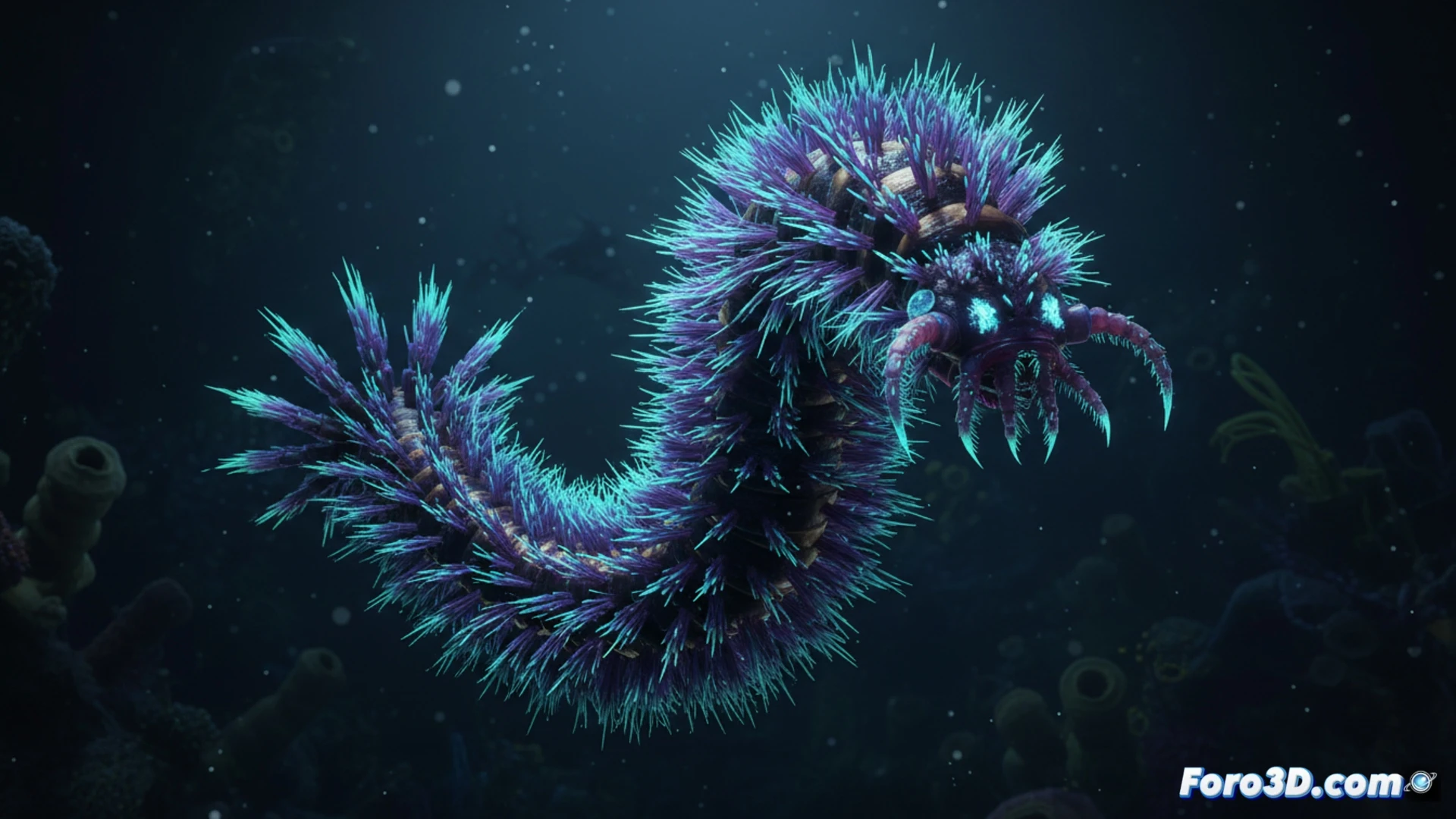
The discovery of a new polychaete worm in the Bounty Trough has captured the attention of the scientific community and digital artists. Colloquially named Sputnik due to its covering of rigid bristles that evoke the aesthetic of early artificial satellites, this Flabelligereidae presents a fascinating challenge for photorealistic 3D modeling. Its morphology, adapted to the extreme pressure of the ocean floor, requires a meticulous analysis of its anatomy for an accurate representation.
Digital Anatomy and Bathymetric Recreation 🐛
To develop a high-fidelity 3D model of the Sputnik, it is crucial to start with a detailed study of its cuticle and the arrangement of its chaetae (bristles). These structures, rigid and translucent in reality, must be recreated using subdivision geometry combined with displacement maps to simulate their glassy texture. The visual reference of the Sputnik satellites can inspire the render lighting, using hard light sources to highlight the contrast between the bristles and the soft body. Furthermore, the animation of its locomotion must integrate bathymetric data from the Bounty Trough (approximately 4,800 meters deep) to simulate the water density and gravity of the environment, achieving a slow, undulating movement realistic for an organism of the abyssal zone.
From Biology to Visual Metaphor 🚀
The comparison between a deep-sea creature and an artifact from the space race is not just a popular science resource; it is an opportunity to reflect on the convergence of forms in nature and technology. By modeling this worm, the scientific artist not only documents a species but builds a visual bridge between two remote worlds: the ocean floor and outer space. For a virtual museum, this piece not only educates about biodiversity but invites the viewer to question the limits of life and aesthetics in extreme environments.
What scientific visualization techniques were used to model the bioluminescence and transparency of the Sputnik worm's exoskeleton from data obtained in the depths of the Bounty Trough?
(PS: if your manta ray animation doesn't excite, you can always add documentary music from channel 2)