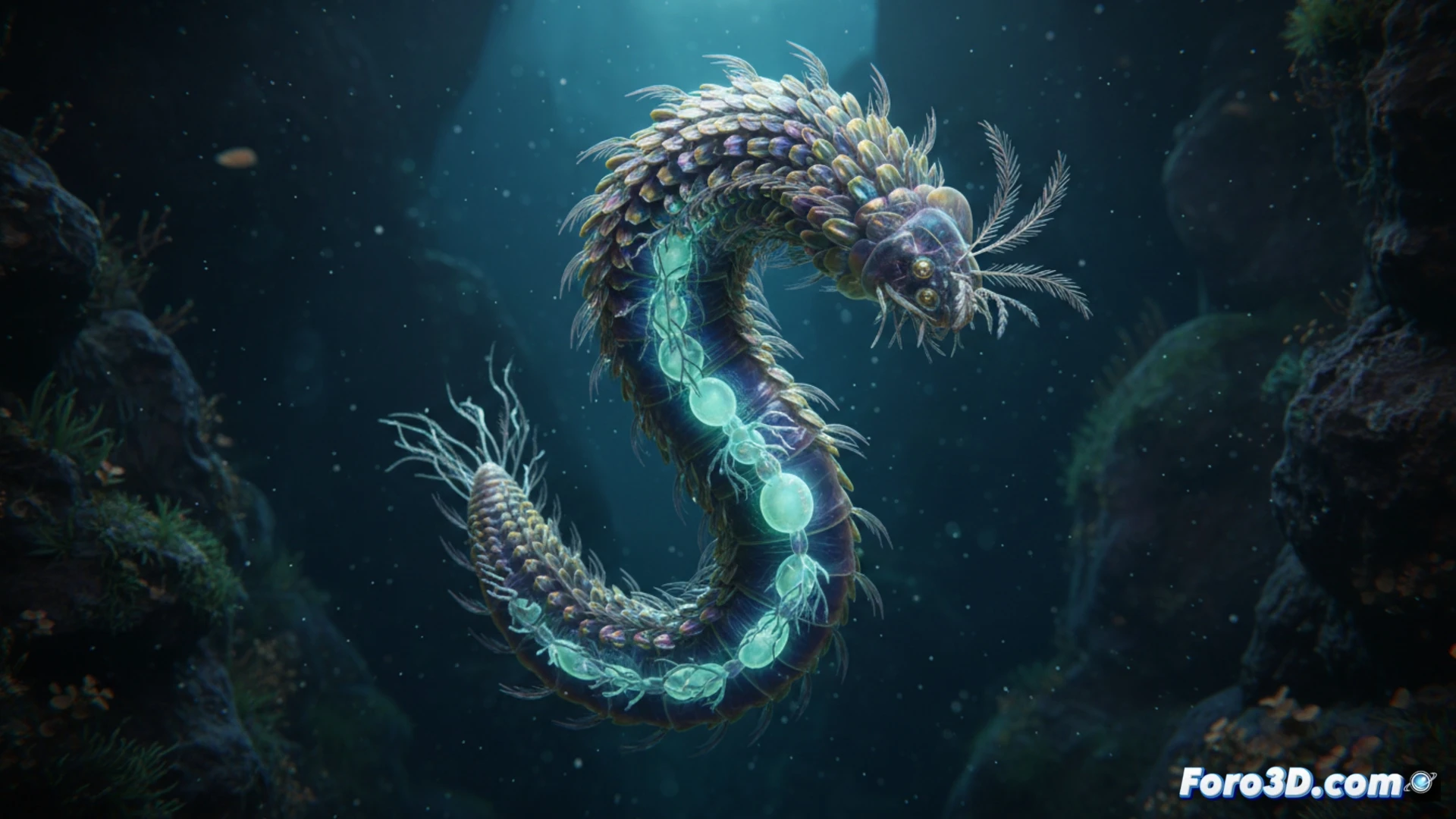
The discovery of Photinopolynoe iskrae off the coast of California has captured the attention of the scientific community due to its ability to generate a unique glow. Nicknamed Iskra (spark in Slavic), this iridescent scale worm represents a fascinating technical challenge for scientific visualization. Its anatomy, which combines reflective structures with bioluminescent organs, demands a precise approach in 3D modeling to effectively communicate its biology.
Technical Workflow for Photorealism 🖥️
To replicate the iridescence of the scales, it is recommended to use a multi-layer shader in Blender or Maya, combining a subsurface scattering material with a color gradient based on the viewing angle (thin-film effect). The geometry of the scales should be modeled with subdivisions to capture the micro-folds that generate light interference. Bioluminescence will be simulated using a particle system with point emitters of blue-green color (wavelength ~490 nm), animated with a soft pulse cycle. For the animation in the seabed environment, an HDRI volumetric lighting system should be integrated to simulate light filtered at 200 meters depth, while the worm's undulating movement will be articulated using a curve rig with spline deformation.
Educational Potential of the Model 🎓
Creating an interactive infographic comparing the structure of Photinopolynoe iskrae with other polychaetes, such as the fireworm or the nereis, allows visualizing the evolutionary adaptations of scales and photophores. This model not only serves for scientific outreach in virtual museums but also offers a didactic tool for marine biologists, facilitating the study of bioluminescence without the need for live specimens. The resulting animation can be integrated into virtual reality platforms to immerse the viewer in the worm's abyssal habitat.
What specific technical challenges does a 3D artist face when modeling the iridescence and bioluminescence of the Photinopolynoe iskrae worm to achieve a scientifically accurate representation in an animation?
(PS: at Foro3D we know that even manta rays have better social connections than our polygons)