The discovery of Macellicephala sp. in the Atacama Trench represents a milestone in hadal biology. This polychaete, an inhabitant of the deep South Pacific, presents unique adaptations to abyssal pressures exceeding 600 atmospheres. For scientific visualization, its anatomy offers a fascinating challenge: representing in 3D the chitinous scales, flexible cuticle, and modified parapodia that allow it to survive in extreme conditions. This article details the digital reconstruction process of the species.
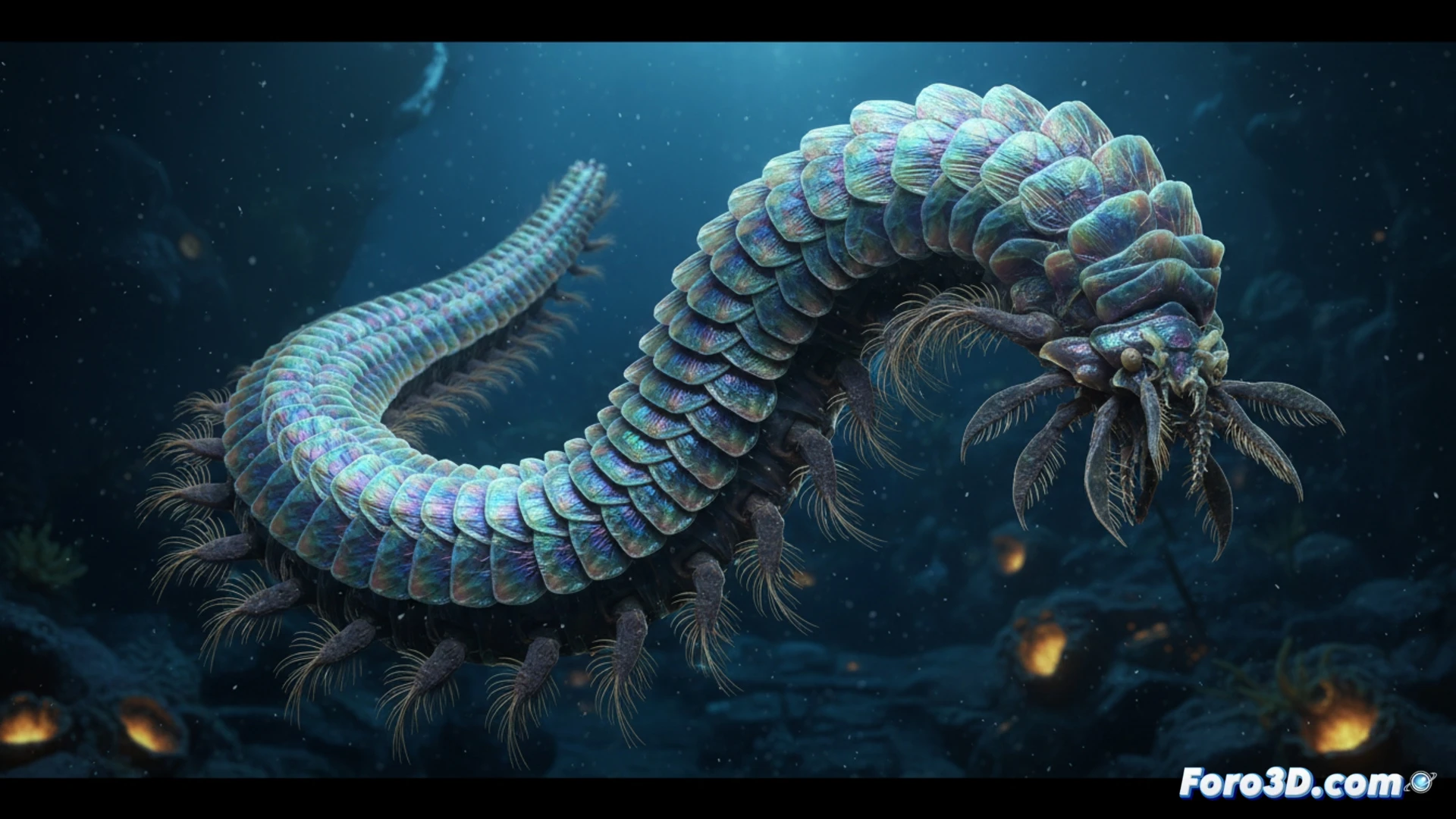
Anatomical Reconstruction: Scales, Cuticle, and Parapodia in Blender 🧬
Modeling Macellicephala sp. requires a modular approach. We start with body segmentation, using a base mesh of 12 segments, each with a pair of biramous parapodia. The dorsal scales (elytra) are key: they must be modeled as overlapping plates with a high-frequency texture to simulate keratinization. The cuticle, on the other hand, benefits from a translucent shader with a low roughness value to emulate hydration under high pressure. For ecosystem simulation, a muddy sediment background with suspended particles (turbidity) and a lighting gradient that fades at 6000 meters is recommended. Locomotion animation should avoid abrupt movements; hadal polychaetes move via slow peristaltic waves. A rig with bones influenced by a curve modifier is the most efficient technique.
Cross-Sections and Evolutionary Comparison 🔬
Representing cross-sections in the thoracic segment reveals the circular and longitudinal musculature, essential for hydrostatic pressure. Comparing this model with that of a shallow-water polychaete (such as Nereis virens) allows visualizing the reduction of gills and the thickening of the cuticle in the hadal species. This comparison not only enriches the visual piece but also validates biological hypotheses about convergent evolution in ocean trenches. A day/night cycle render helps contextualize the total absence of sunlight in its habitat.
What was the main technical challenge when 3D modeling the morphological adaptations of Macellicephala sp. to withstand the extreme pressure of the Atacama Trench?
(PS: fluid physics for simulating the ocean is like the sea: unpredictable and you always run out of RAM)