The echiuran known as the spoon worm inhabits the Atacama Trench, an extreme ecosystem thousands of meters deep. Its most notable feature is an extremely long proboscis that it extends over the sediment to collect detritus. This behavior, along with its unique anatomy, represents a fascinating challenge for scientific 3D visualization, allowing for precise recreation of its adaptations to abyssal pressure and darkness.
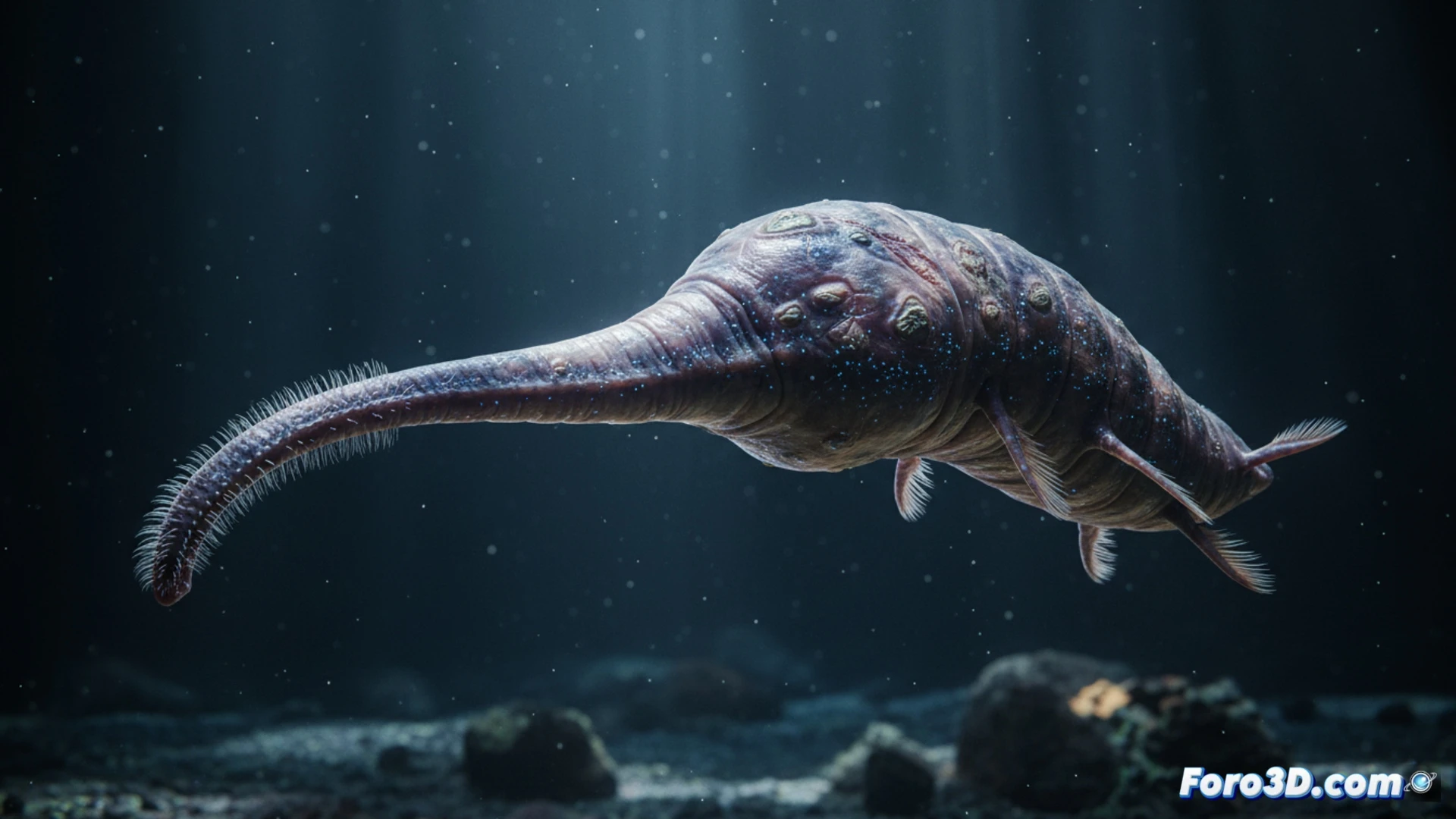
Building the Anatomical Model and Simulating the Bathyal Environment 🐙
For modeling, one must start with a base mesh of the echiuran's cylindrical body, integrating the proboscis as a dynamic element with advanced rigging to simulate its extension and retraction. Texturing requires displacement maps to replicate the rough cuticle and sensory papillae. The Atacama Trench environment demands volumetric lighting with extreme attenuation, suspended sediment particles, and a color gradient reflecting the total absence of sunlight. It is crucial to incorporate pressure data (exceeding 600 atmospheres) and temperature (close to 2 degrees Celsius) as visual metadata, through overlaid graphs or changes in the density of the simulated water.
The Value of Biological Precision in Scientific Animation 🔬
Animating the extension of the proboscis is not just a technical exercise; it is a tool for understanding the worm's energy efficiency in a resource-scarce environment. By visualizing how the animal sweeps the seafloor with slow, calculated movements, we can communicate the fragility of these ecosystems. A precise model, validated with real biological data, transforms a zoological curiosity into an educational resource on extreme adaptation and conservation of ocean trenches.
How to 3D model the elastic morphology of the spoon worm from the Atacama Trench to visualize its adaptation to extreme pressure without losing anatomical detail in scientific rendering software
(PS: fluid physics for simulating the ocean is like the sea: unpredictable and you always run out of RAM)