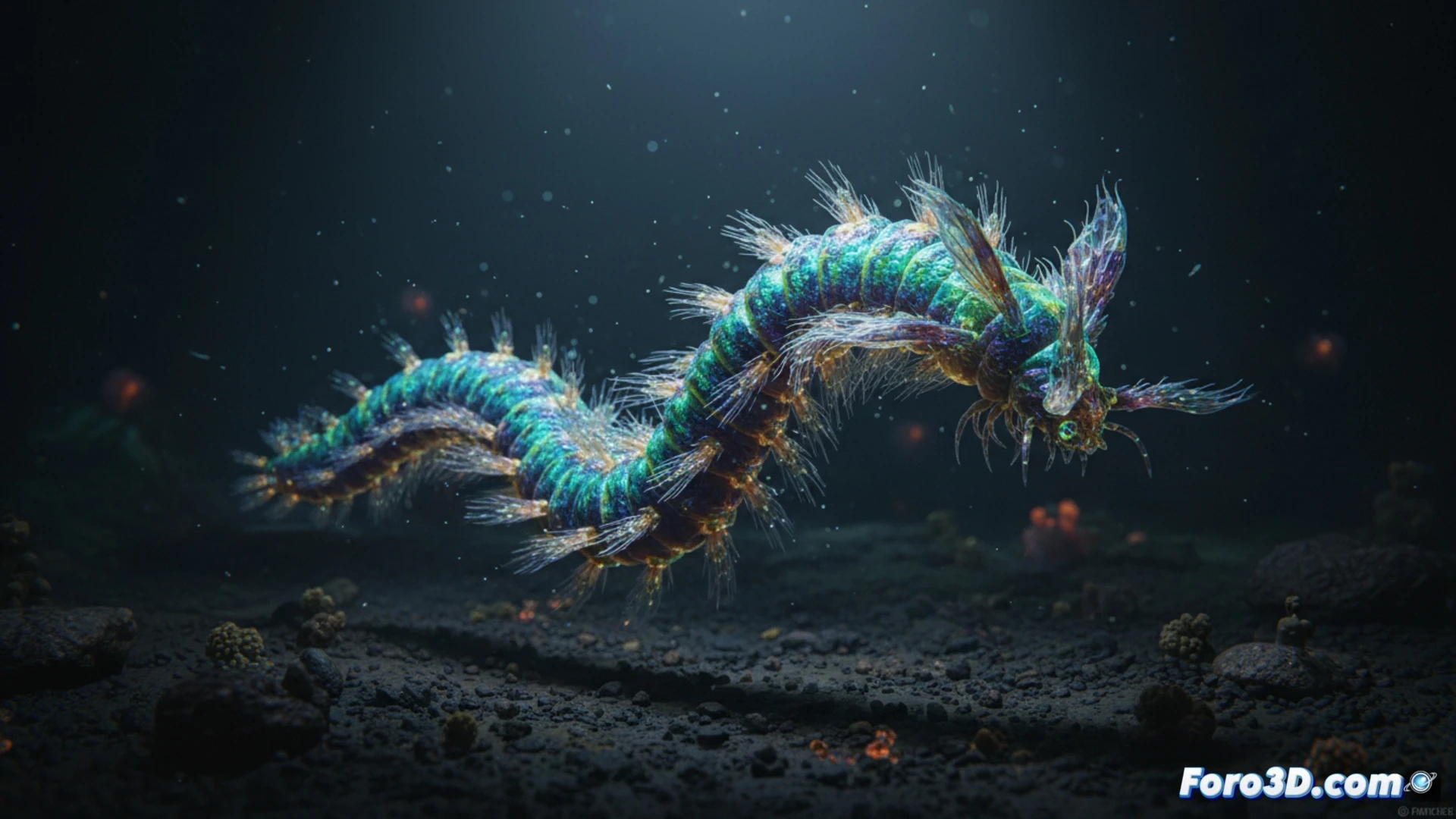
The discovery of Pectinereis strickrotti in 2024 has revolutionized marine biology. This polychaete, which inhabits the ocean depths, possesses parapodia that shine with an iridescence similar to feathers, a visually striking feature. For scientific visualization specialists, it represents a technical challenge: recreating in 3D not only its segmented anatomy, but also the texture and reflectance of its luminous limbs, as well as simulating its unique locomotion near the seabed.
Modeling and Simulation Techniques for Iridescent Parapodia 🐛
Modeling Pectinereis strickrotti requires a multidisciplinary approach. The body geometry is built using splines and organic meshes, replicating the segmentation of annelids. The critical point is the parapodia; their iridescence is achieved with multi-layer shaders that simulate light interference in biological nanostructures. Animating its swimming involves complex rigging that synchronizes body waves with the movement of these feathery limbs. Tools like Blender or Houdini, combined with low-light underwater video data, allow recreating its extreme pressure habitat, offering biologists a virtual window to study its biomechanics without stressing the specimen.
The Impact of 3D on the Conservation of Abyssal Species 🌊
The 3D visualization of Pectinereis strickrotti not only satisfies scientific curiosity but transforms the way research is conducted. By generating precise digital twins, marine biologists can analyze the behavior and anatomy of abyssal creatures without needing to capture them, avoiding damage to fragile ecosystems. This model serves as a basis for evolutionary comparisons with other polychaetes and for developing educational documentaries. At Foro3D, we believe that every new discovery like this is an invitation to perfect our rendering and simulation techniques, uniting art and science at the frontier of oceanic knowledge.
How would you 3D model the bioluminescence system of Pectinereis strickrotti to be scientifically accurate and visually impactful in a simulation of its abyssal habitat?
(PS: if your manta ray animation doesn't excite, you can always add documentary music from channel 2)