The recent discovery of Cnemaspis psychedelica on an island in Vietnam has caused a stir in the herpetological community. This small lizard exhibits a unique chromatic combination: bright orange limbs, a purple-blue body, and a yellow tail. For scientific visualization, this finding represents a fascinating technical challenge. The photorealistic reproduction of its color pattern requires a precise workflow combining field photogrammetry with high-resolution morphological data, allowing researchers to study its anatomy without disturbing its habitat.
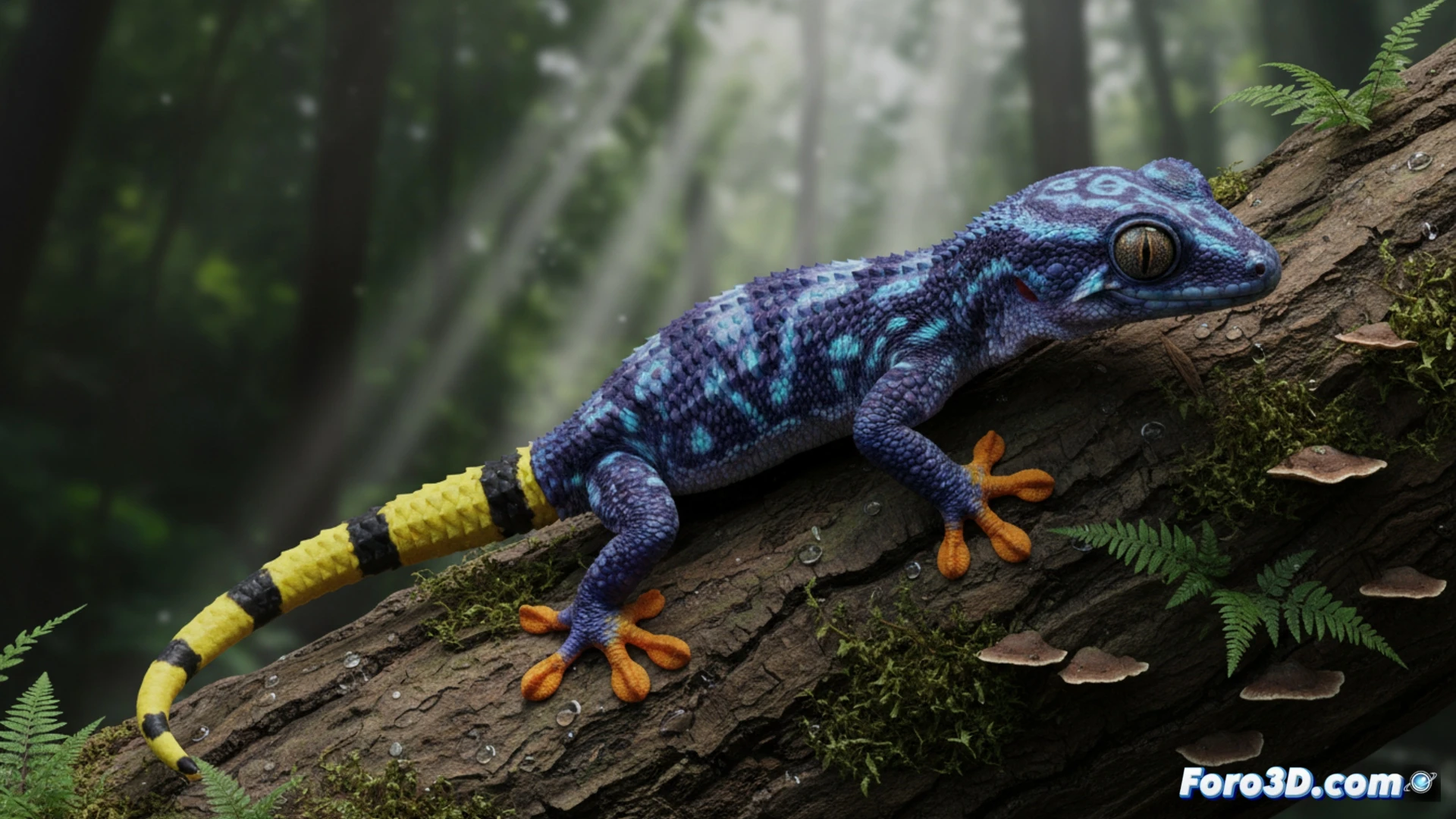
Technical Process: Scanning, Texturing, and Rigging 🦎
The creation of the 3D model begins with photogrammetry. Between 150 and 200 images of the live specimen are captured from multiple angles, using cross-polarized light to eliminate specular reflections on its scales. The reconstruction software generates a high-polygon base mesh, which is then retopologized to 15,000 polygons for animation. Texturing is the most critical phase: diffuse, specularity, and roughness maps are painted to replicate the iridescence of the purple-blue and the contrast of the orange. For rigging, a skeleton with 40 bones is created, including advanced controls for the prehensile tail and adhesive toes. Finally, a locomotion and feeding cycle is animated based on field observations.
Applications in Herpetology and Conservation 🌿
This model transcends mere illustration. It allows herpetologists to analyze the microstructure of scales and the biomechanics of movement on vertical surfaces without needing to manipulate live specimens. For conservation, the virtual environment recreates the Vietnamese island with geographic precision, simulating understory light and humidity. This resource is invaluable for educating the public about the fragility of this insular endemic species and for training park rangers in species identification, directly contributing to its protection against illegal wildlife trafficking.
As a 3D modeler, what texturing and digital sculpting techniques do you recommend to accurately capture the iridescent patterns and skin microstructure of the Cnemaspis psychedelica, and what specific challenges does this process present for scientific visualization?
(PS: modeling manta rays is easy; the hard part is making them not look like floating plastic bags)